




JOMA-Style vs Rigid Carbide Blades: Matching the Edge to the Route
Two carbide approaches dominate winter blade selection, and choosing between them is a route decision, not a brand preference. A rigid carbide blade is one solid edge that scrapes aggressively on long, straight runs.…

Two carbide approaches dominate winter blade selection, and choosing between them is a route decision, not a brand preference. A rigid carbide blade is one solid edge that scrapes aggressively on long, straight runs. A JOMA-style blade is a segmented, rubber-encased system that flexes to follow uneven pavement and absorbs impacts. Each one wins on the routes that match its design, and each one loses where the other belongs.
This article compares the two approaches across the decisions that matter, gives a side-by-side view of their strengths, and explains how a fleet can blend both types instead of forcing one choice.
Two carbide approaches, two operating profiles
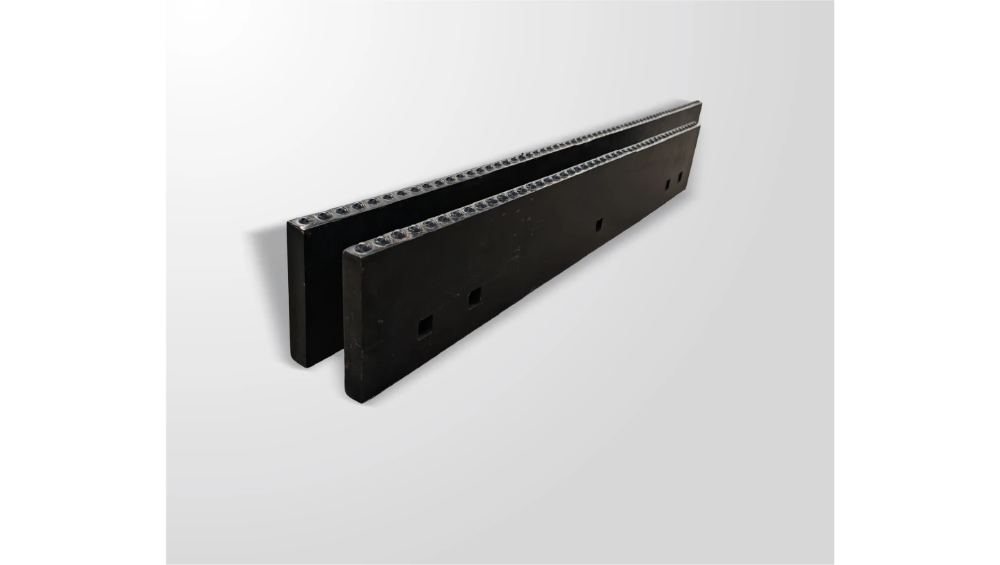
The rigid carbide blade is a beam: one continuous edge with carbide attached to a steel carrier, mounted directly to the moldboard. It is simple, strong, and aggressive, and it works best where the surface is predictable.
The JOMA-style blade is a system: independent segments, each with carbide inserts brazed into steel and encased in rubber, that flex as the plow crosses uneven ground. It trades some simplicity for the ability to follow the road and cushion impacts.
The operating profiles follow from the construction. Rigid carbide suits routes where the edge can stay in contact: highways, arterials, and long, straight runs with consistent surface. JOMA-style suits routes where a rigid beam would bridge over low spots: residential streets, patched asphalt, jointed concrete, and impact-heavy work.
The decision is rarely about which material is stronger; both use the same carbide at the working edge. It is about how the edge meets the road. One approach holds a straight line and wins on predictable surfaces; the other conforms and wins where the surface fights back.
Which routes favor rigid carbide blades?
Rigid carbide blades win on routes where the pavement is predictable and the duty is abrasive:
- Interstate and highway corridors with long, straight runs;
- Arterials where the edge stays in steady contact;
- Routes where high mileage and abrasion are the dominant cost;
- Operations that prioritize simple mounting and aggressive scraping.
The strength of a rigid blade is wear life under abrasion. Its weakness is that it cannot conform to an uneven surface: on a crowned or rutted road, it contacts the high points and leaves snow and ice in the gaps. That is not a defect; it is the design, and it is why the blade is assigned to surfaces that suit it.
Which routes favor JOMA-style systems?
JOMA-style systems win on routes where surface variation and impact are the problem:
- Municipal residential streets with patched asphalt and frost heaves;
- Roads with joints, manholes, and curb aprons that punish rigid edges;
- Routes where noise and vibration are an operational issue, including night plowing;
- Contractor work on lots and uneven commercial surfaces.
The strength of the system is articulation. The segments follow the surface, keep the carbide in contact, and let the rubber absorb impacts that would otherwise travel into the moldboard. SENTHAI describes its Joma-style line as delivering extended service life, reduced vibration and noise, and a lower cost-per-mile on the routes it fits.
The weakness is on long, straight, highly abrasive runs, where the added joints and rubber complexity do not pay for themselves. A rigid edge is simpler there, and the wear economics favor it.
A side-by-side comparison table
| Comparison point | Rigid carbide blade | JOMA-style system |
|---|---|---|
| Construction | One solid edge, carbide on steel | Segmented, rubber-encased carbide sections |
| Surface conformity | Follows predictable surfaces | Flexes to follow uneven surfaces |
| Impact handling | Transfers shock to moldboard | Rubber absorbs shock |
| Noise and vibration | Higher on hard surfaces | Lower by design |
| Best-fit routes | Highways, arterials, abrasive runs | Residential, jointed, impact-heavy routes |
| Maintenance | Simple mounting, full-edge replacement | Section replacement, hardware checks |
The table is a starting point, not a verdict. The route profile decides which column applies, and a fleet’s route mix usually includes both.
The table also highlights the cost logic. Rigid blades concentrate the investment in carbide wear life, while segmented systems spend part of the cost on the rubber and the articulation that protect the carbide and the machine. On the right route, each spending pattern pays for itself; on the wrong route, neither does.
Blending both types across a fleet
Most fleets do not have to choose. A balanced assignment puts rigid carbide on the high-mileage corridors and JOMA-style segments on the uneven, impact-heavy routes, with the packed ice kit reserved for bonded crust corridors. The mix is a per-route decision, and it is recorded in the fleet’s blade matrix.
The practical benefits of the blend: each edge works where it is strongest, the maintenance plan is predictable per route group, and the fleet avoids the “one blade for everything” compromise that produces field complaints on both sides.
SENTHAI supplies both families, so the assignment can be made on route data rather than on which product a supplier happens to offer. The carbide snow plow blade page covers the rigid option, and the JOMA-style blade page covers the segmented system.
The blend also protects the fleet from the single worst-case decision: standardizing on one edge because it is easier to buy. A fleet that orders per route group carries a little more inventory complexity and gains a lot of field performance, because each edge is working where its design matches.
The blend also changes the maintenance conversation. Instead of one edge that fails everywhere a little, the fleet manages two or three edge types, each with a clear route assignment and a clear failure signature. The changeout log then shows whether the assignment is working: if a rigid blade keeps failing on a residential route, the route belongs to the segmented system; if a segmented edge wears too fast on a highway, the corridor belongs to rigid carbide. The data closes the loop between assignment and result.
Choosing the edge for your worst route
The most useful way to make the choice is to start with the worst route, not the average. Identify the corridor where the current edge fails most often, whether that is wear on an abrasive highway or lost contact on an uneven street, and match the blade to that failure. The worst route is where the difference shows up fastest and where the investment pays back first.
The “worst route” method also keeps the decision honest. A fleet that picks the average route will see an average result, and the comparison will look inconclusive. A fleet that picks the route that fails every storm gives the new edge its hardest test, and if it passes there, the fleet-wide case writes itself. That is why the pilot route matters more than the pilot quantity.
To apply the decision, send the route list, the failure history, and the equipment details through the contact page and ask for a per-route recommendation. The comparison matters less than the assignment: the right edge on the right route is the whole game.
And when the fleet’s routes genuinely fall on both sides of the line, the answer is not a compromise edge; it is both edges, each where it belongs.
That is the honest conclusion of the comparison: neither approach is better, each is better somewhere, and the route map decides where.
Expert view — SENTHAI engineering team: “The route writes the specification. Rigid edges earn the abrasive corridors, and segmented edges earn the uneven ones.”
Frequently Asked Questions
What is the difference between JOMA-style and rigid carbide blades? Rigid carbide is one solid edge for predictable surfaces; JOMA-style is a segmented, rubber-encased system that flexes to follow uneven pavement and absorb impacts.
Which blade lasts longer? It depends on the route. Rigid carbide wins on abrasive, predictable runs; JOMA-style wins on uneven, impact-heavy surfaces. Service life is route-dependent, not brand-dependent.
Can a fleet use both types? Yes, and most should. Assign rigid carbide to high-mileage corridors and JOMA-style to uneven routes, and the fleet avoids the one-blade compromise.
Are JOMA-style blades quieter? By design, yes. The rubber shell absorbs shock and dampens vibration, which is why segmented systems are used on residential and night routes.
Which is easier to maintain? Rigid blades have simpler mounting and full-edge replacement. JOMA-style systems use section replacement and require hardware and rubber checks. The maintenance difference is a factor in the assignment.
Does SENTHAI make both types? Yes. SENTHAI supplies rigid carbide blades, JOMA-style segments, packed ice kits, and carbide inserts, so the selection can follow the route.
How do I decide for my fleet? Start with the worst route, identify the dominant failure, and match the blade to it. Send the route and failure data to the manufacturer for a per-route recommendation.
Do both blade types use the same carbide? Yes, the working edges are carbide in both cases. The difference is the construction: one solid edge versus segmented, rubber-encased sections, and the route behavior that follows.
Sources
Related articles
 Plow Skid Shoes vs Plow Feet: What They Do and How to Set ThemCore Topics
 What Is a Packed Ice Carbide Kit? The I.C.E. Blade System ExplainedCore TopicsCost-per-Mile for Plow Blades: A KPI Buyers Can Actually UseCore Topics
 Why Carbide Blades Crack in Deep Cold: Stress Relief, Brazing, and HandlingCore Topics