




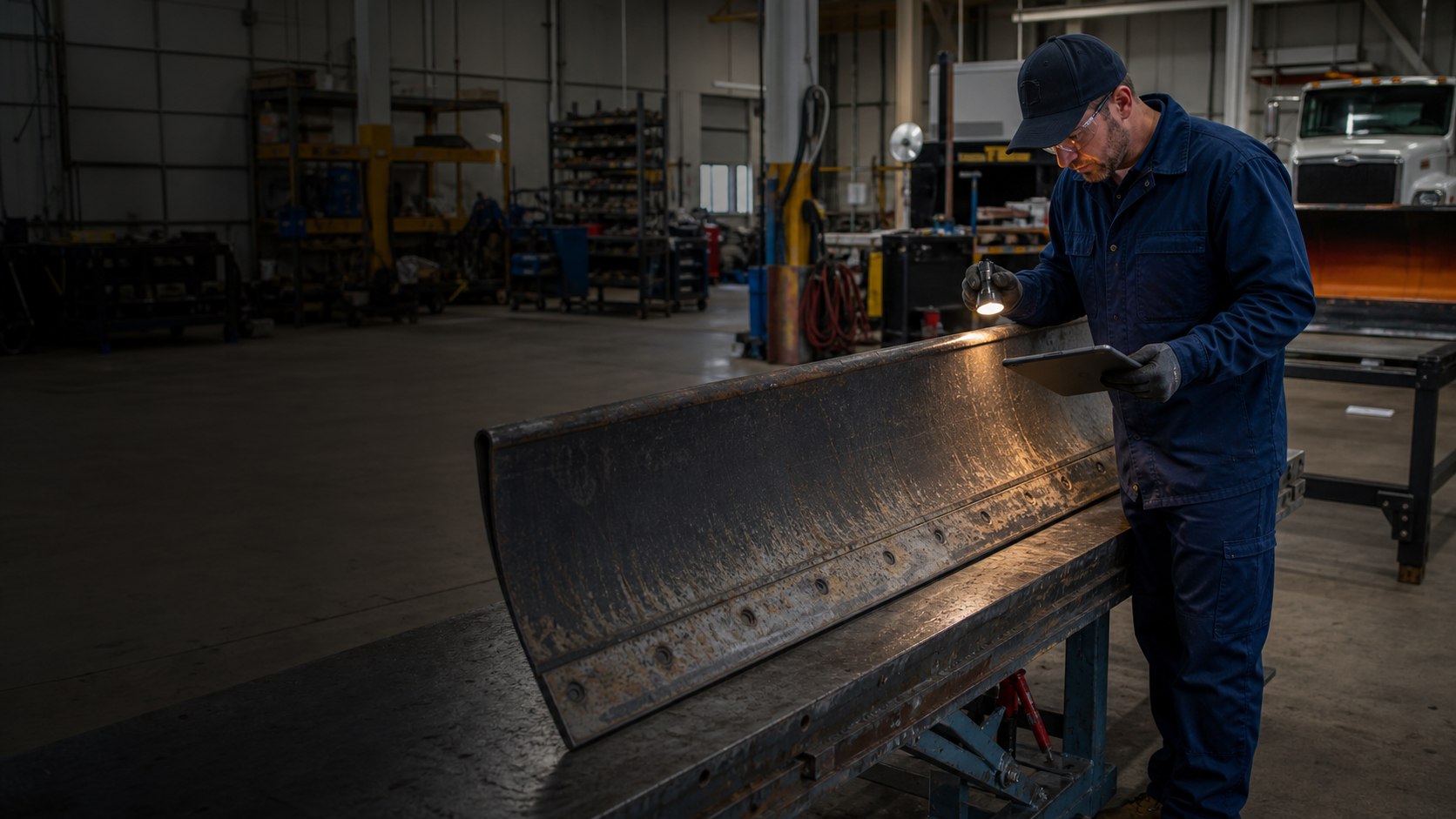
One measurement point is a guess. Three points along the edge, taken at every service, turn blade life into a number with a trend behind it.
Mark the measuring points on the carrier so every check happens at the same place. Wear is rarely even across an edge, and the comparison between points is what tells you whether the plow is set correctly or the route is simply abrasive.
Decide the wear limit where the blade stops clearing, not the point where it disappears. Publishing that number to drivers is what stops a fleet running edges to failure and losing hours to a mid-storm change.
Surface abrasiveness, down-pressure, impact exposure and rotation discipline. Change any one of them and the expected life changes with it.
Sand, gravel and chip seal grind an edge down quickly; bare asphalt and concrete are gentler. Down-pressure is the operator-controlled variable, and the useful setting is the lowest one that keeps full contact.
Impact damage ends more edge lives than abrasion does. Rotation spreads the wear across the whole edge and reveals the impact damage before it becomes a break, which is why fleets that rotate report both longer life and fewer surprises.
Check the surface, then the setup, then the operator, and only then the blade. That order matches how often each cause turns out to be responsible.
A new chip-seal treatment shortens blade life across an entire fleet at once. Uneven wear, by contrast, points at the mounting, the pressure or the carrier. Neither is solved by buying a different grade of carbide.
Running a dull edge forces the operator to add down-pressure, which accelerates wear further. Teaching the replacement threshold and the correct pressure setting usually recovers more life than any specification change.
At every service interval during the season, and always before the first storm. On high-mileage routes a weekly check is normal; on light residential duty a fortnightly check is enough.
The point at which the edge stops clearing the surface it is meant to clear. Set it as a measurement, publish it, and treat anything past it as an exception rather than a judgement call.
Usually a mounting or alignment issue rather than a blade defect. Check the carrier for distortion, the mounting height and whether the moldboard is set level before replacing the edge.
Yes. Rotating moves the wear to the unworn part of the edge and typically recovers a significant share of service life, at the cost of one scheduled change per season.
Only from your own data. Record lane-kilometres per edge for one season and you have a baseline that beats any supplier claim for your specific fleet.
How to read the pattern and set the threshold.
The four inputs behind every blade-life estimate.
Rotation, inspection and replacement programmes.
If you record blade life today, send it. We will tell you whether the wear pattern points at the edge, the plow setup or the route.
✓ Measurement points and current wear
✓ Lane-kilometres or hours per edge
✓ Surface type and route class
✓ Current blade specification
Email: [email protected]