




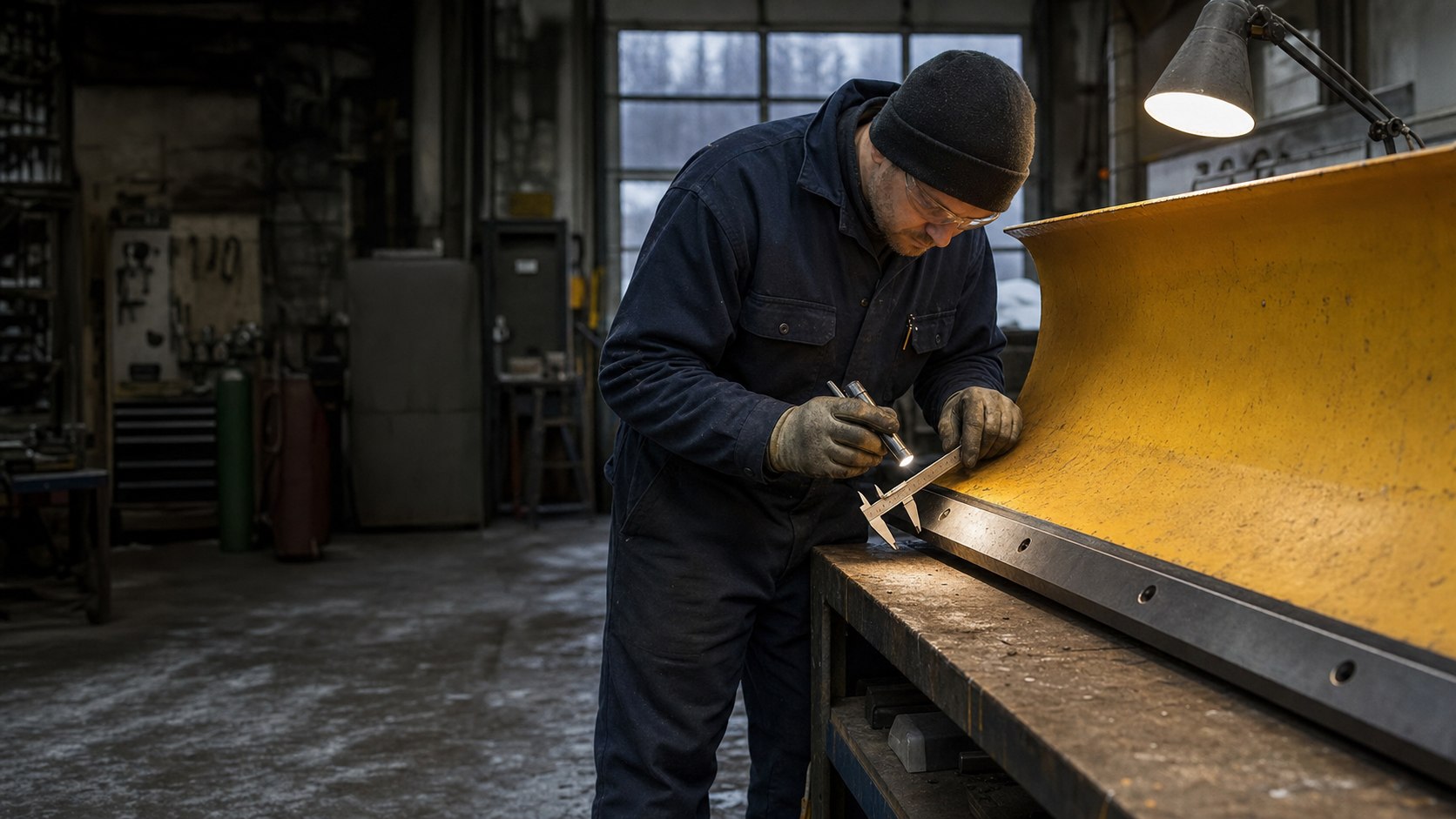
A straight moldboard rolls snow to one side at a fixed angle. Every V, wing and underbody design is a deviation from that baseline to solve one specific problem. If you cannot say which problem you have, you want a straight blade.
Blade type and edge construction get confused constantly. A V-plow can carry a rigid carbide edge or a flexible rubber-encased segment edge, and the same moldboard will behave quite differently depending on which one it has. Decide the geometry first, then decide the edge.
Bevel angle, edge thickness and the contact percentage of the cutting face all change how the same moldboard scours a road. Two edges of the same width can differ by a factor of three in cost per mile for exactly this reason.
Each configuration exists because a plain straight blade could not do the job on some specific route. Use that route as the test.
Pulling snow away from doors, loading docks and garage aprons loads the edge in the opposite direction to normal plowing. A standard edge that survives forward work can be destroyed in a single back-drag season without a carbide-protected kit.
Snow pushers and box designs trade manoeuvrability for volume. They are for parking lots, transfer stations and logistics yards where the job is stacking rather than scraping, and they put almost no load on a cutting edge.
On wide roads and runways the edge is built from sections. Sectional designs let you replace only the damaged part, which changes both the maintenance budget and the handling risk.
Read the failure first. It usually tells you the configuration is wrong for the route, not that the blade was badly made.
A blade that rides over packed snow rather than cutting it is usually a contact problem, and the fix is either a different edge geometry or a different edge material — rarely more down pressure.
Steel edges go brittle in deep cold while carbide keeps its shape. If your failures cluster in the coldest weeks rather than the busiest ones, this is the mechanism.
Aggressive geometry clears ice and marks decorative concrete, driveway seal and bridge decks in the same pass. On those surfaces the constraint is the surface, not the ice.
No. A V-plow earns its cost on deep drifts and on routes where you need to push a path through rather than cast snow to one side. On long straight roads at speed a straight blade moves more snow per pass with less weight and less fuel. Choose by the route.
Yes, or at least a protected one. Back-dragging reverses the load direction and puts the cutting face under tension instead of compression. Without a carbide or rubber-encased kit, the edge and sometimes the moldboard take the damage instead.
A pusher carries snow in a box and stacks it; a plow blade casts it to the side. Pushers suit parking lots, yards and transfer stations where stacking is acceptable. Plows suit roads where snow must leave the surface entirely.
It usually costs less over a season rather than lasting longer. Sections let you replace only the damaged part, which matters on wide blade systems where impact damage is localised. The trade-off is more fasteners and more handling.
Look at how the blade fails. Loss of contact, skipping and polishing point to edge geometry or material. Impact damage points to shock resistance. Surface damage points to edge aggressiveness. If the problem changes with the surface rather than with the machine, it is an edge problem.
Truck, tractor, UTV, skid steer and grader load a blade differently.
The five measurements that decide whether an edge bolts on.
Carbide, JOMA-style flex, packed-ice kit and inserts, side by side.
Tell us the machine, the surface and what the blade has to move. If you are replacing an existing edge, include the dimensions and mounting pattern.
✓ Route type, speed and surface
✓ Machine and mounting arrangement
✓ Snow, slush, packed ice or glare ice
✓ Obstacles the blade meets regularly
✓ Estimated quantity and delivery country
Email: [email protected]