




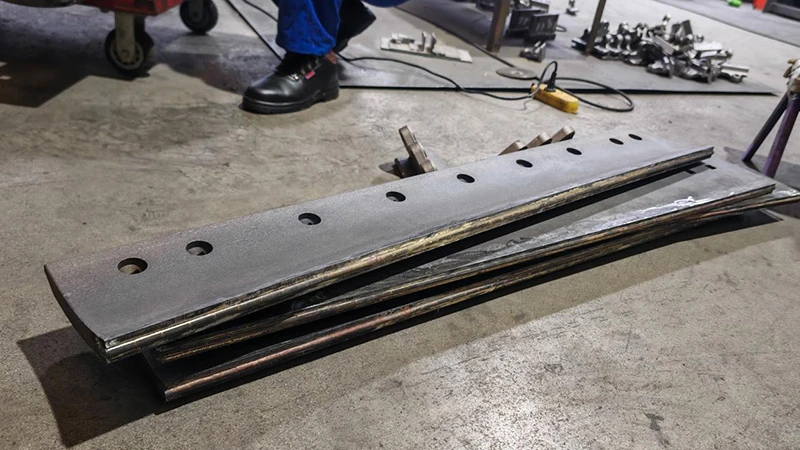
Hot asphalt, continuous cutting and higher tool speeds. The wear mechanism is abrasion dominated, with thermal load that road plowing never sees.
Milling teeth and planing tools run continuously against abrasive material at temperature. The grade choice leans harder than it would on a plow edge, and the economics are driven by tool changes per lane-kilometre rather than by seasonal replacement.
Crack sealing, patching and surface preparation use smaller tooling with the same underlying question: is the cost per metre lower with a harder grade that lasts longer, or a tougher one that survives the occasional obstruction? The answer follows the surface.
Buckets, edges, augers and drill tooling share the material logic with plow blades, and usually fail for the same reasons: grade, geometry and the bond.
Loader and excavator wear parts are specified the same way as plow edges — by the surface they work in and the failure they suffer. Where the failure is impact, toughness wins; where it is abrasion, hardness does.
Grade specification, bond quality, inspection and traceability all transfer directly. A buyer who has a working specification for plow edges can apply the same structure to any carbide wear part, which is usually where the cost saving is.
Name the duty, the failure mode, the grade properties and the inspection method. That structure works on any carbide wear part, not just an edge.
A bucket tooth and a plow edge are specified the same way: what it has to do, how it fails now, what properties the material needs, and how compliance will be checked. Building that structure once removes most of the work from every subsequent part.
Planing and milling tooling runs hot and continuously, which pushes the grade harder than a plow edge needs. Bucket and auger tooling usually fails by impact or by losing geometry. The structure transfers; the grade does not.
Not usually. Planing and milling tools run hotter and more continuously against abrasive material, which pushes the grade harder than a plow edge needs.
Yes. Grade, geometry, bond quality and inspection documentation transfer directly from plow edges to any other carbide wear part.
It depends on the tool. Teeth and bits lose their cutting geometry; bucket edges wear through; augers fail at the flight or the tip. Each has a different replacement trigger.
Standardise the specification structure and the documentation, even where the parts differ. That is what makes comparison between suppliers possible.
Yes. Custom requirements are reviewed from a drawing, sample or specification, and feasibility and terms are confirmed by quotation.
Grades and economics for milling work.
Buckets, augers and attachment tooling.
Choosing the grade for the duty.
Custom parts from a drawing.
Tell us the machine, the material it works in and the failure mode, and we will suggest a grade and a geometry.
✓ Part type and machine
✓ Material and surface worked
✓ Current failure mode and life
✓ Quantity and delivery destination
Email: [email protected]