




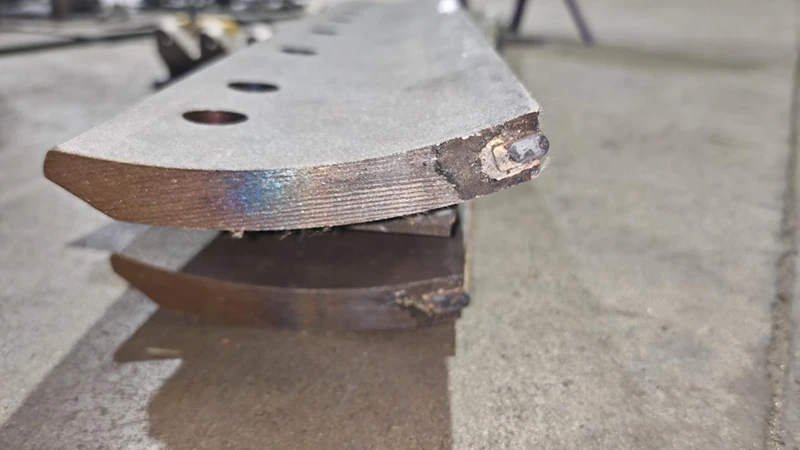
Bucket edges wear through. Teeth and bits lose cutting geometry. Augers fail at the tip or the flight. The replacement trigger differs for each.
These edges share more with plow blades than the rest of the list: a straight cutting edge loaded against the ground with impact from buried obstructions. The specification approach is effectively the same, with a different duty profile.
Teeth and drilling tools are cutting geometry rather than edges, and they fail by losing shape or by tip loss. Replacement is triggered by penetration performance rather than by a thickness measurement, so the inspection method changes.
Grade specification, bond quality, inspection and traceability. A buyer with a working plow-edge specification can apply the same structure anywhere.
Write the duty, the failure mode, the grade properties, the inspection method and the documentation requirement. That structure does not change between a plow edge and a bucket tooth, which is why it is worth building once.
Where several attachments share a wear material, standardising the grade and the documentation across them reduces the number of specifications a buyer maintains. It also makes supplier comparison possible across product families rather than one part at a time.
The principle is the same — harder for abrasion, tougher for impact — but the balance changes with each attachment and its failure mode.
By penetration performance rather than by a thickness figure. When the tool stops cutting at the expected rate, the geometry is gone and the tool is finished.
Yes, wherever a carbide element is bonded into a steel body. The failure mechanisms and the inspection methods are the same.
Only if they can meet each specification. The practical approach is a standard specification structure and a qualified supplier per product family.
Yes, from a drawing or a sample. Feasibility, tooling and terms are confirmed by quotation.
Continuous cutting at temperature.
The trade-off behind every choice.
When the bond is the weak link.
Custom parts from a drawing.
Tell us the machine, the material and the failure mode and we will recommend a grade and geometry.
✓ Part type and machine
✓ Material worked and conditions
✓ Current failure mode and life
✓ Quantity and delivery destination
Email: [email protected]