




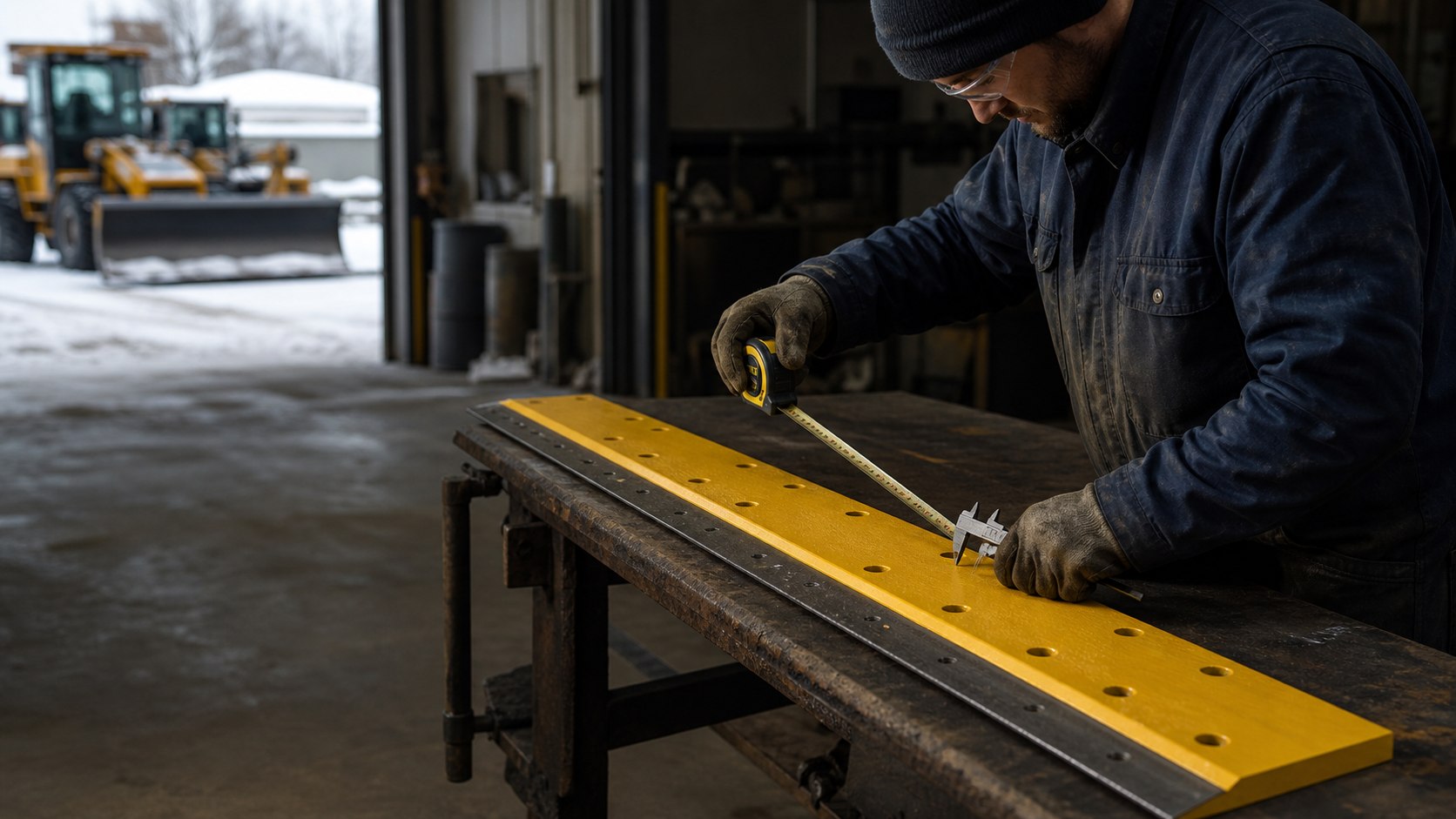
Blade price, life in lane-kilometres, change-out labour, surface damage and downtime. Leave any one out and the model flatters the cheaper blade.
Divide the total cost of owning an edge over a season by the lane-kilometres it cleared. Include the labour for every change and the cost of any surface damage. The result usually ranks blades differently from the purchase order.
A tender that evaluates on acquisition price attracts the cheapest blade that meets the form. Stating a service-life or cost-per-mile basis, with the measurement method defined, changes what suppliers offer and makes the evaluation defensible.
Documentation, lead time, origin and the ability to answer a field failure are all part of what a supplier costs.
The cheapest quote is expensive if the supplier cannot provide a batch record, misses the season window or disappears when a failure needs investigating. Score suppliers on documentation, capacity and continuity as well as price.
On most fleets the blade is a small share of the winter budget compared with fuel, labour and de-icer. That does not make blade choice unimportant — it makes the second-order effects, like fuel use and repeat passes, the place to look for savings.
What you pay per blade and how many hours or kilometres it lasts. The other three inputs improve as you measure them.
Most fleets know their blade price and their season length. Turning that into cost per operating hour requires one more input, the hours per machine, which is usually available from the workshop or a telematics system. Start there rather than waiting for perfect data.
Cost per hour usually reorders the options rather than confirming them, because it prices the labour and downtime that a quote leaves out. It is also the number that survives a finance review, which is what turns a recommendation into an approved change.
It depends entirely on the surface, the duty and the blade class, which is why a single figure is misleading. The useful number is your own, measured over one season and compared against alternatives.
Because the evaluation criteria reward acquisition price. Adding a stated cost-per-mile or service-life basis, with the measurement method defined, changes the outcome without excluding suppliers.
Convert both to cost per operating hour or per lane-kilometre, including change-out labour. Unit price alone cannot be compared when the blades last different distances.
For a season-critical product, qualifying a second supplier is worth more than the price advantage of consolidating. Split the order if that is what it takes to keep both qualified.
Change-out labour and downtime. Both dwarf the material difference between two reasonable blades, and neither appears on a purchase order.
The model and its five inputs.
Writing specifications that stay comparable.
Scoring suppliers on more than price.
Origin, tariffs and continuity.
Send the route profile, current blade life and change-out practice and we will model the alternatives.
✓ Route length, surface and duty
✓ Current blade life and change frequency
✓ Change-out labour and downtime
✓ Annual volumes and budget
Email: [email protected]