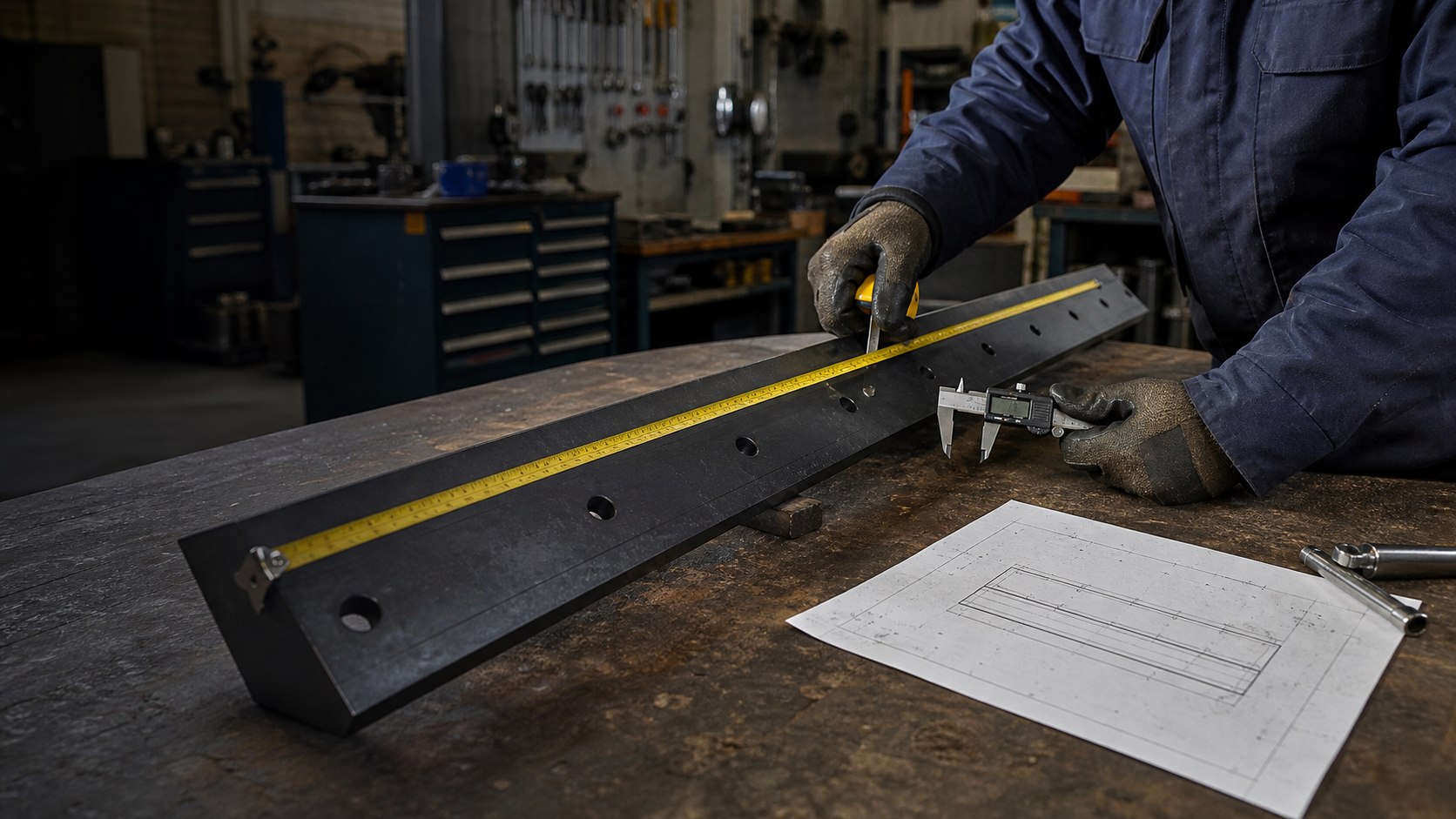
Fleet Plow Blade Standardisation: Cutting the Cost of Variation
Fleet plow blade standardisation explained: how to group trucks, what to standardise and what to leave alone, with fitment and continuity planning.
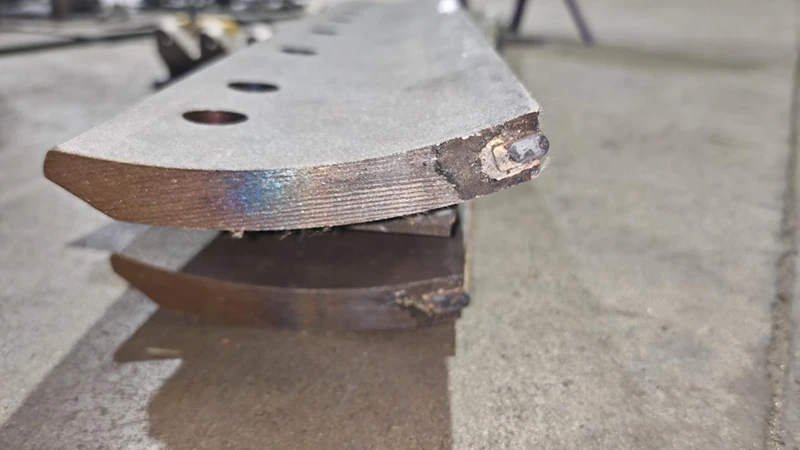
Every additional edge specification in a fleet costs something that never appears on a purchase order: an extra part number in the stores system, an extra hardware list, a receiving inspection that has to know the difference, and a technician who has to decide which of two similar-looking edges belongs on a particular truck. Standardisation is how a fleet removes those costs, and it fails when it is applied across trucks that were never interchangeable.
Fleet Plow Blade Standardisation: What It Has to Deliver
It should cut variation without cutting fit.
The objective is fewer, better-defined specifications that each cover a group of trucks with genuinely similar requirements, so records stay comparable and spares stay interchangeable within the group.
Standardisation delivers four benefits when it is done on the right grouping. Part numbers fall, which reduces the chance of a truck receiving the wrong edge. Hardware lists converge, which reduces fitting variation. Wear records become comparable within a group, which is what makes rotation and replacement decisions possible. And purchasing volumes concentrate, which improves the position a fleet negotiates from.
The failure mode is equally predictable. Standardising across trucks with different moldboard widths, carriers or route classes forces a specification that suits none of them, and the fleet spends the season compensating. A single profile applied to light residential trucks and heavy highway trucks will spread down-pressure incorrectly on one group, and the resulting complaints are usually attributed to the edge rather than to the grouping decision.
How Standardised and Mixed Specifications Differ in Service
Standardised fleets compare; mixed fleets explain.
Where a group runs the same specification, wear readings describe the route rather than the parts, so rotations can be planned. Where specifications are mixed, every difference has two causes and neither can be resolved.
The operational difference is most visible at inspection. A supervisor checking a standardised group looks at measured height, compares it with the previous reading and makes a decision. A supervisor checking a mixed group has to establish which edge is fitted, which specification it belongs to, and what the correct interval is for that combination before any comparison can be made. In a busy week, that extra step is the one that gets skipped.
Mixed specifications also affect the stores function. Every additional variant needs its own stock level, its own reorder point and its own identification on the rack. The administrative load grows faster than the part count, and the practical consequence is usually that edges get pulled by appearance rather than by part number. Keeping specifications to a small number per group is what makes the discipline affordable.
There is a measurable test for whether a fleet has standardised usefully. If a supervisor can state, without checking a record, which specification a given truck runs and what interval is expected from it, the grouping is working. If the answer requires a lookup, the fleet is still in the mixed state and the inspection routine will not produce comparable readings.
Specification Inputs You Need Before Standardising
Five inputs define a group. The mounting pattern, including hole diameter and centre spacing measured from the blade in service. The moldboard width and plow class. The available down-pressure and carrier weight. The route classes and surface mix the group runs. And the edge dimensions the group needs, which follow from the pattern and the moldboard. Two trucks belong in the same group only if all five are compatible.
Recording those inputs is a short exercise, and it is the step that prevents the compromise specification. The measurement procedure is covered in the blade selection guide, and a supplier validating fitment against AASHTO or DIN patterns can confirm the grouping before an order is placed.
One input is frequently missed: the operating history. Two trucks with the same pattern can belong in different groups if one runs refrozen streets and the other runs packed snow on a highway route, because the edge that suits each is not identical. Standardisation should follow the work, not just the machine.
Fitment, Hardware and Installation Consequences for Fleet Plow Blade Standardisation
Standardising changes what the workshop has to know, and the hardware list is where that shows first. A group running one specification needs one bolt length, one washer type and one torque value, which removes a class of fitting error. SENTHAI validates fitment against AASHTO and DIN bolt patterns before release and works to plus or minus 0.02 mm dimensional tolerances on carbide components, with AASHTO published standards as the reference for agency specifications and DIN covering European and export conventions.
The installation consequences should be written down with the specification. Record the torque value, the inspection points and the fitting sequence for each group, so a technician moving between trucks is working to the same procedure. Where an OEM mounting interface is involved, refer to the equipment documentation, and note that SAE standards for mobile machinery describe the interfaces those designs were built around.
Where standardisation reduces the number of specifications, it also reduces the number of variations a supplier has to produce. That has a practical benefit: fitment confirmation, tolerance and documentation are easier to keep consistent across a smaller set of configurations, and repeat orders are less likely to drift.
Receiving inspection benefits as well. Once a group has one specification, the incoming check becomes routine: confirm the pattern, confirm the dimensions against the drawing, confirm the documentation package. That check is straightforward for a stores team to perform consistently, whereas a delivery containing several specifications requires the receiving function to know the difference between them, which is where errors become likely.
Cost Per Metre and Replacement Logic Across a Group
Cost per metre becomes more useful as a management tool once trucks are grouped, because the reading now describes the route rather than the specification. The model structure is set out on the cost per mile page; standardisation changes three inputs in practice.
| Input | Before standardisation | After standardisation |
|---|---|---|
| Part numbers | One or more per truck, growing over time | One per group, with a defined pattern |
| Replacement interval | Unknown, because specifications differ | Measurable per group from comparable readings |
| Stores and administration | More line items, more identification errors | Fewer line items, easier identification |
| Fitting labour | Varies with the specification encountered | One procedure and hardware list per group |
| Purchasing position | Fragmented volumes | Concentrated volumes by group |
Replacement logic improves for the same reason. Once a group has comparable readings, the fleet knows the interval, can rotate edges to even out exposure and can plan ordering against the season rather than against stock-room impressions. The rotation strategy itself is a separate exercise, covered in the material on blade rotation strategies.

Documentation and Traceability to Ask For on Fleet Plow Blade Standardisation
Standardisation is only durable if the specification is documented and traceable. Ask for the specification in writing for each group, a fitment confirmation against the pattern, and lot-level traceability that links each delivery to its batch and grade. SENTHAI inspects and archives every batch, so the record behind a delivery is available on request; the quality control and traceability page describes what those records contain.
Keep the fleet’s own record alongside it: which group each truck belongs to, which specification it runs, and the revision history of the specification itself. Where a group’s specification changes, the change should be dated and the reason recorded, because a specification with no history cannot be evaluated. Public procurement is easier to manage when the technical section is stable, and supplier registration requirements for federal awards are handled through SAM.gov and general procurement resources through GSA.
Reorder and Continuity Planning Across the Fleet
Continuity planning starts with the group rather than the fleet. Each group needs a reorder point based on its measured consumption, and each group needs enough spare coverage to survive the weeks when replacements cluster. Where a group’s interval is known, the holding quantity becomes a calculation rather than an estimate.
Two practical arrangements help. First, keep the specification reference attached to the group record rather than to the individual truck, so a reorder does not depend on identifying an edge by sight. Second, agree with the supplier that follow-on orders are produced to the same specification revision, which is what prevents a gradual drift in grade or tolerance between deliveries.
The final step is a review date. Standardisation should be assessed after a season against the same criteria used to set it up: part numbers held, interval achieved per group, hardware interventions and fitting errors reported. A standardisation programme with no review tends to expand again one truck at a time, and the fleet returns to the position it started from.
Where the review shows a group achieving a shorter interval than expected, the cause is usually the route rather than the specification: a group may have been defined on equipment similarity while the trucks run different surfaces. Where a group performs better than expected, the same logic applies, and the specification may be worth extending to a comparable group. In both cases the grouping is the variable to examine first, because it is cheaper to correct than a specification revision.
Standardisation pays when it follows genuine similarity. Group trucks by pattern, carrier, route and edge requirement; write one specification per group; and keep the hardware and inspection procedure attached to that group.
The savings appear in stores, fitting and purchasing, and the technical benefit is comparability: readings that describe a route rather than a part, intervals that can be planned and rotations that can be justified. Review it after a season, and the programme becomes evidence-based rather than aspirational.
Send SENTHAI your truck list, measured mounting patterns and route classes, and the technical team will help define the fleet groups and the edge specification that suits each one.
Frequently Asked Questions
How many blade specifications should a fleet carry?
As few as the equipment and routes allow, and as many as the work genuinely requires. Most fleets settle on two or three groups, defined by mounting pattern, carrier class and route type, with one specification each. Attempting to reduce below that usually means compromising the edge on one group, which costs more than the administration it saves.
Does standardising mean buying a single grade for the whole fleet?
Not necessarily. Standardisation is about reducing uncontrolled variation, not about forcing identical material onto different work. Where route conditions differ, a group can carry a grade suited to its surfaces. The discipline is that changes are deliberate, documented and applied to a defined group rather than accumulating one truck at a time, because variation that grows without a decision is the kind that cannot be measured or reviewed.
What is the fastest way to start standardising an existing fleet?
Measure the mounting pattern on every truck and record the plow class, carrier weight and route class beside it. That single exercise usually reveals that the apparent variety comes from a small number of patterns and that a handful of groups covers the fleet. From there, write one specification per group and confirm fitment with the supplier before ordering.
How do we keep standardisation from drifting back into variation?
Control the change process. Require any specification change to be recorded with a date, a reason and the group it applies to, and review the group list once a season against the fleet as it stands. Drift usually comes from one-off purchases made without reference to the specification, so making the specification the reference for every order is the practical safeguard.