

Pricing Snow Removal Contracts: Where the Wear-Part Input Belongs
When a snow removal contract is priced, the wear parts usually disappear into a consumables assumption that nobody revisits: a set of edges per season per truck, taken from last year. That single line…
When a snow removal contract is priced, the wear parts usually disappear into a consumables assumption that nobody revisits: a set of edges per season per truck, taken from last year. That single line is where the contract either holds its margin or quietly loses it.
This page looks at snow removal contract pricing from the direction most pricing discussions avoid: the consumable input. It covers what the published record shows, where the hidden consumable cost sits, what it means for buyers and for suppliers, how regions differ, and what to watch before the next season is priced.
What the Data Shows
Published data covers practice and triggers, not contract rates.
Association and agency material describes how winter work is organised and triggered; no citable source publishes what a contract should charge for it.
Start with how winter work is structured. The professional body for snow and ice management, SIMA, documents the contracting models used in the industry, including seasonal agreements, per-event pricing and trigger-based terms, and that structure is what creates the difference between two quotes for the same driveway or the same route. Agency practice guidance from the FHWA road weather programme explains the service expectations that sit behind a public contract, which is often what decides how many passes a route receives and therefore what an edge has to survive.
The materials side of the cost is also documented, though rarely in pricing terms. De-icing practice published by the Salt Institute explains when a route is treated rather than ploughed, and that decision changes the abrasion an edge meets: treated routes tend to present more packed ice and refreeze, which is the condition that separates a general edge from a specified carbide one.
Weather is the third input and the least predictable. The variability material published by NOAA is the honest basis for a variance assumption, because a contract priced on an average winter is a contract that loses money in the years when the average does not appear. Fleet operating cost research such as the work published by ATRI is useful for method: it shows how operators construct a cost per unit of work rather than reading one from an invoice.
The Consumable Cost Hidden in the Price
The consumable input is hidden because it is usually priced as a per-truck assumption rather than as a cost per unit of work. Converting it is what makes a contract price defensible.
A contract price is made of labour, equipment, materials, insurance and overhead, with a margin on top. The consumable line inside materials is the one that varies most with the winter, and it is usually the one with the least documentation behind it. Reducing it to one number per truck per season creates an assumption that survives exactly until a bad winter, after which the operator absorbs the difference.
The fix is to price the consumable per unit of work. Lane miles per route class is the natural unit for a snow contract, and it turns the edge into a rate that can be applied to however many passes the winter demands. It also exposes the labour attached to the part: a change-out that takes an operator off a route for an hour is a cost in the contract whether or not it appears anywhere in the assumptions.
| Contract structure | Who carries winter variance | What the consumable line should contain |
|---|---|---|
| Seasonal flat fee | The contractor | Edge cost plus change-out labour plus a spares position for a severe season |
| Per event or per push | Shared, depending on triggers | A rate per lane mile or per push that includes wear and change-out time |
| Time and materials | The client | Documented part cost and documented labour hours, with evidence attached |
| Hybrid with a seasonal base | Negotiated by clause | Base cover plus a consumption rate above the agreed threshold |
Whichever structure applies, the consumable assumption should be traceable to a record. An operator who can show previous seasons’ change-out counts is negotiating from evidence; an operator who cannot is negotiating from memory, and memory always under-counts the bad winter.
What It Means for Buyers
Buyers should ask how the consumable was priced.
A procurement officer who understands the consumable input can tell whether a low price is efficient or simply assumes a mild winter and a short-lived edge.
The first question to ask any bidder is what edge specification the price assumes and what wear life that assumption implies. A quote built on a general-purpose steel edge and a quote built on a specified carbide edge are not the same offer at different prices; they are different levels of service. Once the specification is on the table, the price can be compared on service delivered rather than on the headline rate.
The second question is who carries the risk of a severe winter. Under a seasonal fee the contractor does, which is why seasonal bids are usually higher and why that difference is not automatically inefficiency. Under per-event pricing the client pays for what falls, which is easier to budget but harder to cap. Neither structure is wrong; the mistake is choosing one without knowing which risk it carries.
Third, buyers should insist that the parts used in a contract are the parts specified in it. A contract that names a grade and profile but permits substitution at the operator’s discretion hands the wear life and the service level to the lowest available part. Writing the specification into the contract, with the change-out record as evidence, is what makes the agreement enforceable rather than aspirational.
Finally, the parts themselves are a separate purchase for many fleets, and the commercial terms that apply – volume bands, packaging, sampling and delivery windows – are stated in the written quotation or order documents. A contract price review is a good moment to re-check those terms against the consumption the contract actually generates.
What It Means for Suppliers
Suppliers can help price the consumable honestly.
A manufacturer who can give an operator a documented wear life by surface turns an unbudgeted risk into a rate the operator can defend.
The useful contribution is technical, not commercial. A contractor pricing a seasonal fee needs to know how many lane miles an edge will complete on the specific routes in the schedule, and the only way to answer that is to work from the surface, the attachment and the duty cycle. A manufacturer who asks those questions and then recommends a grade and profile is giving the operator something that survives a bad winter: a specification with a reason behind it.
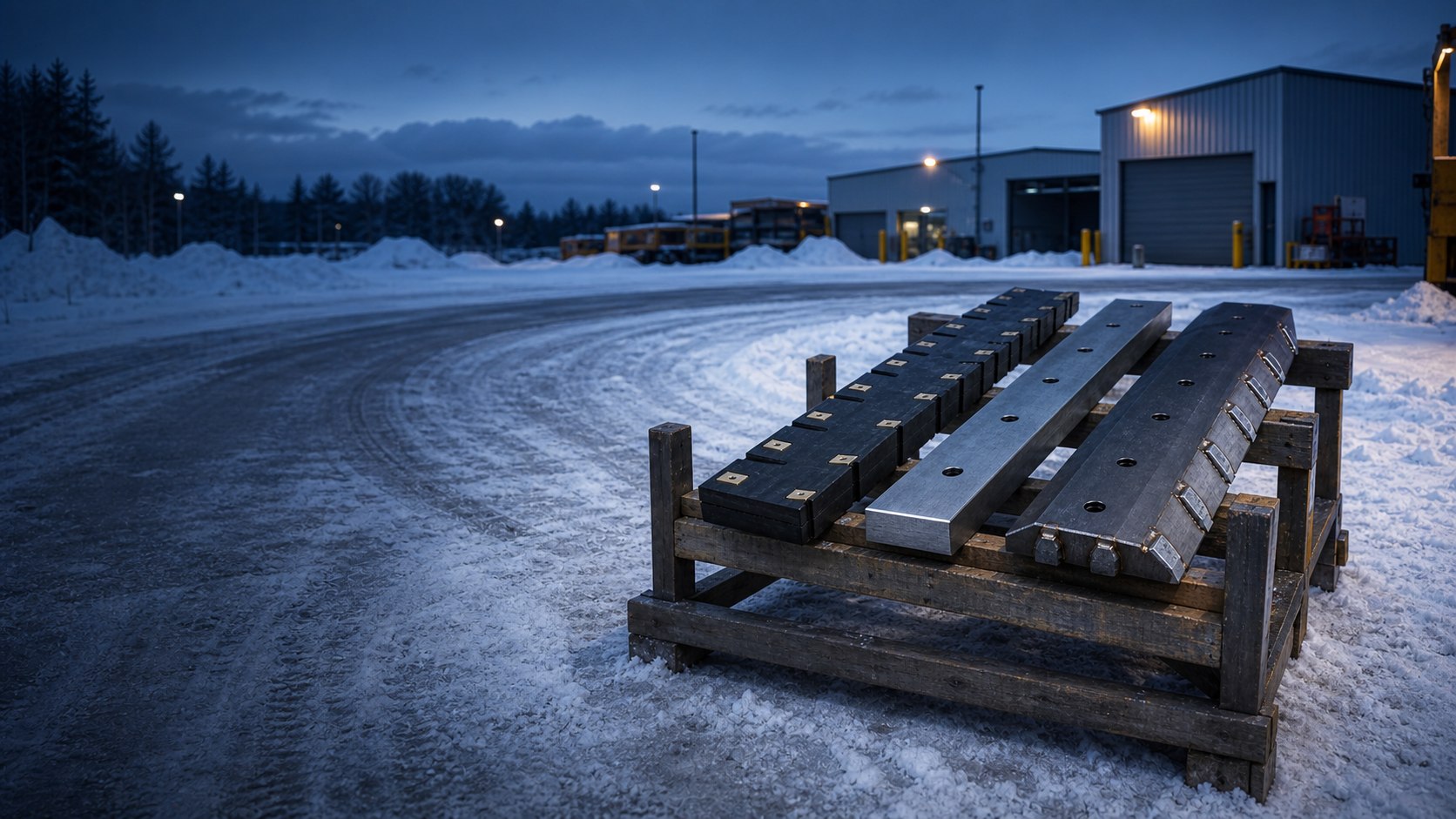
That is where the snow plow range approach helps a contractor more than a discount does: documented grades and profiles, with insert geometry chosen for the surface rather than for the catalogue. Where an operator is standardising a fleet across several attachments, the wholesale supply route is what keeps the specification consistent across machines and seasons.
The second contribution is evidence. When a contract sets a service level, a change-out log becomes part of the contractor’s defence in a performance discussion. A supplier who ships a traceability reference with each delivery, and who can provide grade and dimensional records on request, is effectively protecting the operator’s margin.
Delivery terms matter in this context too. Where parts cross a border, the Incoterms rules published by the International Chamber of Commerce define who carries freight and risk at each point, and a contractor who has not fixed that term in writing is pricing an unknown.
Regional Differences
Contract structure changes more between regions than the physical work does. A market built on seasonal agreements rewards different behaviour from one built on per-event work, and the consumable line sits differently in each.
In North America, per-event and seasonal structures both exist, and public agency contracts often carry explicit service levels that make performance measurable. That favours operators who can document wear and change-out history. In Europe, winter services are frequently bundled into longer-term municipal agreements with a technical specification attached, so the consumable is priced inside a fixed service obligation, and the operator carries the specification risk unless the client defines the edge.
In the Middle East and parts of Asia, winter work is often concentrated in specific corridors and highland areas, and contracts are smaller and more mixed. There the constraint is usually availability: an operator who cannot source a matching edge mid-season loses the route, which makes a validated fitment and a local spares position more valuable than a lower unit rate.
What to Watch Over the Next 12 Months
Watch trigger wording and labour availability.
The two variables most likely to move a contract result are the trigger language that decides when work is paid for and how easily a crew can be found to do it.
Trigger wording is where contract value is won or lost. A clause that starts charging at a defined depth, at a defined time or on a defined call-out protects the operator; a vague clause does not. Expect buyers to test those clauses harder as budgets tighten, and expect operators to arrive at negotiations with better records.
Labour availability is the second variable. Where crews are hard to staff, the cost of a mid-storm change-out rises because the machine waits, and the operator’s strongest protection is a longer-wearing specified edge plus a spares position sized for a severe season. That is a decision made at specification stage, months before a contract is priced.
The third thing to watch is the specification itself. If a client moves to a stricter service level, or to a treatment strategy that produces more packed ice, the wear assumption behind an existing price becomes stale, and the operator should re-price rather than absorb the difference.
How to Act on This
Price the consumable as a rate, not a guess.
Convert the per-truck edge assumption into a cost per lane mile, then test it against the previous two seasons before the next price is set.
- Record change-outs by route and count the lane miles each edge completed.
- Time one change-out per route class, including the second operator where one is used.
- Value the downtime as route coverage lost, then add it to the consumable rate.
- Fix the edge specification in writing, with the grade and profile the rate assumes.
- Set the spares position against a severe season, not an average one, and confirm commercial terms in writing.
A contract price built on those five steps can be explained line by line, which is what makes it survive both a bad winter and a procurement review.
The wear-part input belongs in a contract price as a rate per unit of work, not as a per-truck assumption. Pricing the consumable that way shows the operator what a specification change is worth, gives a buyer a way to compare offers on service rather than on headline rate, and makes the cost of a bad winter visible before it happens. Trigger wording, labour availability and the specified edge are the three variables to watch; the parts themselves are the one the operator can influence months in advance.
Send SENTHAI your route schedule, attachment details and last two seasons of change-out counts, and the technical team will review the edge specification behind your consumable rate.
Frequently Asked Questions
Why is snow removal so expensive?
Because the work is capital intensive, labour intensive and impossible to schedule. Equipment has to be owned or contracted whether or not snow falls, crews have to be available at short notice, insurance and liability costs follow the work, and a severe season multiplies all of it. The consumable share is small, but it is the part that varies most with the winter and the part an operator can influence.
How do operators usually charge for snow removal?
The common structures are a seasonal fee, a per-event or per-push rate, time and materials, and hybrid agreements with a seasonal base plus consumption above a threshold. Each allocates winter variance differently, which is why two quotes for the same route can look very different and both be rational. The relevant terms, triggers and rates are stated in the written agreement or order documents.
Should the contract name the edge specification?
Yes. A contract that leaves the edge to the operator hands the service level to the cheapest available part, and the client feels the consequence as more change-outs and slower route coverage. Naming grade family, profile and fitment validation, with change-out records as evidence, converts a service aspiration into a requirement that can be administered.
How do we budget for a severe winter rather than an average one?
Treat the average as a planning case and the severe season as the case that must not break the service. Practically that means a spares position sized on the severe case, a documented consumable rate that applies to extra passes, and trigger wording that starts paying when the work starts. The commercial terms that apply are stated in the written agreement or order documents.
Related articles
 A Supplier Scorecard for Wear Parts: Metrics That Change BehaviourMarket intelligence, TCO and procurement
 Wear Parts Cost Per Mile and Cost Per Lane Mile: Building the ModelMarket intelligence, TCO and procurement
 Total Cost of Ownership for Fleet Wear PartsMarket intelligence, TCO and procurement
 Snow Removal Industry Statistics and What They Mean for Fleet BudgetsMarket intelligence, TCO and procurement