




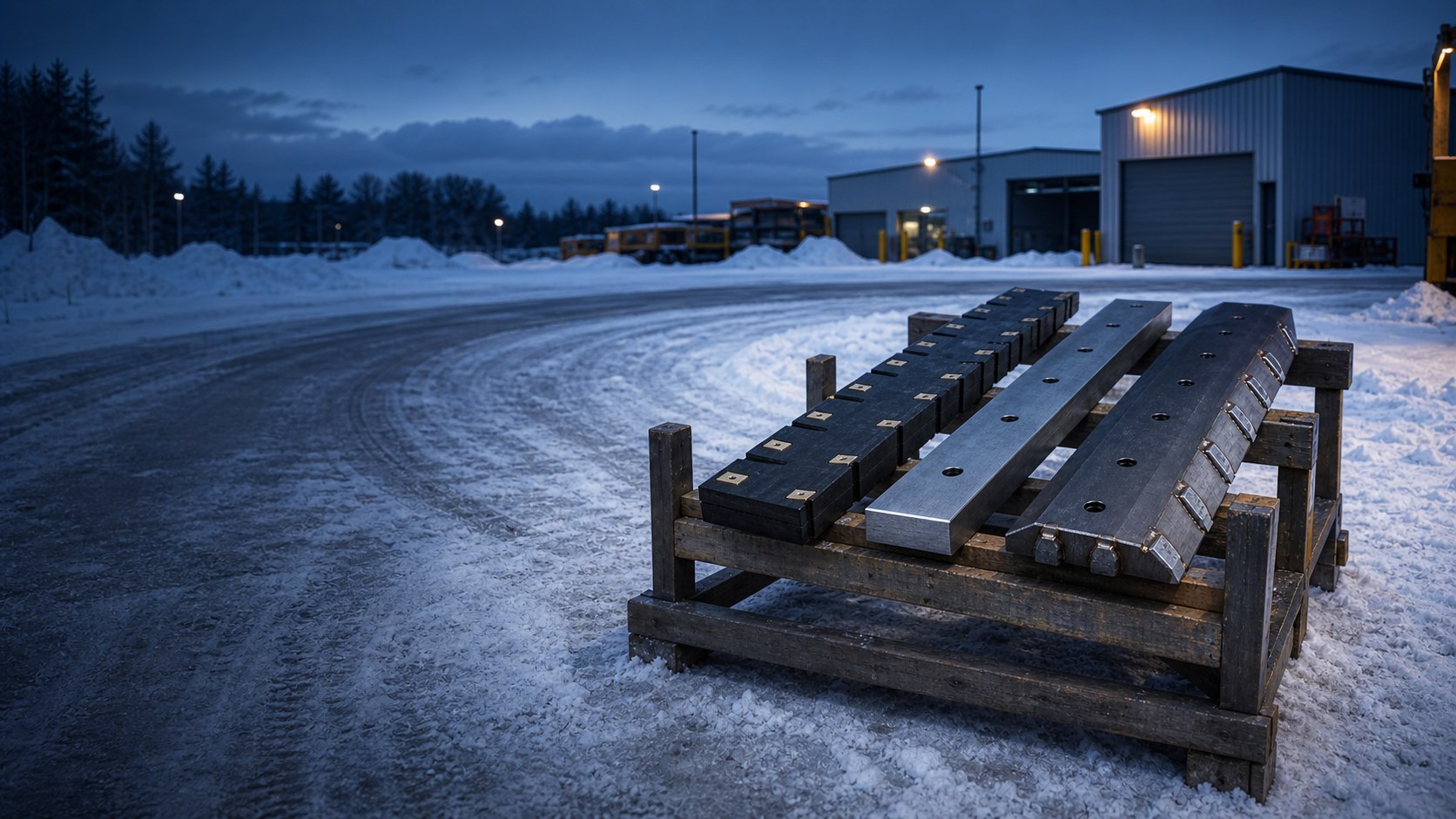
Write the requirement, verify the fitment, then compare. Reversing the order is what produces blades that arrive, do not fit, and cannot be returned in a snow season.
Before any supplier conversation, put the surface, the ice condition, the machine, the mounting arrangement and the failure you are trying to fix into a paragraph. A requirement that exists only in someone’s head cannot be quoted against, and it cannot be compared later when two offers arrive with different assumptions.
Length, width, thickness, hole diameter and hole spacing decide whether the blade bolts on. The sixth item is mounting position, and it decides whether the blade works once it is on. This step is cheap and prevents almost every return.
A blade that costs twice as much and lasts three seasons is the cheaper blade. The comparison only becomes possible once the first two steps are done, because cost per mile depends on the duty cycle, which depends on the route and the machine.
Buying on unit price, specifying from a catalogue rather than from the plow, copying the last order, and treating an ice problem as a snow problem.
A catalogue gives you a part number; it does not give you the requirement. Fleets that specify from their own route data and failure history buy fewer different blades and get better results, because the specification stops drifting every time a supplier changes its range.
Packed ice and bonded ice are not deep snow. A flat edge that clears a foot of snow will polish a glazed surface and then ride on top of it. If the complaint is refreeze rather than depth, the answer is a different edge class, not a heavier one.
What surface, what machine, and what is failing now. Prepare those three answers and most quotes arrive usable rather than needing a second round.
Surface abrasiveness decides grade and thickness; machine class decides weight, down-pressure and mounting. A supplier who does not ask these two questions is quoting from a catalogue rather than from your requirement.
A blade ordered because the last one cracked needs a different specification from one ordered because the last one wore out. The failure mode is the most useful single piece of information you can hand a supplier.
The short answers. Each one leads into the stage that covers it properly.
Whether the problem you are solving is snow clearance or ice cutting. That single answer eliminates most of the range before price is discussed, and it is the question suppliers ask first for a reason.
The machine is a given; the blade is the variable. Start from the machine’s front load, mounting arrangement and operating speed, then choose the edge that survives those conditions.
There is no useful number without a duty cycle. Compare candidates on cost per lane-kilometre or cost per operating hour, including labour for the changes each option needs over a season.
Standardising the mounting pattern across machines is usually worth more than standardising the edge, because it lets you carry fewer spare parts. Keep two edge classes if the routes genuinely differ.
The requirement paragraph, current dimensions and hole pattern, the plow make and model, the surface and ice conditions, quantity and destination. Drawings or photographs close the remaining gaps.
Tolerances, drawings, RFQs and the tender language that survives a season.
Sizes across major brands, bolt patterns and compatibility checks.
Head-to-head comparisons and best-for recommendations by duty.
Send the requirement paragraph and whatever dimensions you have. We will tell you which class of edge fits before any price is discussed.
✓ Surface, ice condition and route type
✓ Machine, mounting arrangement and speed
✓ Current blade dimensions and hole pattern
✓ Quantity and delivery destination
Email: [email protected]