




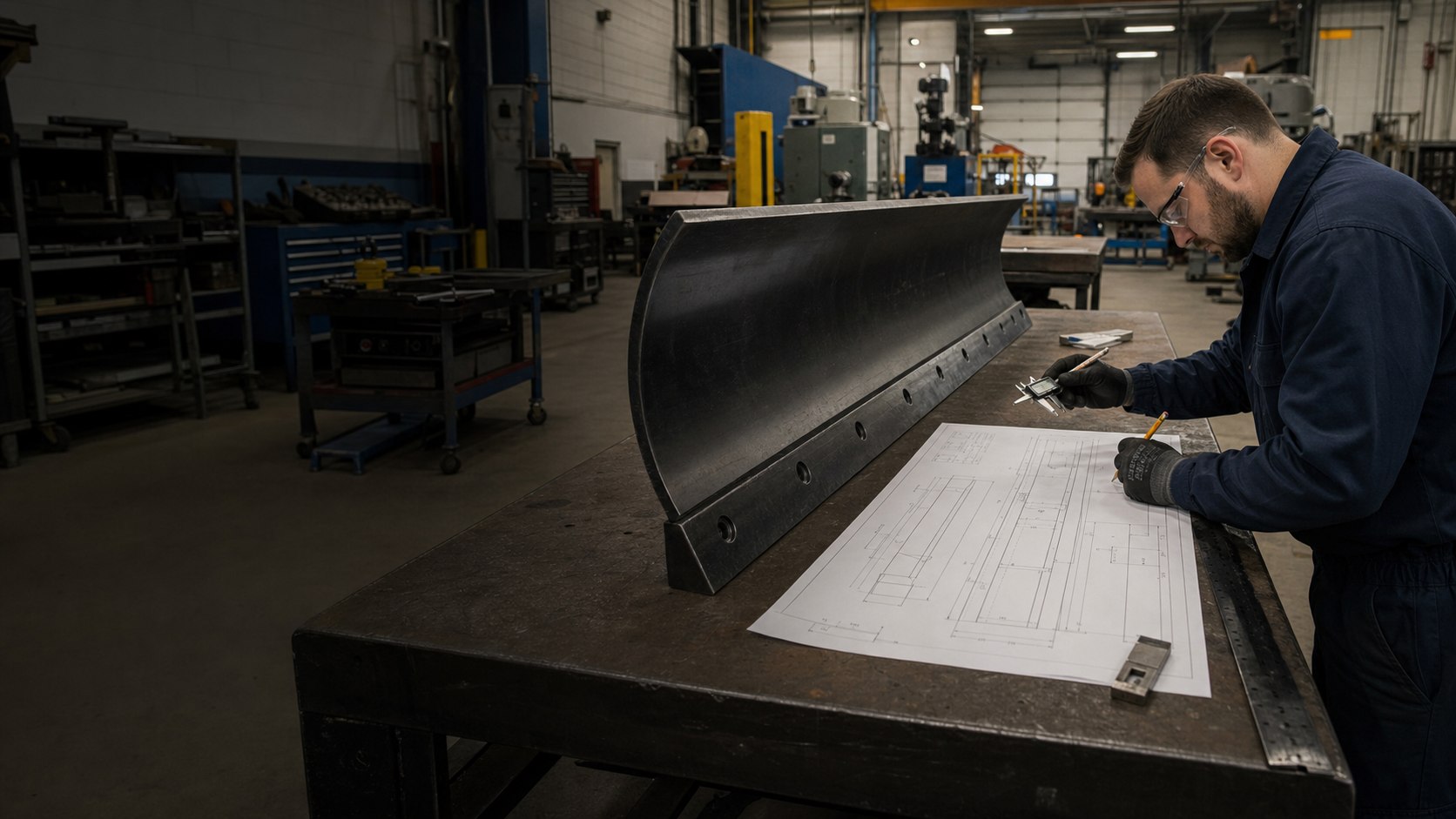
Length, width, thickness, hole diameter, hole spacing and hole position relative to each end. If only one of these is loose, the blade may still bolt on — and may still be wrong.
A blade specified as 3/4 inch thick without a tolerance range invites a mill tolerance that lands outside your carrier’s range. State the nominal value, the acceptable band, and which dimension is critical. The critical one is usually hole spacing, because it is the number that decides whether the edge bolts on at all.
A specification that describes the road surface but not the obstacles is incomplete. Manhole covers, curb heads, expansion joints and rumble strips load an edge in ways a surface description never captures, and the shock requirement is what separates two otherwise identical quotes.
Name the carrier steel, the carbide grade and the bond method, and ask for the document that proves each one on delivery.
Claims about virgin tungsten or a named steel grade are worth little without a batch record. A specification that requires a mill test report for the carrier and a grade statement for the carbide converts a sales claim into a deliverable that can be checked at goods-in.
Decide in advance how a disagreement about hardness, porosity or bond integrity will be resolved. A named method — hardness testing, ultrasonic inspection, a pull test or a first-article dimensional check — turns an argument into a measurement before the order is placed.
Bid specifications get read by people who are not blade engineers, so the technical section has to be unambiguous without being impossible to bid against.
A tender that specifies only form gets exactly that; one that specifies only performance cannot be compared between bidders. The workable structure is a form section that fixes the interface — dimensions and hole pattern — and a performance section that allows the supplier to propose the material and construction that meet the duty.
If the tender evaluates on acquisition price, the specification will attract the cheapest blade that meets the form. Adding a stated service-life or cost-per-mile basis changes what gets offered, and it is legitimate as long as the measurement method is defined in the same document.
One page covers most requirements: dimensions with tolerances, material and grade, bond method, inspection method, documentation and quantity. Anything longer is usually a copy of a previous tender with clauses nobody checks.
Specify the interface generically — dimensions, hole pattern and duty — and let suppliers propose the construction. Naming a brand limits the bids and usually raises the price without improving the result.
Hole spacing. Width and thickness errors usually still bolt on and then wear badly; a spacing error means the blade never goes on at all.
Not for a repeat order, but for anything custom a drawing removes most of the back-and-forth. If no drawing exists, a measured edge with a photograph and a tape measure visible is usually enough to start.
Yes, and using their engineering input is normal. Keep the commercial evaluation separate from the technical drafting so the specification does not become a description of one supplier’s range.
A specification is only useful if the blade physically bolts onto the plow.
How to run a fair comparison once the specification exists.
See the three-stage method from the start.
We will review it for gaps — the clauses that usually cause a dispute — and come back with what is missing before you go to tender.
✓ Current specification or RFQ document
✓ Plow and mounting details
✓ Duty, surface and ice conditions
✓ Quantity and delivery destination
Email: [email protected]