




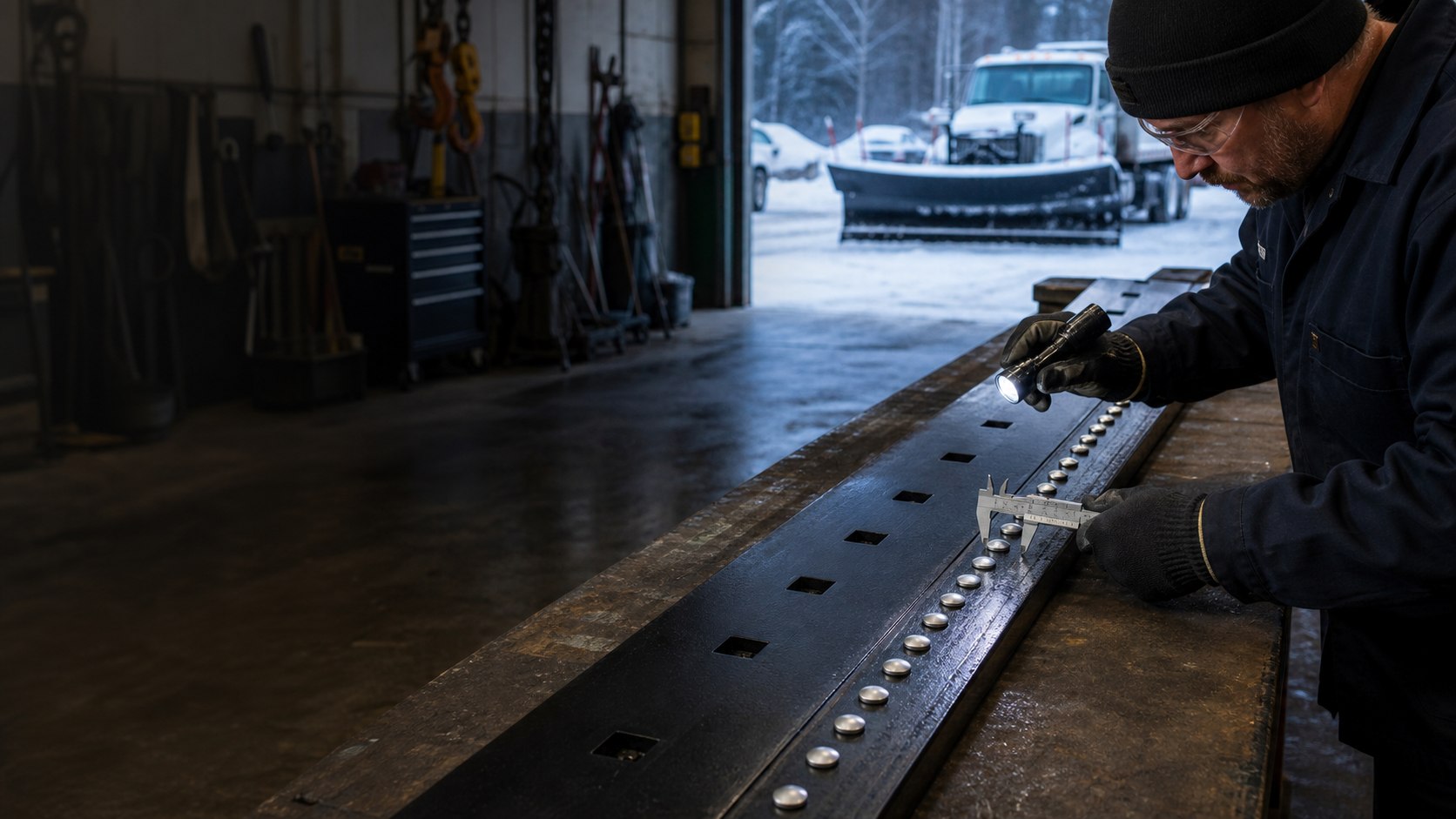
Compaction, thickness and how often it forms decide the kit. A kit for occasional glaze differs from one for routine hard-packed ice.
Section length, width, mounting pattern and coverage all follow the plow and the road. Add up the sections before ordering: a kit that is short at the ends leaves the wheel tracks untouched, which is exactly where the ice matters most.
Bonded ice has to be fractured rather than scraped, and the geometry that does it concentrates force into a narrow contact area. A flat edge under any amount of down-pressure polishes the surface and leaves it as dangerous as it was.
Every pass that leaves ice behind is a pass that will be followed by salt or brine. Cutting the ice mechanically is usually the cheaper way to remove it.
Ice control sequences usually start with mechanical removal and use de-icer for what remains. Where the equipment polishes the surface instead of cutting it, the de-icer becomes the primary tool and the cost shifts to the material budget.
Kits are heavier, come in sections and need correct alignment and clamping. Handling large sections safely and keeping the alignment true are what stop a kit from damaging the plow frame or wearing unevenly.
A packed-ice kit is one tool in an ice-control programme. Snow clearance, road planing and night operations each have their own answers.
Not every fleet needs a dedicated kit. Where ice forms occasionally and the route is mainly snow, a standard carbide edge with correct down-pressure handles it, and the money is better spent on the night-time set-up.
Emergency routes, hospital access and steep gradients cannot be cleared twice. Those routes justify an ice-cutting kit on their own, because the cost of a missed pass is not measured in blade life.
If the road is glazed and the edge rides over it, yes. If the edge is skipping through deep snow, the problem is contact and pressure rather than the ice.
Deep snow yields to a wide edge; bonded ice does not. If adding down-pressure changes nothing, you are looking at a cutting problem rather than a clearance problem, and a kit is the right answer.
Add the sections up against the moldboard and check where the joints fall relative to the wheel tracks. Coverage errors are the most common and most expensive mistake in a kit order.
A multi-section cutting-edge system built to fracture and remove compacted or bonded ice rather than to clear loose snow. It is specified around the ice condition and the plow.
It can handle occasional ice, especially with correct down-pressure and angle. Where packed ice is the routine condition, a cutting system outperforms a standard edge.
It removes more ice mechanically per pass, which reduces the salt or brine needed afterwards. The size of the reduction depends on how much the previous set-up was leaving behind.
From the plow width, the mounting pattern and the wheel tracks you have to clear. Check the coverage adds up end to end before ordering.
It has more sections and more fasteners, so alignment and clamping matter more. The trade-off is that a damaged section can be replaced individually.
Sections, coverage and mounting.
Sequencing mechanical removal and de-icer.
Reading the condition you are cutting.
Handling, alignment and replacement.
Describe the ice you get and how often, and send the plow details. We will say whether a kit is justified and which configuration fits.
✓ Ice type and how often it forms
✓ Plow width and mounting pattern
✓ Current edge and what it leaves behind
✓ Quantity and delivery destination
Email: [email protected]