




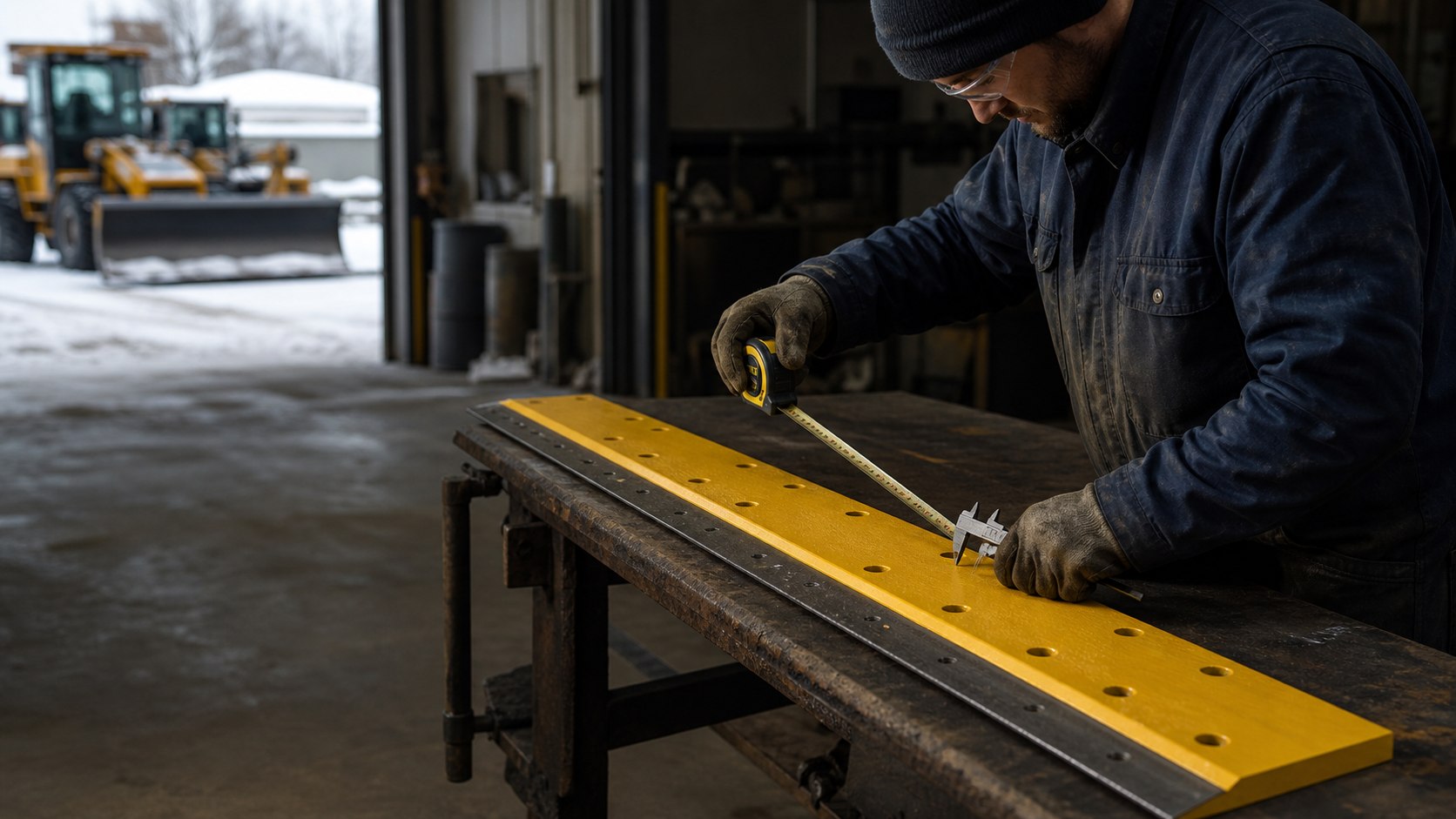
Total kit length has to equal or exceed the moldboard, and the sections have to land so the joints do not sit in the wheel tracks.
Work out the number of sections from the moldboard width and the standard lengths available, then check the joints against where the wheels run. A joint in the wheel track wears fastest and clears least, so moving it a few inches is worth doing at the ordering stage.
Hole diameter, spacing and position decide whether the kit can be fitted at all. Measure the mounting pattern rather than assuming compatibility from a brand name, and check whether the plow’s trip mechanism changes the geometry.
Geometry, ice condition, carbide grade, section count and inspection. Five items, and the kit arrives as specified.
State whether the kit will work on glaze, bonded ice or hard-packed snow, because the grade and geometry follow from it. A kit specified for a mixed condition is a compromise everywhere, and it shows up in the second season.
Section length tolerance, hole position and the inspection that confirms them. On a multi-section kit the accumulation of small errors is what stops the sections aligning, so the tolerance per section matters more than it does on a one-piece blade.
Divide the moldboard width by the section length, round up, and then check where the joints fall relative to the wheel tracks. Adjust the arrangement rather than accepting a joint in the wrong place.
It should cover it fully. A short kit leaves the outer strips uncleared, which on most roads is exactly where ice forms first.
Often yes, if the mounting pattern and trip mechanism allow it. Check the mounting geometry and the down-pressure the machine can apply before ordering.
The grade follows from the ice. Harder grades suit abrasive, steady surfaces; tougher grades survive the impact that comes with broken pavement and refrozen ruts.
Yes, at least one of each length. A missing section clears badly and loads its neighbours, so the spare is operational rather than optional.
How the kit fits an ice-control programme.
Reading the surface the kit has to cut.
Fitting and looking after a sectional kit.
The wider RFQ document.
Give us the moldboard width and the mounting pattern and we will work out the section arrangement.
✓ Moldboard width and mounting pattern
✓ Ice type and how often it forms
✓ Machine and down-pressure
✓ Quantity and destination
Email: [email protected]