




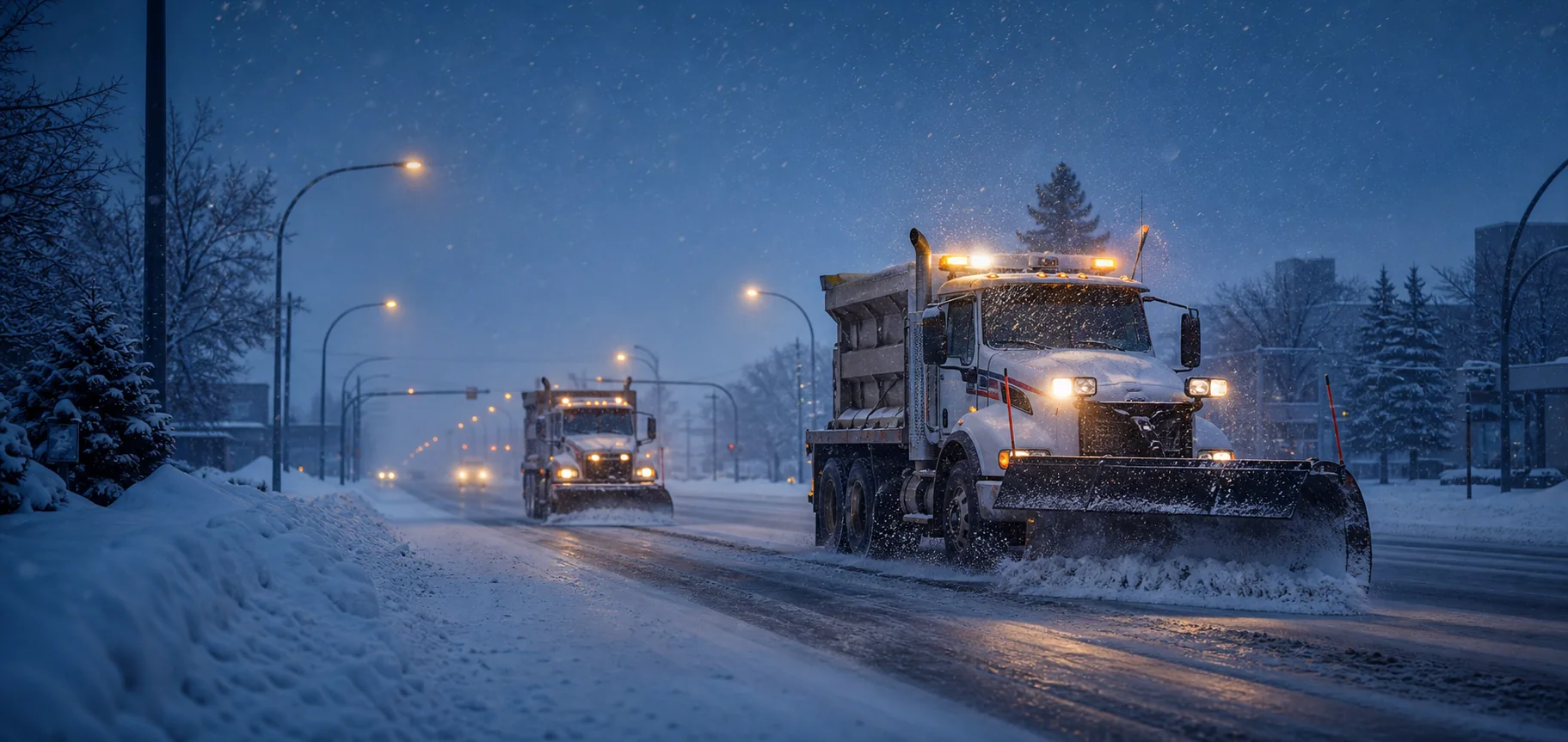
Every pass that leaves ice behind creates the need for a de-icer application. Cutting the ice removes the cause rather than treating it.
The efficient sequence is a cutting pass that fractures and lifts the ice, followed by de-icer only for what remains bonded at the edges and joints. Where the equipment polishes, the de-icer becomes the primary tool and consumption rises with every storm.
Track material applied per lane-kilometre before and after a change of edge. That number is the honest measure of an ice-control improvement, and it is usually larger than the blade saving itself.
Emergency access, hospital routes and steep gradients cannot be treated twice. Those routes justify a cutting edge on their own.
Where a missed pass is a safety or contractual failure, the cost of a second attempt is not measured in fuel. Ice-cutting equipment earns its place on those routes before it earns it anywhere else.
Gutters, bridge decks, shaded slopes and street furniture create ice that no edge reaches cleanly. Those areas need a different answer — drainage, hand work or targeted material — and expecting the blade to solve them leads to over-scraping everywhere else.
It removes more ice mechanically per pass, so less material is needed afterwards. The size of the reduction depends on how much the previous set-up was leaving behind.
After mechanical removal, for what remains. Pre-treatment is a separate decision and depends on the forecast, the surface temperature and the route priority.
Material applied per lane-kilometre, tracked over a season and compared with the previous year on the same routes. That figure captures both the equipment and the operational change.
No. Routes where ice is occasional are better served by a standard carbide edge and correct down-pressure. Reserve the cutting equipment for the routes that need it.
Those are localised problems with localised answers. Over-scraping a whole route to solve a gutter problem wears the equipment out for no benefit.
Choosing the cutting system for the route.
Black ice, bonded ice and hard-packed snow.
Running ice control across a fleet.
Turning the saving into a budget number.
Tell us how much material you apply and what the current edge leaves behind, and we will assess whether a cutting system changes it.
✓ Current routes and priority classes
✓ Material applied per storm
✓ Current edge and what it leaves behind
✓ Fleet size and machine types
Email: [email protected]