




Ice Control Alternatives Compared: Where Packed Ice Kits Fit
Ice control alternatives compared: where packed ice kits fit alongside treatment, abrasives and route strategy, and how to weigh them on one basis.

“Ice control” covers several different things, and the alternatives are rarely substitutes for one another. Chemical treatment changes the surface, abrasives change its friction, route strategy changes when and how often it is worked, and a cutting edge changes whether contact is established at all. Comparing them as competing options produces the wrong decision; the useful question is which combination removes the repeat passes that are actually costing the fleet.
Ice Control Alternatives: What Each Approach Is Designed For
Each approach addresses a different part of the problem.
Chemical treatment reduces bond strength or lowers the freezing point, abrasives increase friction on the surface as it stands, route strategy reduces exposure by timing and sequencing, and a packed ice kit changes whether the blade can establish contact with a bonded layer.
Those mechanisms operate at different points in the process and on different timescales. Treatment may take effect minutes or hours after application and depends on temperature and moisture; abrasives work immediately but change the wear environment for the edge; route sequencing avoids the condition rather than addressing it; a cutting edge works only while it is on the road. None of them replaces the others, and a fleet that treats them as alternatives tends to solve one part of the problem and pay for the rest.
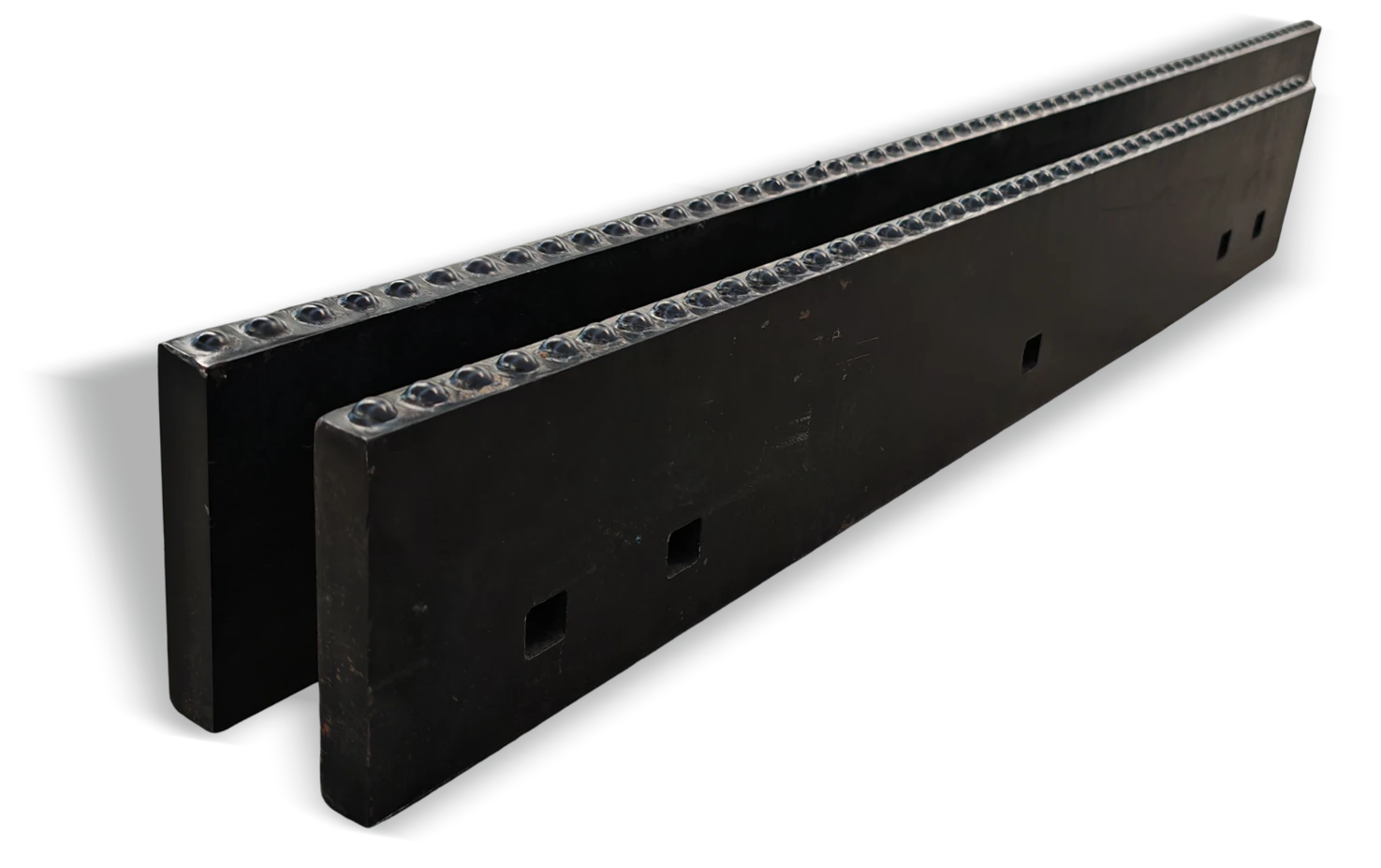
A packed ice kit addresses the case where the layer has already bonded and the surface resists displacement. What the kit is and how the mechanism works is described in the material on the isolated carbide edged design, and the specification options are set out in the packed ice kit specification guide.
How the Approaches Differ in Service
The approaches differ in what they change and how durably.
Treatment changes the condition of the surface but is consumed by traffic and weather. Abrasives remain until they are displaced or buried. Route sequencing avoids the event but does not change the surface. An edge specification changes the fleet’s ability to remove the layer whenever it occurs, without being consumed in the same way.
That durability difference is the reason the comparison matters. A treatment programme has a recurring material cost and a recurring application cost, both proportional to the number of events. An edge specification has a purchase cost and a replacement interval, and it works on every event in that interval. Where a network experiences many refreeze events, the edge cost is spread across all of them; where it experiences two, the treatment approach may be cheaper and more targeted.
The approaches also affect each other. Heavy abrasive use changes the wear environment, which shortens an edge’s interval and may change the grade that suits the route. Aggressive chemical treatment can leave a surface state that behaves differently from untreated refrozen snow. Treating the decision as a single choice hides those interactions, which is why the regulatory context for material use that many agencies plan against is worth reading alongside this comparison; the EPA’s municipal stormwater guidance sets out much of it.
Surface and Condition Differences Between Approaches
Surface state decides which approach is worth applying. Bonded, refrozen snow that resists displacement is the condition a packed ice kit addresses and the condition that chemical treatment may not resolve quickly in very cold conditions, where the reaction is slow. Loose snow over ice is a different case, where an edge establishes contact but treatment may still be needed to prevent the layer re-forming.
Treatment performance varies with temperature in ways that matter to the comparison. Some materials work well at moderately cold temperatures and lose effectiveness as conditions harden, and where the application is made ahead of a freeze, the outcome depends on moisture and timing as much as on the material used. Seasonal guidance published by the National Weather Service is useful context when a fleet reviews how a treatment plan performed against the conditions that actually occurred.
Route characteristics decide how much of the problem an edge specification can solve at all. Routes with shading, poor drainage or bridge decks hold refrozen layers longest, and those are the routes where contact-led specifications produce the most benefit. Routes that dry and drain quickly produce the condition rarely, and there the argument for the specification is weak regardless of how well it performs.
A further condition difference is the traffic pattern that creates the layer. Where vehicles run over snow before it freezes, the layer forms compacted and bonded; where a route is ploughed clean and then refreezes, the surface is thinner and often broken by a single pass with the right edge geometry. The two situations look similar from the cab and respond differently to the same specification, which is why recording how the layer formed is more useful than recording only that it was present.
Operational Trade-Offs Beyond Wear With Packed Ice Kits in an Ice Control Plan
The first trade-off is where the cost appears. Treatment and abrasives are recurring operating costs, visible in the materials budget every year. An edge specification is a capital and consumable cost that appears in the fleet budget and, if it works, reduces operating costs in fuel, operator hours and repairs. Comparing them therefore requires looking across budget lines rather than within one.
The second is the point of application. Treatment and abrasives are applied to the surface, while an edge specification is applied to the machine. That makes the edge approach independent of timing, since it works whenever the truck is working, while treatment depends on the decision being made far enough ahead to take effect.
The third is the effect on the machine. Additional passes and extra down-pressure load the trip mechanism, shoes and mountings, so a combination that reduces them pays back in workshop time as well as in fuel. Where a fleet records workshop work by task, that effect is visible within a season and belongs in the comparison. Pooled research on winter maintenance practice is published by Clear Roads, and the operating context for road weather management is published by the Federal Highway Administration.
Fitment and Equipment Compatibility for Packed Ice Kits in an Ice Control Plan
Only one of the approaches has a fitment requirement, and it is the one being added to the fleet. SENTHAI validates fitment against AASHTO and DIN bolt patterns before release and works to plus or minus 0.02 mm dimensional tolerances on carbide components, with AASHTO published standards as the reference for agency specifications and DIN covering European and export conventions.
Where a kit is added to an existing operation, three checks matter. The measured pattern from the blade in service. The seating height once the heavier assembly is fitted, since this changes the angle at which the working face meets the surface. And the hardware set, because a heavier assembly may need longer fasteners or a different washer type. Where an OEM mounting interface is involved, SAE standards for mobile machinery describe the interfaces those designs were built around.
Compatibility with the rest of the ice control plan matters as well. Where a fleet spreads abrasives, the surface the edge meets becomes more abrasive, and the grade and interval should be set with that in mind. Where liquid de-icing is used, the surface state differs again. Those interactions make the specification a function of the treatment plan rather than an independent choice.
Cost Per Kilometre Compared
Cost per kilometre is the common basis, provided the comparison includes recurring costs on both sides. The model structure for the edge side is set out on the cost per mile page; the alternatives have to be costed on a comparable basis.
| Approach | Cost pattern | What to measure |
|---|---|---|
| Chemical treatment | Recurring material and application cost per event | Material used, application hours, events treated |
| Abrasives | Recurring material cost plus increased edge wear | Material used and resulting edge interval |
| Route sequencing | Operational cost, no materials | Deployment hours and service results |
| Packed ice kit | Purchase and replacement interval, working every event | Passes per event, measured wear, workshop hours |
| Combination of the above | Mixed recurring and capital costs | The inputs above, recorded per route group |
Two cautions belong with the table. Comparing a recurring materials cost against a capital purchase requires a defined period, usually a season, so that both are expressed on the same basis. And the comparison should be run per route group, because a treatment plan that works on one route may be inappropriate on another where the same condition occurs under different traffic and drainage.

Combining Approaches on a Mixed Network
The practical answer for most networks is a combination, allocated by route. Treatment and abrasives cover the general network, route sequencing handles the sections where early ploughing prevents bonding, and a contact-led edge specification is applied to the routes that repeatedly produce refrozen layers and generate repeat passes.
Allocation should be reviewed on records rather than on impressions. Compare passes per event, material used, service results and edge intervals for each route group, and look for the routes where the current combination is still producing repeat work. Those are the candidates for a change, and they are also the routes where a trial produces the clearest evidence. The wider framework for comparing edge options across a fleet is set out in the blade selection guide.
Treatment, abrasives, route strategy and edge specification address different parts of the ice control problem, and none substitutes for another. The decision is not which approach to choose but which combination reduces repeat work on the routes that produce it.
Cost the approaches on the same basis over a defined season, allocate them by route group, and measure passes, material use and edge interval for each. Reviewed that way, the combination is adjusted on evidence, and each addition has to justify itself against the routes it was applied to.
Send SENTHAI the routes where refrozen surfaces recur, your treatment records and current edge specifications, and the technical team will review where a packed ice kit adds to the existing plan.
Frequently Asked Questions
Does a packed ice kit replace chemical treatment?
No. Treatment changes the condition of the surface and a kit changes whether the blade can remove it; they operate at different points and complement each other rather than substituting. The useful question is which combination reduces repeat passes on the routes that repeatedly freeze, and that is answered by measuring passes and material use per route group.
How should the alternatives be compared on cost?
Cost them over the same defined period, usually a season, and include the recurring costs on both sides: material and application hours for treatment, materials plus the effect on edge interval for abrasives, deployment hours for sequencing, and purchase plus interval plus workshop hours for a kit. Comparing a capital purchase against a per-event cost without a period produces an answer that changes with the time frame chosen.
Where does a packed ice kit add the most value?
On routes that repeatedly produce bonded, refrozen layers, particularly where shading, drainage or bridge decks hold the condition and where repeat passes are already being made. On routes that produce the condition rarely, the specification is harder to justify because the purchase price is paid whether or not the condition occurs. Allocate by route rather than across the network.
Can the approaches be trialled at the same time?
They can, provided each route group is recorded separately and the inputs are defined in advance: passes per event, material used, service results and edge measurements. Where two changes are made on the same group at once, the result cannot be attributed to either, which leaves the following season’s decision as uncertain as the one before it.
Related articles
 Packed Ice Kit Tender: Writing the SpecificationPacked ice carbide kits
 Packed Ice Kit for Municipalities and Contractors: How Use DiffersPacked ice carbide kitsPacked Ice Kit Maintenance: Inspecting What MattersPacked ice carbide kits
 Packed Ice Kit Performance on Ice Compared With Standard EdgesPacked ice carbide kits