




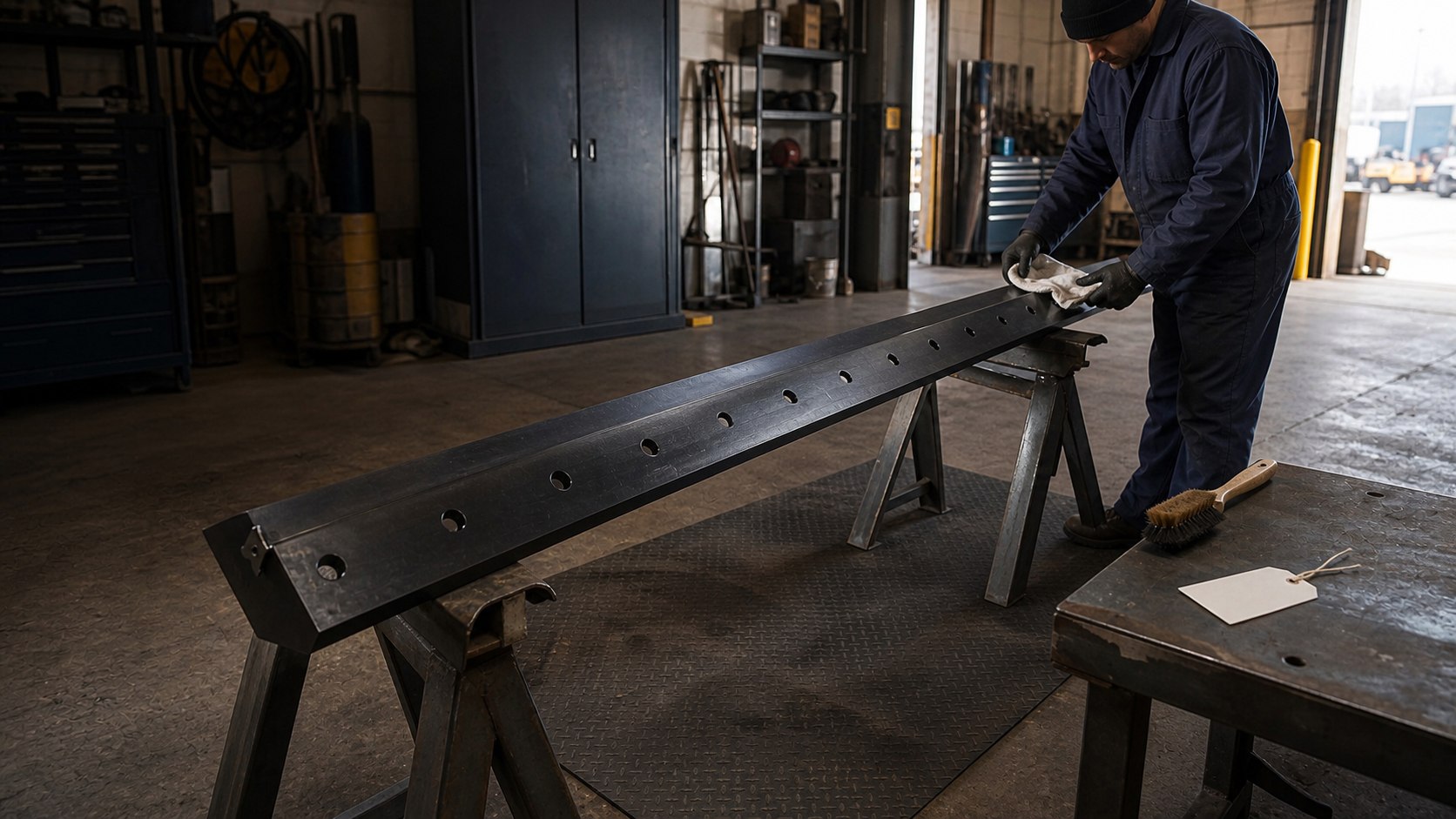
Salt and Debris
Before Storage
Visible Condition
Identity and Location
The correct handling method depends on the blade design, weight and equipment requirements. Use these priorities to organize the work without replacing product-specific instructions.
Remove loose road dirt, salt deposits and debris using a method approved for the equipment and blade materials. Pay attention to mounting surfaces, holes, slots and areas where residue can remain trapped.
Do not place a wet blade directly into long-term storage. Allow accessible surfaces and adjoining components to dry before tagging and moving the blade to its storage position.
Record visible wear, cracks, deformation, corrosion, loose components or damaged mounting features. Photograph the blade before storage so its condition is not confused with later handling damage.
Use a stable support method appropriate for the blade. Keep components separated from traffic and impact, then attach a durable record showing identification, status and storage location.
Complete the record while the blade history and installed configuration are still easy to confirm.
Follow the equipment manufacturer’s safety and removal procedure. Support the blade securely before cleaning, inspecting, photographing or moving it.
Record the part number, drawing reference, equipment information and installed position when available. Mark the reference end and keep the same orientation in all photographs.
Remove visible road residue and allow the blade to dry. Avoid unapproved chemicals or treatments that could affect steel, carbide, rubber or adjoining components.
Take complete front and back photographs, both end profiles and close-ups of any finding. Add confirmed dimensions if replacement planning may be required.
Use the handling and support method specified for the blade. Support its weight without unstable leaning, point loading, contact between cutting edges or pressure on flexible components.
Keep the condition record with the blade location. Route unresolved replacement, compatibility or damage questions before the next winter service period.
SENTHAI’s published corrosion guidance recommends dry, ventilated storage away from standing water and aggressive chemicals for snow plow blades and inserts.
✓ Keep blades away from standing water
✓ Use a dry area with ventilation
✓ Separate the blade from vehicle and forklift traffic
✓ Prevent cutting edges from rubbing each other
✓ Keep identification and condition tags attached
✓ Follow the blade-specific support requirements
Do not assume one storage orientation or protective treatment is suitable for every steel, carbide, rubber or composite blade configuration.
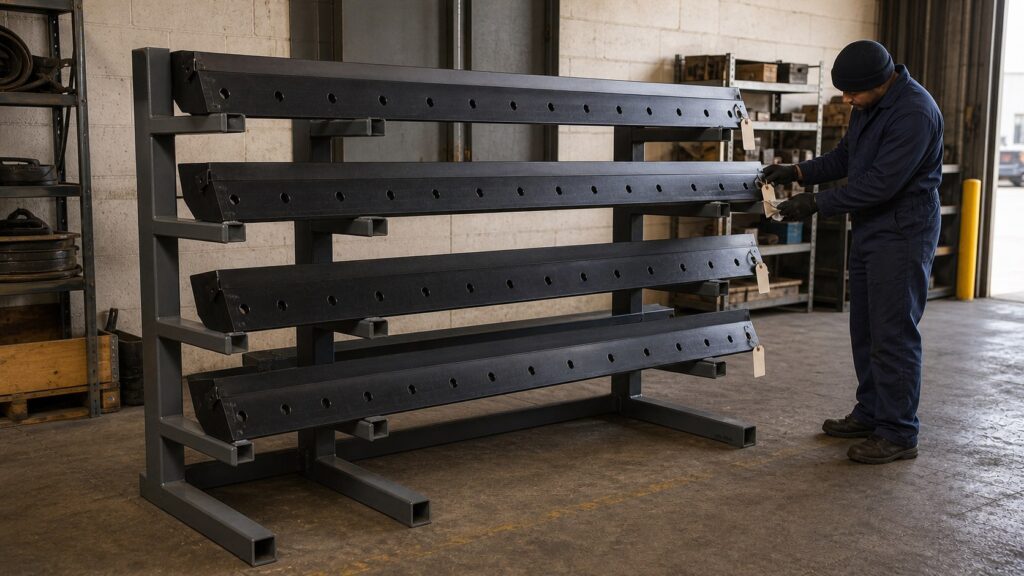
Illustrative dry storage area with supported, separated and identified cutting edges.
Correct the storage environment before leaving the blade unattended for the off-season.
Moisture and trapped road residue make later condition checks harder and can increase corrosion risk on susceptible components.
A blade should not depend on an unstable wall, pallet or neighbouring component for support. Use handling equipment and support suitable for its weight and shape.
Direct contact between cutting edges or mounting features can create handling damage and make individual blades difficult to remove safely.
Without a part number, orientation, condition status and storage location, a usable blade can be confused with an unreviewed or replacement item.
Before the next winter season, use the stored record to confirm the blade identity and review any condition that was left unresolved.
✓ Confirm the correct blade and stored location
✓ Compare the current condition with post-winter photographs
✓ Review mounting and visible blade components
✓ Add missing measurements or drawings
✓ Request replacement review before the blade is needed
Use product-specific requirements whenever they differ from this general workflow.
This page does not prescribe one universal orientation. Use the manufacturer’s handling requirements and a stable support method appropriate for the blade’s weight, profile and flexible components.
Yes. SENTHAI’s corrosion guidance recommends removing salt deposits and road grime before off-season storage, then keeping blades dry and away from standing water and aggressive chemicals.
Not automatically. Confirm that any protective treatment is approved for the actual steel, carbide, rubber, coating and adjoining components before applying it.
Keep the part number or drawing reference, equipment information, orientation, storage location, condition status, photographs and any unresolved inspection or replacement notes.
No. Records help preserve identification and condition history. Final feasibility, compatibility, configuration and commercial terms must be confirmed for the actual replacement requirement.
Send the information available if the post-winter inspection identifies a possible replacement or configuration question.
✓ Blade identification and equipment information
✓ Condition photographs
✓ Confirmed dimensions or drawing
✓ Required quantity
✓ Delivery country or destination
Email: [email protected]