




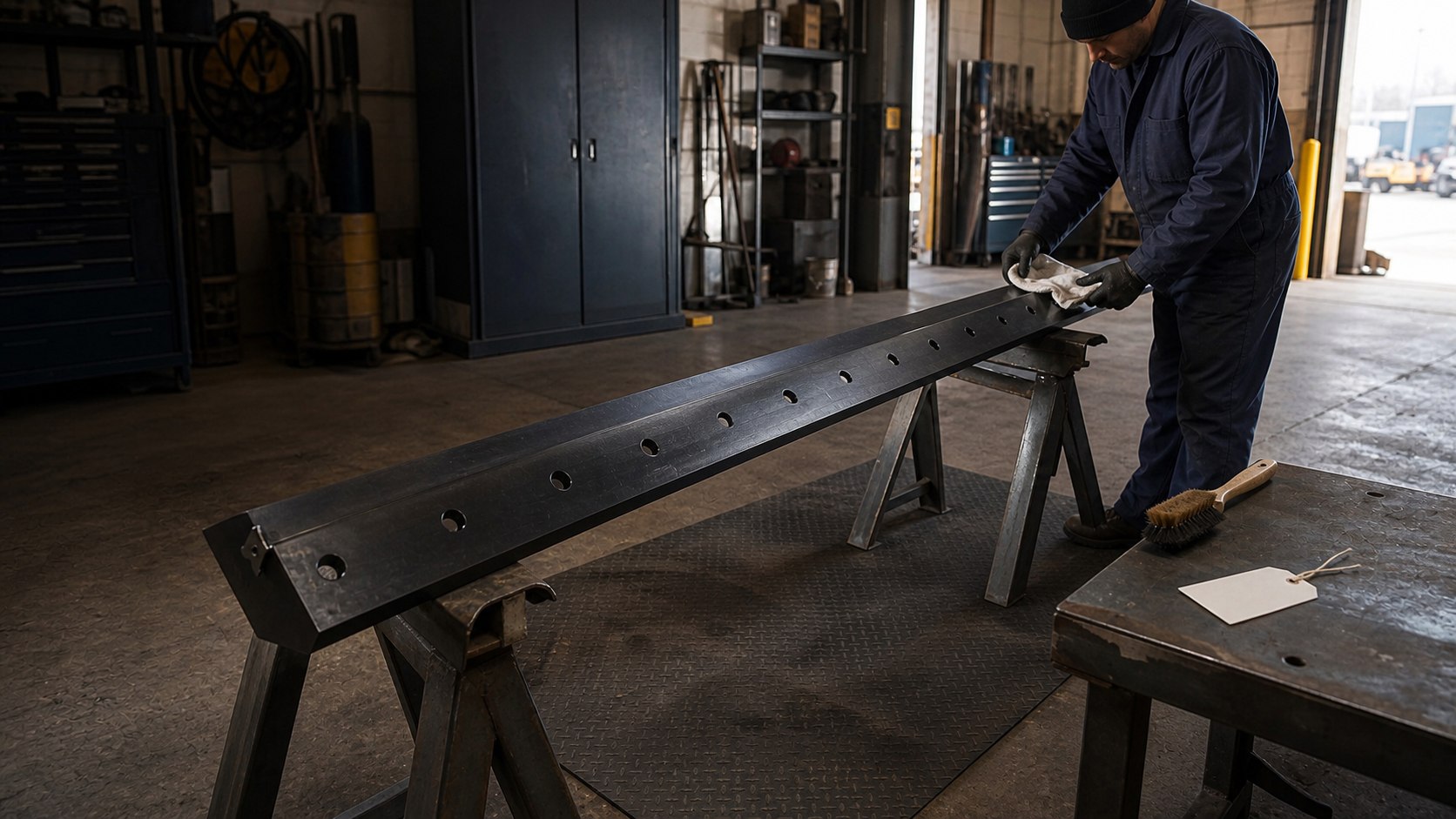
Lay every section out and check hole alignment before tightening a single bolt. A kit dry-fitted first takes a fraction of the time to install correctly.
Check the accumulated tolerance across the sections before clamping, because small errors add up and the last section is always the one that will not line up. If the pattern does not close, correct it before applying torque rather than forcing it with longer bolts.
Sections are heavy, sharp and awkward to lift. Use mechanical lifting or two people, support the plow mechanically before reaching underneath, and never rely on hydraulics to hold a raised blade while you work.
Re-check torque after the first shift, keep the sections aligned, and read the wear across the whole kit rather than on the section that is easiest to reach.
Clamping pressure relaxes, sections settle and wear is rarely even. A kit that is checked as a whole — every joint, every section — lasts longer than one inspected at whichever end is accessible from the workshop door.
Store spare sections off the floor, protected from UV and moisture, labelled by length. When a section is finished, replace it with a matching length rather than the nearest available, because a mismatched section loads its neighbours unevenly.
Usually accumulated tolerance across the sections or a distorted moldboard. Dry fit first and check the mounting face before forcing bolts.
After the first shift, then at every service interval. Sectional kits have more joints than a one-piece edge and each one is an opportunity for settling.
Yes, and it is the main maintenance advantage. Match the length and specification of the replacement to the sections around it.
Off the floor, out of direct sunlight, labelled by length, and with the cutting faces protected. Rubber-encased or coated sections need UV protection in particular.
Uneven alignment, over-clamping and running past the wear threshold. All three are preventable with a routine that treats the kit as one assembly rather than a set of separate blades.
Section lengths and coverage arithmetic.
The general installation checklist.
Off-season care for edges and sections.
How the kit fits the route programme.
Send the plow and mounting details and we will confirm the section arrangement and the installation sequence.
✓ Plow and mounting details
✓ Moldboard width
✓ Machine and down-pressure
✓ Quantity and destination
Email: [email protected]