




Why a Packed Ice Carbide Kit Is Changing How Crews Deal with Black Ice
There’s a moment every winter crew recognizes: the plow is down, the truck is pushing, but the surface doesn’t give. Instead of clean scraping, the blade skates over a thin, glassy layer of black…
There’s a moment every winter crew recognizes: the plow is down, the truck is pushing, but the surface doesn’t give. Instead of clean scraping, the blade skates over a thin, glassy layer of black ice. You slow down, make another pass, maybe add more salt—but the result barely improves. That’s usually where people start questioning whether a packed ice carbide kit is actually necessary, or just another add-on.
The reality shows up in those exact conditions. When ice bonds tightly to asphalt after freezing rain, standard edges often lose their bite. Packed ice carbide kits aren’t just a material upgrade—they change how force is applied to the surface. And that difference becomes obvious the moment conditions move from “snow removal” to “ice breaking.”
What a packed ice carbide kit actually changes in ice removal
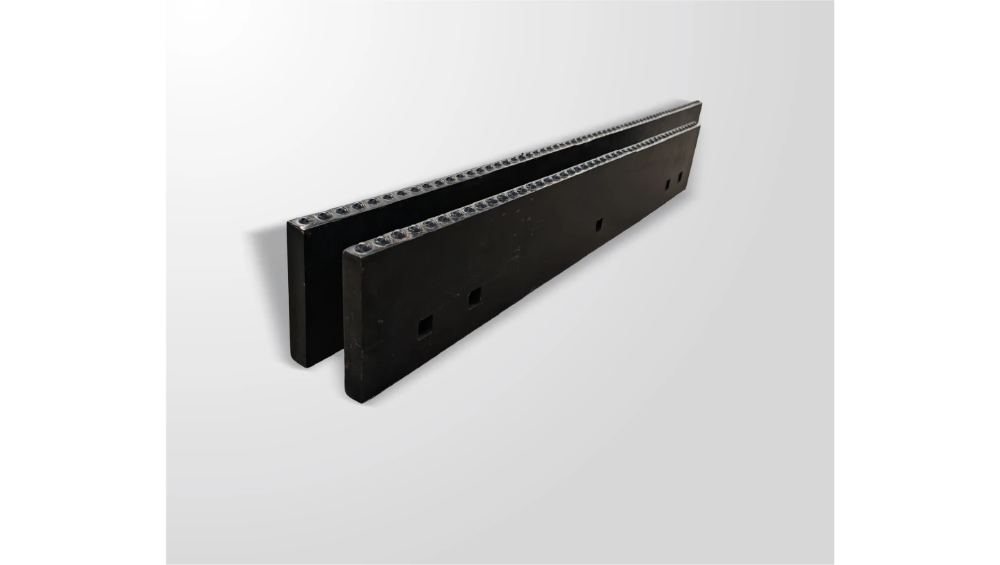
A packed ice carbide kit replaces continuous cutting edges with segmented, impact-focused carbide inserts. Instead of spreading force across a long blade, it concentrates pressure at multiple contact points.
Why does that matter in real conditions?
-
Continuous blades tend to glide over dense ice layers.
-
Concentrated carbide points generate localized stress, which fractures ice instead of polishing it.
-
The result is less dependence on friction and more reliance on mechanical breakage.
This distinction becomes critical on black ice, where surface smoothness reduces traction and cutting resistance simultaneously.
How point-load pressure breaks ice more effectively
The key mechanism is simple but often misunderstood: pressure increases as contact area decreases. A packed ice carbide kit uses this principle to its advantage.
When a plow with carbide inserts contacts the road:
-
Each insert applies high pressure to a small area.
-
Micro-fractures form in the ice layer.
-
Repeated impacts propagate cracks until the ice breaks apart.
In contrast, traditional steel or even standard carbide blades distribute force too evenly. Instead of cracking the ice, they often compress it or slide across it—especially under wet freeze conditions.
This is why operators often notice that after switching systems, fewer passes are needed even though plowing speed may stay the same.
Where these kits make the biggest difference
Not every job requires this setup, which is where confusion often comes in. Packed ice carbide kits show clear advantages in specific scenarios:
-
Freeze-thaw cycles that create layered ice sheets.
-
High-traffic roads where compaction turns snow into dense ice.
-
Bridge decks and shaded areas prone to black ice formation.
-
Situations where salt application is restricted or costly.
In lighter snow or loose accumulation, the difference is less noticeable. That’s why some crews underestimate their value—they’re testing them in the wrong conditions.
Packed ice carbide kit vs traditional blade systems
The decision often comes down to whether you’re trying to remove snow—or break bonded ice.
-
Traditional steel blades: Lower upfront cost, effective for loose snow, but struggle with bonded ice.
-
Standard I.C.E. blade replacement: Better wear resistance, improved scraping, but still limited under extreme ice adhesion.
-
Packed ice carbide kit: Designed for fracture-based removal, higher initial investment, but significantly reduces repeat passes.
This is also where ice breaking plow teeth and impact resistant carbide designs start to overlap in function, though not always in consistency. Kits tend to provide more uniform coverage across the plow width.
Why results can vary more than expected
Not every operator sees immediate improvement, and that’s usually tied to setup or expectations.
Common issues include:
-
Running at speeds optimized for scraping rather than impact.
-
Incorrect down pressure, reducing effective contact force.
-
Expecting smooth clearing instead of fractured ice removal.
-
Mixing worn inserts with new ones, leading to uneven performance.
There’s also an adjustment period. The feedback through the plow changes—more vibration, less glide—which some operators initially interpret as inefficiency.
Reducing salt usage without sacrificing results
One of the less obvious advantages is how these kits shift the role of deicing chemicals.
Instead of relying on salt to penetrate and loosen ice:
-
Mechanical breaking exposes more surface area.
-
Salt works faster and more efficiently on fractured ice.
-
Overall chemical usage can drop significantly over time.
For municipalities or contractors facing rising material costs, this becomes a practical trade-off rather than just a performance upgrade.
SENTHAI Expert Views
From a manufacturing perspective, the performance gap between standard blades and carbide-based systems often comes down to bonding strength and material consistency. In facilities like SENTHAI’s Rayong production base, processes such as controlled sintering and automated welding directly influence how well carbide inserts withstand repeated impact.
With over 21 years in carbide wear part production, SENTHAI has seen how small variations—like insert spacing or bonding integrity—can change field outcomes more than raw material choice alone. This is especially true for packed ice carbide kits, where each insert must absorb shock without loosening over time.
Their experience across more than 80 global partners also reflects a pattern: regions with frequent freeze-thaw cycles adopt these systems faster, while colder but drier climates rely less on them. It’s not just about severity—it’s about ice behavior.
That perspective highlights an important point: performance isn’t only about hardness or durability, but how consistently the system maintains pressure and alignment under real operating stress.
When upgrading actually makes sense
Switching too early—or too late—can both lead to frustration.
A packed ice carbide kit tends to make the most sense when:
-
You’re increasing salt usage but seeing diminishing returns.
-
Multiple passes are required for the same stretch of road.
-
Ice remains bonded even after scraping attempts.
-
Equipment wear from repeated plowing becomes a cost factor.
On the other hand, for light-duty or infrequent snow operations, the return may take longer to justify.
Frequently Asked Questions
How is a packed ice carbide kit different from an I.C.E. blade replacement?
A packed ice carbide kit focuses on breaking ice through point pressure, while an I.C.E. blade replacement improves scraping efficiency but still relies on continuous contact. In real conditions, the former performs better on bonded or layered ice, while the latter works well for general snow removal.
Does it completely eliminate the need for road salt?
No, but it can significantly reduce it. By fracturing ice mechanically, salt can penetrate faster and work more effectively, which often lowers total usage rather than replacing it entirely.
Why does my plow feel rougher after installing carbide inserts?
That’s expected. The vibration comes from impact-based contact rather than smooth scraping. It usually indicates the inserts are engaging the ice surface correctly rather than sliding over it.
Are ice breaking plow teeth the same as a packed ice carbide kit?
They share a similar concept but differ in consistency and coverage. Plow teeth may create aggressive contact points, but kits provide more evenly distributed pressure across the blade, which improves overall performance.
How long does it take to see efficiency gains?
Often within a few operations, but it depends on conditions. Crews working in heavy freeze-thaw environments tend to notice faster improvements, especially in reduced passes and lower salt consumption.
Maximize your ice-clearing efficiency with our patented I.C.E. technology.
Related articles
 Optimizing Winter Fleets: The Definitive Guide to Kueper Plow Blades Substitute Systemsinfo
 Sourcing a Credible Kennametal Snow Plow Blades Equivalent: The Metallurgical and Operational Guideinfo
 Polarflex Plow Blade Replacement: The Engineered Sourcing Guide for Peak Fleet DurabilityinfoBeyond OEM Lock-In: Modern Fleet Guide to Cutting-Edge Plow Blade Alternativesinfo