




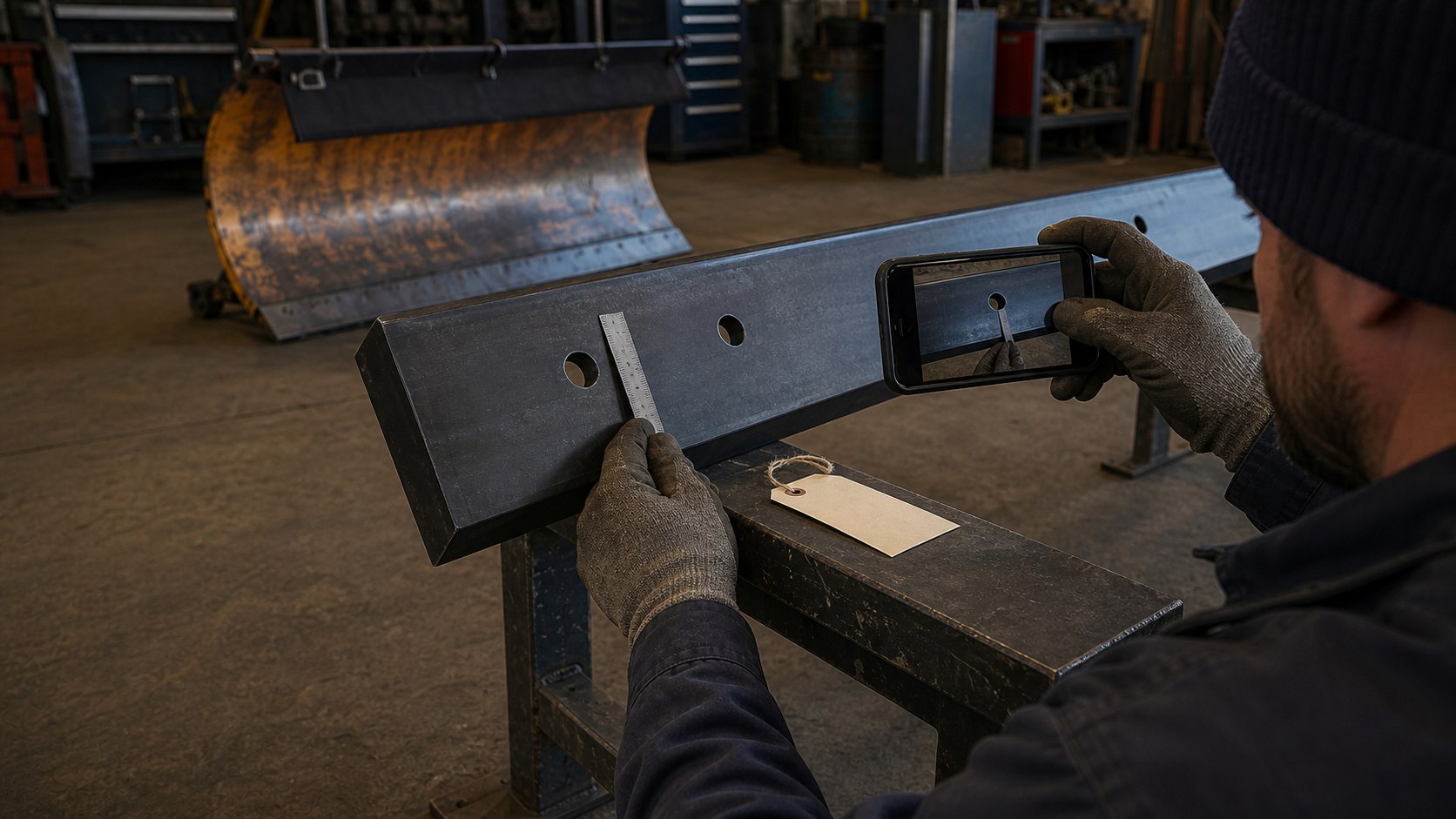
A bent moldboard or an elongated hole will destroy a new edge in weeks. Inspect and correct the carrier while the blade is off, because there is no second chance once the season starts.
Lay a straight edge along the mounting face and check each hole for elongation. Ream or drill oversize only where the specification allows it; otherwise the carrier is the problem and a new edge is a waste of money.
Clean the mounting face, remove burrs, and fit new fasteners where the old ones have fretted or stretched. A painted or contaminated face will settle under load and the torque will be lost within a shift.
Set the edge so it contacts the surface evenly at working down-pressure, then torque from the centre outward so the blade beds flat against the carrier.
Too little contact skips and polishes; too much scrapes the binder out of the surface and accelerates wear. Set the edge to full contact at the lowest pressure that keeps it there, and record the setting so it can be reproduced.
Torque in a sequence from the centre toward the ends, then re-check after the first shift or the first two hours of work. New edges bed in, and a re-check catches the settling that would otherwise become a loose blade.
Impact travels through the edge into the frame, the hitch and the hydraulic system. Isolating it at the mounting is cheaper than replacing what it breaks downstream.
Rubber or elastomer mounts and correct trip settings reduce what the rest of the plow has to absorb. Fleets that address this report fewer cylinder seal failures and fewer cracked hitches, both of which cost more than the edge.
Blades are heavy, the mounting area is awkward, and the work usually happens in the cold. Use the correct lifting method, support the plow mechanically before reaching underneath, and never rely on the hydraulic system to hold a raised blade.
The lowest setting that holds full contact across the whole edge at working speed. More pressure accelerates wear and damages the surface without clearing more snow.
Yes, after the first shift or two hours of work. New edges and new fasteners settle, and the re-check is what prevents a loose blade in the first storm.
Only if they are in good condition and have not been stretched or fretted. New fasteners cost very little relative to the consequences of a failure mid-route.
A trip mechanism lets the edge fold back when it hits an obstacle. It changes the geometry at the mounting, so set the trip and the edge height together rather than independently.
Usually a mounting problem: an uneven face, a distorted carrier, over-torque on one side, or impact without shock isolation. Check the installation before blaming the blade.
What to check before and during the season.
The bolts, nuts and washers worth replacing.
When to rotate and when to replace.
The measurements that decide whether it bolts on.
We will review the mounting step and tell you where first-week failures are most likely to come from.
✓ Current fitting procedure
✓ Machine and plow details
✓ Torque figures in use
✓ Failure history after fitting
Email: [email protected]