




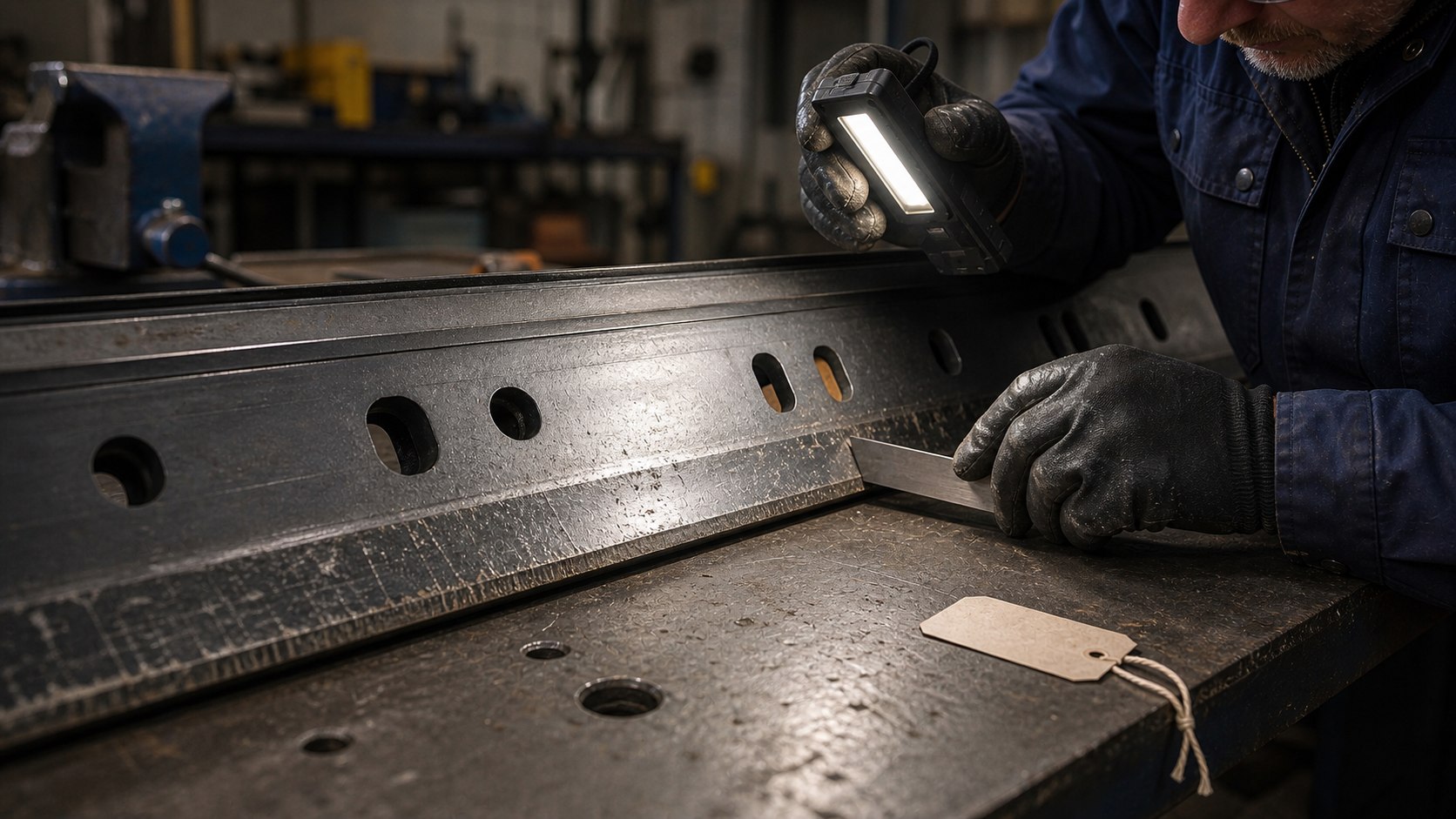
The pre-season checklist
Edges, carbide, bond lines, fasteners, carrier, skid shoes, mounting height and spares. Ninety minutes per machine, once a year.
The edge and the carbide
Measure the edge at the marked points, look for chipped or missing carbide, and check the bond line for separation. A bond that has begun to fail is visible before it becomes a lost insert, and a lost insert damages the carrier around it.
- incoming Inspection for Snow Plow Blades: What to Check Without a Lab
- how to Qualify a Carbide Snow Plow Blade Manufacturer: A Buyer’s Checklist
- carbide Snow Plow Blades in Extreme Cold: Qualification, Inspection, and…
- ice Rink Equipment Maintenance Checklist: Resurfacer Blades, Traction,…
- custom Carbide Wear Parts RFQ Checklist: Drawings, Tolerances, Trials, and…
- how to inspect stored snowblower blades without missing hidden micro-cracks
- how Do You Train Mechanics on Carbide Blade Inspection
- how to Store Snow Plow Blades for UV Protection: A Guide to Preventing…
- how to Evaluate a Global Carbide Snow Plow Blade Manufacturer: A B2B…
- snow Plow Blade Inspection: Ultimate Pre-Winter Checklist for Fleet Managers
- snow Blade Testing & Inspection Protocols: Complete Guide
Fasteners, carrier and skid shoes
Check every fastener for fretting and correct torque, look for elongation at the mounting holes, and set the skid shoes to their correct height. Loose hardware and worn shoes together account for a large share of in-season call-outs.
- are Snow Plow Shoes Essential for Winter Road Maintenance
- how To Inspect Carbide Tipped Blades Properly
- reliable Canadian Winter Maintenance Parts from SENTHAI for Arctic Conditions
- top 10 Industrial Snow Plow Blades for Highway Maintenance 2026
- how Can OEM Snow Plow Blade Manufacturers Redefine Efficiency and…
- how Does a Dump Truck Snow Plow Enhance Winter Road Maintenance Efficiency
- how Durable Are Studded Tires for Ice Resurfacers and Arena Maintenance
In-season checks that take minutes
A visual pass after every significant storm, and a measurement at every service interval, catches almost everything before it becomes a failure.
Post-storm visual checks
Look for loose bolts, newly chipped carbide and fresh damage to the carrier after a route with heavy impact. Two minutes at the yard prevents the failure that would otherwise happen on the next call-out.
- pre-Winter Blade Inventory: What to Stock Before the First Storm
- when Should You Replace Your Ice Resurfacing Machine? Maintenance Checklist
- what Prevents Rounding of the Carbide Edge on Snow Plow and Road…
- next-Gen Winter Maintenance: 2026 Trends in Snow Blade Materials and Design
- how Is Road Maintenance Done for the 2026 Winter Olympics
- how Can Thailand’s Carbide Blade Suppliers Redefine Global Road…
- how Do Arctic‑Grade Snow Blades Solve Modern Winter‑Maintenance Challenges
- is your carbide circular saw blade really maintained
Finding the damage you cannot see
Micro-cracks in carbide and bond-line failures start small. Where the duty is severe, a periodic non-destructive check — dye penetrant, ultrasonic or a simple tap test — finds problems that a visual inspection misses.
- what Is the Future of Road Maintenance with Carbide-Enabled Automation
- snow and Ice Removal: The Complete Guide for Safe and Efficient Winter…
- is OEM carbide blade the right choice for your road maintenance needs
- how Can Long Lasting Snow Blades Transform Winter Maintenance
- what Is Nature’s Ice Melter and Why It Matters for Winter Maintenance
- how Do Carbide Blades Improve Highway Maintenance Equipment
Inspection questions
When should the pre-season inspection happen?
At least a month before the expected first call-out, so that any parts needed have time to arrive. An inspection the week before the season starts leaves no room to fix what it finds.
How long should an inspection take per machine?
Around an hour to ninety minutes for a full pre-season check including fasteners and skid shoes. In-season checks are a two-minute visual pass plus a measurement at service intervals.
What is the most commonly missed item?
The bond line between carbide and steel. It fails progressively and is visible long before an insert comes off, but it is on the face of the blade where nobody looks during a visual pass.
Do I need non-destructive testing?
Only where the duty is severe and the consequence of failure is high — airports, high-speed highway work, heavy impact routes. For most fleets a careful visual inspection is proportionate.
Who should do the inspection?
Someone who knows what a good edge looks like, using a written checklist. The checklist matters more than the seniority of the person holding it.
Installation and mounting
Correct fitting, torque and down-pressure.
Rotation and replacement
Turning inspection findings into a schedule.
Storage and protection
Preparing inspected edges for the off-season.
Wear measurement
How to measure and record edge wear.
Ask for an inspection checklist
Tell us your fleet and duty and we will send the checklist items that matter most for your machines.
✓ Fleet size and machine types
✓ Route classes and surface types
✓ Current inspection routine
✓ Most common failure mode
Email: [email protected]