




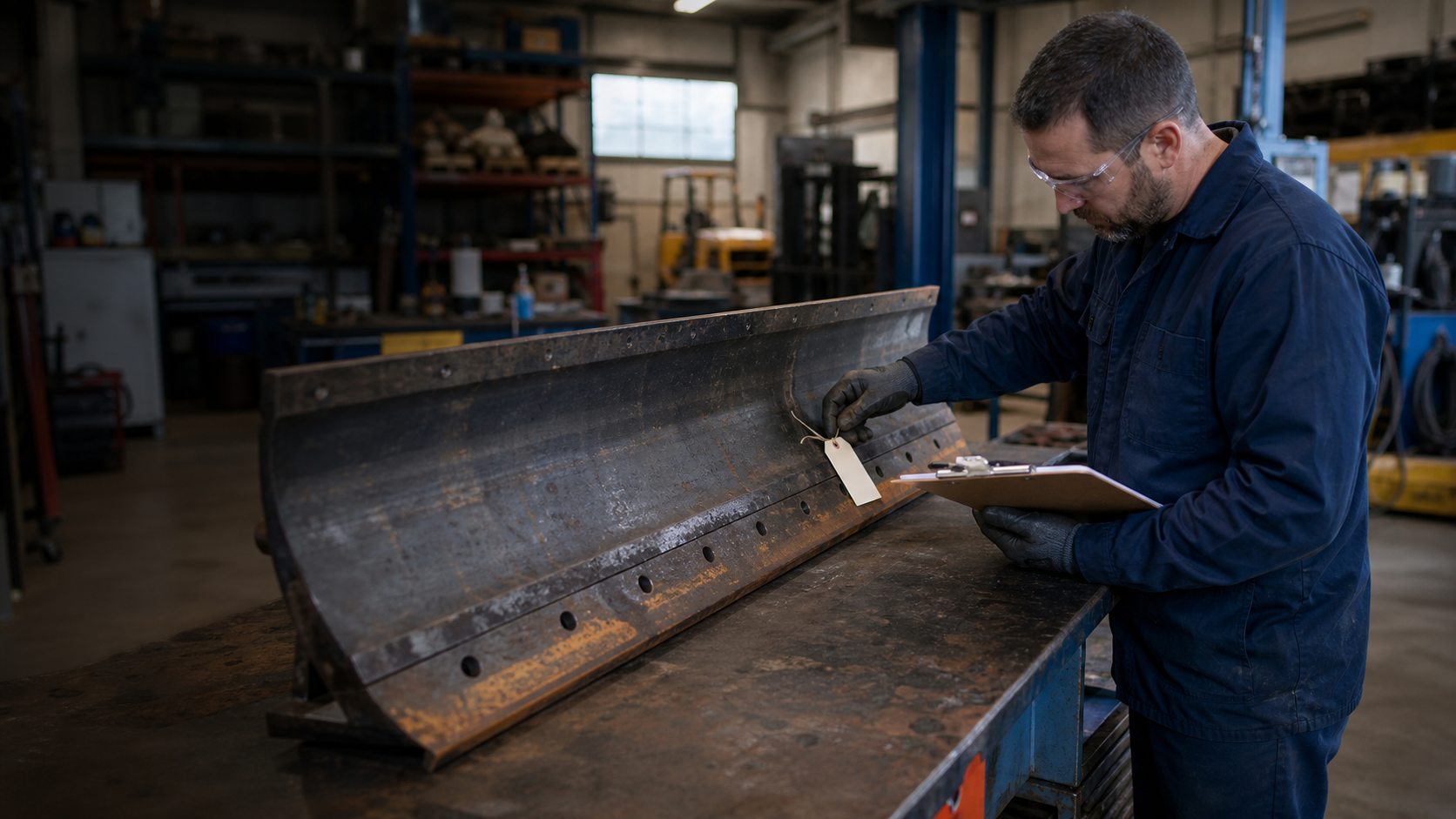
Turning an edge end-for-end moves the wear to the unworn section and typically recovers a significant share of service life for the cost of one scheduled change.
On high-mileage routes, rotate at the midpoint of expected life or at every service interval, whichever comes first. On light routes once a season is enough. The schedule matters less than having one and recording that it happened.
Rotating forces a measurement and an inspection, which surfaces uneven wear and impact damage early. Fleets that rotate generally report fewer mid-season failures, because the failure is found at a scheduled change rather than on a route.
The replacement trigger is the point where the edge stops clearing the surface. Publish it as a number and the decision stops being a conversation.
Edge thickness at the marked points, visible loss of contact, a change in the surface left behind, or a cracked or missing carbide section. Any one of them is sufficient, and writing them down removes the mid-storm debate.
A planned change happens in the yard with the right tools and the right parts. A reactive change happens on a route in the cold and costs a shift. The difference between them is a spare set on the shelf and a measurement schedule.
Re-tipping or rebuilding a worn edge is usually cheaper than a new blade — provided the carrier is straight, the holes are sound and the bond can be reproduced to specification.
If the steel carrier is within tolerance, replacing the worn inserts is often the lowest-cost route to another season. Check the carrier first: a refurbished edge on a distorted carrier fails faster than the original did.
Elongated holes, a bent or cracked carrier, or a bond line that has failed in several places means the blade is beyond economic repair. At that point the honest comparison is a new edge against the risk of the refurbished one failing on a route.
No, and it is normal practice. Rotate at a scheduled service rather than mid-route, and re-check the fasteners afterwards.
When the wear measurement has reached the published threshold, when contact is lost, or when a section has cracked or gone missing. Rotation extends life; it does not restore it.
Where the carrier is sound, usually yes. Where the carrier is distorted or the holes have elongated, the refurbished edge will fail quickly and a new blade is the cheaper answer.
Enough to cover the replacement rate of the busiest two weeks of the season, plus one set for the machine with the highest duty. Below that level, one storm creates a shortage.
Yes. Recording the rotation, the measurement and the hours is what turns a habit into a programme, and it produces the data for the next season’s budget.
The checks that make rotation worthwhile.
Running rotation and spares as a system.
Keeping spare edges ready to fit.
Re-tipping and insert replacement in detail.
Send your current change frequency and carrier condition and we will tell you whether rotation or refurbishing is the better move.
✓ Current change frequency per machine
✓ Edge specification and measurements
✓ Carrier condition
✓ Quantity and destination
Email: [email protected]