




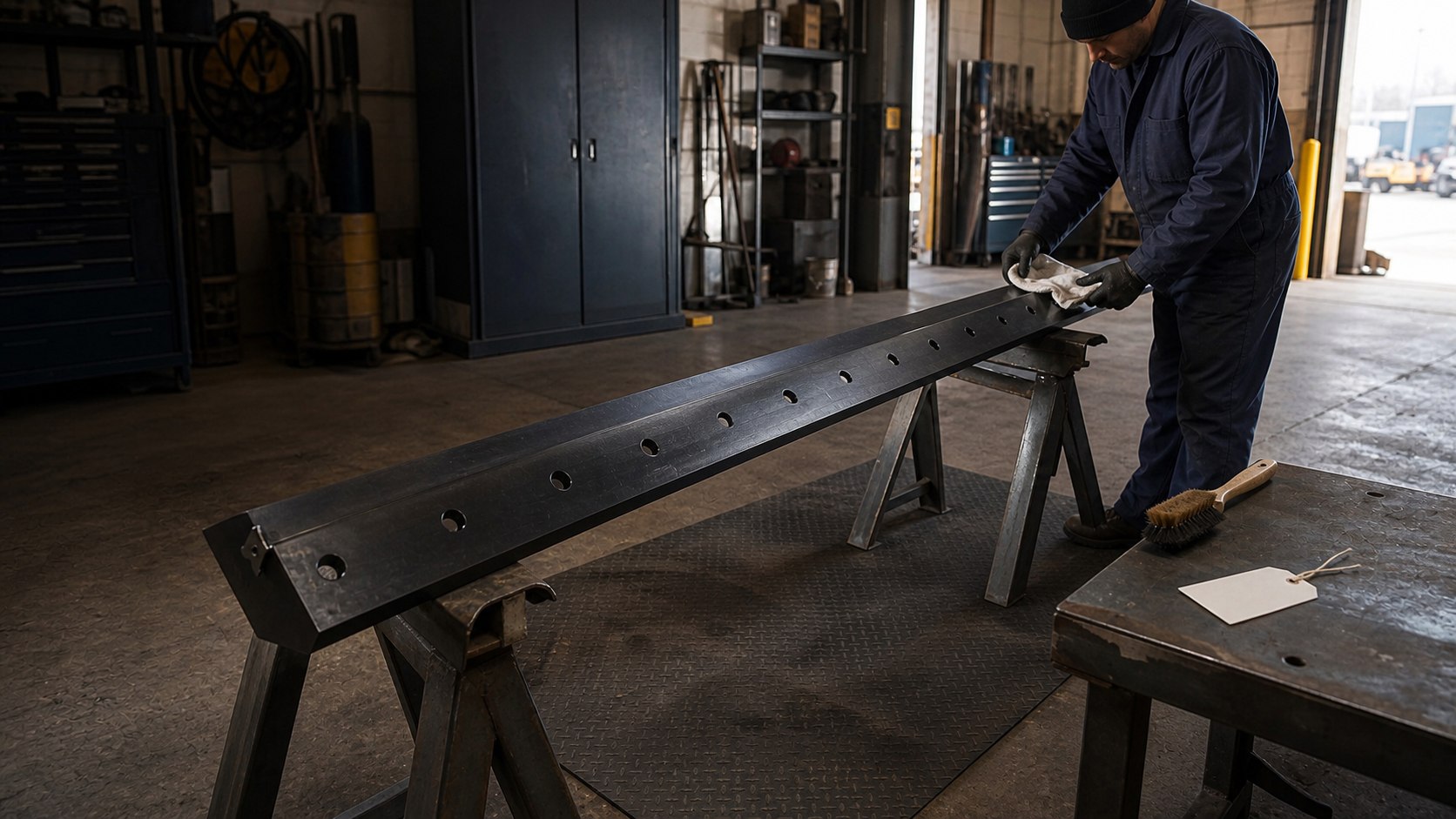
Salt and grit left on an edge over summer is what corrodes it. Wash, dry and inspect first, then protect.
Pressure washing removes the salt that drives corrosion, but it will not remove damage that is already there. Inspect the edge while it is clean and dry, and record what needs attention before the season rather than discovering it in November.
A thin film of oil or a suitable protective coating on the exposed steel slows corrosion at the edges where it starts. Keep it off the rubber components, and never leave a blade sitting directly on a damp floor.
Off the floor, out of direct sun, and without weight resting on the carbide. Those three rules prevent most storage damage.
Racks keep edges off the floor and make them inspectable. Where racking is not available, stack on timber with the carbide clear of contact and never load another blade onto the cutting face.
Ultraviolet light hardens rubber and degrades rubber-to-metal bonds over a summer. Storing rubber-encased edges under cover, rather than in an open yard, preserves the flexibility that the design depends on.
Yes. Damp floors, direct sunlight and weight on the carbide are the three causes of most off-season damage, and all three are avoidable at no cost.
A light film on the exposed steel slows corrosion at the edges. Keep it off rubber and bond lines, and do not use a coating that attracts grit.
Under cover is much better. UV degrades rubber and the rubber-to-metal bond, and an edge stored in an open yard can lose the flexibility the design relies on.
Identically to fitted ones, labelled with specification and quantity, so that a mid-season replacement can be picked without measuring anything.
Assess the carrier for refurbishment before discarding it. If the carrier is sound, re-tipping is usually cheaper than a new blade.
What to check before and after storage.
Refurbishing versus replacing worn edges.
Turning storage into a fleet standard.
Corrosion-resistant edges for coastal fleets.
Tell us what you have and where it is stored, and we will say what will shorten its life over summer.
✓ Edge type and specification
✓ Storage location and conditions
✓ Fleet size and spares held
✓ Coastal or road-salt exposure
Email: [email protected]