




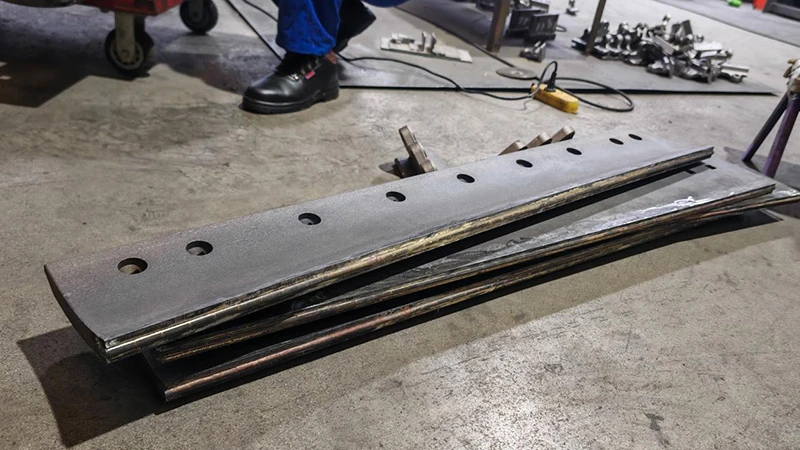
Rubber-encased edges absorb vibration. Ceramic and cladding trade toughness for abrasion resistance. Hybrid edges combine materials to solve two problems in one blade.
Flexible edges hold contact on crowned and broken surfaces, cut noise, and stop the blade marking decorative concrete and driveway seal. They give up some wear life, and on heavy ice they need a harder element embedded in them to bite.
Hardfacing and cladding put a wear-resistant layer on a steel body, raising abrasion resistance at a cost well below solid carbide. Ceramic elements push abrasion resistance further while staying brittle, so they suit steady surfaces rather than obstacle-heavy routes.
If the constraint is noise, choose for noise. If it is surface marking, choose for compliance. Only choose for wear when wear is the actual problem.
Night-time residential routes, hospital zones and downtown cores increasingly constrain how much noise a plow may make and how much surface it may scuff. Rubber-encased and hybrid edges exist largely because of those constraints.
Hybrid edges embed a hard cutting element in a compliant body. They solve the marking problem and the wear problem at once, at the cost of a more complex blade to inspect and repair. Section-level replacement becomes the maintenance model.
It is less wear-resistant, and that is deliberate. It is chosen where the constraint is noise, surface protection or keeping contact on uneven roads rather than maximum edge life.
Yes, they are brittle. They suit steady, abrasive surfaces and are a poor fit for routes with repeated curb and manhole strikes.
Usually a hard cutting element — carbide or ceramic — embedded in a compliant rubber or polyurethane body, so the blade cuts hard and flexes over obstacles.
Yes, and it is often correct. Standardise the mounting pattern and match the edge material to the route class.
Compare on the constraint that matters: complaints per season, surface repair cost, noise compliance, or the number of passes needed to clear the route.
The baseline comparison before adding other materials.
The rubber-encased carbide family in detail.
The three-stage selection method.
Noise, surface marking, wear or ice — name the problem and we will point at the construction that solves it.
✓ The constraint you are solving
✓ Surface type and sensitivity
✓ Route type, speed and noise limits
✓ Machine and quantity
Email: [email protected]