




Carbide Snow Plow Blades Explained: Construction, Materials, and Longevity
A carbide snow plow blade is a cutting edge that pairs a steel carrier with tungsten carbide, the material that does the actual scraping. The steel provides structure and mounting; the carbide provides a…

A carbide snow plow blade is a cutting edge that pairs a steel carrier with tungsten carbide, the material that does the actual scraping. The steel provides structure and mounting; the carbide provides a working edge that holds its shape far longer than plain steel. That combination is why carbide blades dominate heavy winter maintenance: fewer changeouts, less downtime, and a lower cost per mile for fleets that run them where the duty justifies the investment.
This article is the reference guide to the product family: what makes a blade carbide, the two ways carbide meets steel, the materials involved, and the logic behind the long service-life claims. Other articles in the series go deeper into installation, cost, and maintenance; this one explains the construction.
What makes a blade carbide
The word “carbide” in a snow plow blade refers to tungsten carbide, a cemented composite of tungsten carbide grains bonded by a metallic binder, usually cobalt. The material is extremely hard, which is what gives the blade its wear resistance, and its toughness is controlled by grain size, binder content, and the manufacturing process.
That is why not all carbide blades are equal. Two blades can look identical and perform differently because the carbide grade, the grain structure, the bonding, and the brazing quality differ. The specification, not the label, is what defines the product.
SENTHAI, a Thailand-based manufacturer, describes its blades as built from micro-grain tungsten carbide on a premium steel carrier. Micro-grain carbide offers a balance of hardness and toughness that suits the impact-heavy, abrasive duty of snow plowing, which is the construction the product line is built around.
What are the two ways carbide meets steel?
Carbide can be attached to a steel blade in two main configurations:
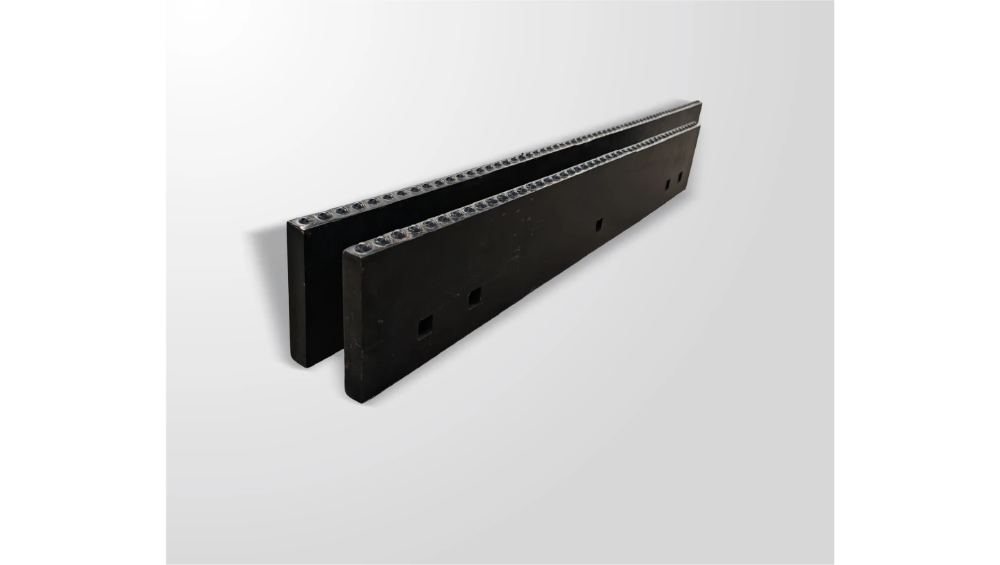
Brazed inserts. Carbide pieces are brazed into milled grooves or slots in the steel carrier, creating a row of individual cutting teeth. This is the most common construction for heavy-duty blades, and it allows the carbide to be concentrated where the edge works hardest. SENTHAI describes its standard blade as a flat, 3/4-inch-thick steel body with a carbide insert brazed onto the face, with other configurations available.
Surface overlay or cladding. Carbide particles or a carbide layer are applied over the working surface, extending wear life across the full edge. This configuration suits applications where continuous carbide coverage matters more than discrete teeth.
| Configuration | How it works | Where it fits |
|---|---|---|
| Brazed inserts | Carbide pieces brazed into milled grooves or slots in the steel carrier, creating a row of individual teeth | Concentrated cutting edge with insert-level replacement |
| Surface overlay or cladding | Carbide particles or a carbide layer applied over the working surface | Extended wear coverage across the edge |
The choice between them depends on the application. Brazed inserts concentrate the cutting edge and allow for insert-level replacement programs; cladding provides continuous coverage and is often used where the full edge benefits from carbide protection.
Materials: micro-grain carbide and C45 steel
The two materials in a carbide blade do different jobs, and both have to be specified.
The carbide side is defined by grain size, binder content, hardness, and the balance with toughness. SENTHAI describes using micro-grain tungsten carbide, which supports the combination of wear resistance and impact strength that winter duty demands. The manufacturing process, including sintering, controls whether those properties are consistent.
The steel side is the carrier, and SENTHAI states that its blades use premium C45 steel. The carrier has to hold the carbide, transfer the plow’s downward force to the road, and survive the mounting and impact loads without deforming. The steel specification matters as much as the carbide, because a carrier that flexes or wears unevenly undermines the whole edge.
The pair works as a system: carbide provides the wear surface, steel provides the structure. A blade that is all carbide would be too brittle and too expensive; a blade that is all steel wears out quickly. The combination is the point.
The materials story also explains why the specification sheet matters. The carbide grade, the grain size, and the binder content are the inputs that decide how the blade balances wear resistance against impact toughness. A grade that is extremely hard will resist abrasion but chip on impact; a tougher grade will survive impacts but wear faster on abrasive routes. The same steel carrier can carry very different carbide, which is why buyers should ask what is actually in the blade, not just whether it says carbide on the box.
Why does carbide last 10 to 20 times longer?
SENTHAI states that its carbide blades deliver a service life 10 to 20 times longer than traditional carbon steel edges. The claim is directional and worth understanding before it is used in a budget: the multiplier comes from comparing carbide’s abrasion resistance with steel’s rapid wear under abrasive winter conditions.
The mechanism is hardness. Carbide resists the micro-cutting action of sand, grit, ice crystals, and pavement contact that wears steel edges down quickly. In abrasive conditions, a steel edge loses its profile fast, while carbide holds its cutting edge through the season. That is why the comparison favors carbide most on abrasive routes and least on light-duty applications where steel already lasts.
The multiplier is not a guarantee. Real life depends on route, speed, down-pressure, abrasives, temperature, and installation quality, which is why the responsible approach is to treat the claim as a planning hypothesis and validate it on the fleet’s own routes. The direction, longer service life, is what matters for the specification.
The comparison also depends on what “steel” means. A high-carbon steel edge in light duty can last reasonably well, while the same edge on an abrasive highway wears quickly, and the multiplier against carbide changes with the baseline. That is why the 10 to 20 times figure is a stated comparison, not a universal constant, and why route-level changeout data beats a brochure number in any budget discussion.
Standard sizes and custom options
Carbide snow plow blades come in standard lengths, thicknesses, and hole patterns, with customization available for fleets and OEMs. SENTHAI describes its standard blade as a flat, 3/4-inch-thick steel body with a brazed carbide insert, supplied in a range of standard sizes with custom options on request.
The mounting pattern matters as much as the dimensions. SENTHAI states that its blades are manufactured with bolt holes that comply with AASHTO (North America) or DIN (Europe) standards, which is what makes the blade a drop-in part for matched plows. For custom work, the drawing defines the length, profile, hole pattern, and carbide configuration.
The specification checklist for any carbide blade order: length and thickness, carbide configuration (insert or overlay), steel carrier, hole pattern and hardware, and the application the blade will serve. Confirming those fields before production prevents most fit and performance problems.
Start with the right construction
The construction of the blade should follow the route, not the catalog. High-abrasion, high-hour routes favor carbide blades with brazed inserts on a solid carrier; mixed routes may need a different configuration or a segmented alternative. The carbide snow plow blade page describes the standard construction, and the snow plow product range shows where it fits alongside JOMA-style, packed ice, and insert products.
To specify a blade for your equipment, send the plow model, drawing or sample, and route information through the contact page and ask for a drawing-based confirmation. The right construction, confirmed against the machine and the duty, is the foundation of every later maintenance and cost decision.
Expert view — SENTHAI engineering team: “The carbide cuts and the steel carries, and the specification names both. The construction is the blade’s contract.”
Frequently Asked Questions
What makes a snow plow blade carbide? A carbide blade pairs a steel carrier with tungsten carbide, which does the scraping. The carbide is attached as brazed inserts or a surface overlay, and its hardness is what extends service life.
What is the difference between brazed inserts and cladding? Brazed inserts are carbide pieces brazed into grooves in the steel, concentrating the cutting edge at discrete teeth. Cladding applies carbide over the surface for continuous coverage. The choice depends on the application.
Why does the steel carrier matter? The carrier provides structure, mounting, and force transfer. SENTHAI describes premium C45 steel as the carrier material, and its condition determines whether the carbide edge works as designed.
Is the 10 to 20 times longer life claim a guarantee? No. It is SENTHAI’s stated comparison with steel in abrasive conditions, and real life depends on route, speed, abrasives, temperature, and installation. Treat it as a planning hypothesis and validate with fleet data.
What sizes and patterns are available? SENTHAI supplies standard sizes with AASHTO or DIN hole patterns and offers custom lengths, profiles, and carbide configurations from drawings or samples.
How do I choose between carbide and a segmented blade? Match the construction to the route: rigid carbide for long, straight, abrasive runs, segmented systems for uneven and impact-heavy surfaces. A balanced fleet often carries both.
What should I send for a specification confirmation? The plow model, current blade drawing or sample, hole pattern, route information, and target quantity. A drawing-based confirmation prevents most fit problems.
Can the same carbide blade serve both winter and summer duty? Only if the duty is confirmed. A blade specified for abrasive winter scraping may not match the impact profile of summer grading work, so the specification should name the season and the surface it is built for.
Sources
Related articles
 Plow Skid Shoes vs Plow Feet: What They Do and How to Set ThemCore Topics
 What Is a Packed Ice Carbide Kit? The I.C.E. Blade System ExplainedCore TopicsCost-per-Mile for Plow Blades: A KPI Buyers Can Actually UseCore Topics
 Why Carbide Blades Crack in Deep Cold: Stress Relief, Brazing, and HandlingCore Topics