




Plow Skid Shoes vs Plow Feet: What They Do and How to Set Them
Plow skid shoes and plow feet are one depth-control part under two names. What each protects, which material fits which surface, and how to set height.
A blade that scrapes asphalt clean will tear a gravel lot apart, and the setting that protects the gravel leaves hard-pack behind on pavement. The part that decides which of those outcomes you get is small, inexpensive, and named differently in almost every catalogue you open: plow skid shoes, plow shoes, plow feet, or plowshoe. Getting the terminology and the height setting straight is what keeps a cutting edge scraping where it should scrape and gliding where it should not.
Are plow feet and skid shoes the same part?
In most catalogues, they are one part with two names.
Suppliers label the same depth-control item a plow skid shoe, plow shoe, plowshoe or plow foot; what differs is the mount and the pad, not the word on the invoice.
The confusion costs money in two places. A purchase order that names only the term sends the supplier guessing at mounting layout, stem height and hole spacing, and a guessed part arrives with the wrong bolt pattern. On the machine, an operator who treats feet and shoes as separate components can adjust one part while assuming the other is controlling depth, which is how a blade ends up either polishing the surface or gouging it.
| Term on a quotation | What it normally means | What to record before ordering |
|---|---|---|
| Skid shoe | The depth-control assembly, pad plus stem or bracket | Pad length and width, stem height, hole spacing and hole diameter |
| Plow shoe | The same item, historically the heavier-duty wording | Same measurements; note whether the pad is replaceable or welded |
| Plowshoe | Single-word catalogue spelling of the same item | Same measurements; confirm the mounting side |
| Plow foot / adjustable foot | Usually the stem-and-pad version with an adjuster | Adjustment range, thread or slot type, locking hardware |
| Weld-on shoe | Shoe supplied with a weldable base plate instead of bolt holes | Base plate thickness, base material, weld procedure |
| Polymer pad shoe | Low-friction pad for paved surfaces | Pad material, fastener countersink, pad thickness |
Once the model, the mounting type and the measurements are on the enquiry, the wording stops mattering. Where bolt patterns are specified to a published standard rather than to a single OEM, the AASHTO and DIN patterns are the ones most municipal fleets name in their tenders, which is why quoting against a drawing beats quoting against a term.
What skid shoes protect
A skid shoe does two jobs at once, and the second is easy to overlook. The familiar job is protecting the surface: the shoe carries part of the blade’s weight so the cutting edge rides at a controlled depth instead of being pressed into whatever is underneath. The overlooked job is protecting the edge itself, because abrasion and impact absorbed by the shoe never reach the cutting edge, the trip mechanism or the moldboard.
What the surface needs differs by material. Asphalt wants protection for joints, patches, sealcoat edges and raised aggregate, all of which a steel edge catches easily. Concrete wants protection for cracked slabs and expansion joints, which behave like a blade trap. Gravel and unpaved surfaces need float rather than scrape, because a blade that cuts to a fixed depth simply ploughs the surface into windrows. Hard-packed ice is the exception in the other direction: there, the operator often wants the edge lower and the shoes doing less work, because a film of hard-pack refreezes into a hazard.
Every millimetre the shoes lift the edge leaves a residue that traffic compacts. That is the trade-off the setting encodes, and it is the reason two operators with identical plows on identical streets can report completely different results. The general case for running shoes at all, and the ways they change blade behaviour, is covered in SENTHAI’s guide to what plow shoes are and why they matter, so this page stays with the terminology and the settings.
What plow feet adjust
A plow foot changes depth, and depth is the whole argument. The adjuster moves the pad vertically relative to the cutting edge, so turning it changes the gap the edge is allowed to drop through. Most designs use a threaded stem with a locking nut; lighter blades use a slotted stem with a pin and a set of positions. Small increments matter, because the useful working range on a paved route is narrow.
Where the feet sit tells you what the designer expected. On truck-mounted plows they normally mount near the outer ends of the moldboard, where they control the blade’s attitude as well as its depth. On compact tractors, UTVs and some utility blades, feet are commonly spring-mounted or caster-mounted so that a hidden curb or frost heave compresses the spring instead of stopping the machine. On underbody and wing setups, depth control may sit behind the edge and share the job with a wear strip.
Three things change when the setting changes: how much snow remains after the pass, whether the edge marks the surface, and how much shock travels into the cutting edge and trip hardware. Operators who set feet high and never revisit the setting trade surface protection for residue and, on ice, for extra salt. Setting up the adjustment sequence itself is operator work that the industry’s training resources treat as basic winter maintenance practice, a topic the Snow and Ice Management Association covers for commercial contractors.
Which material should a plow skid shoe use?
Match the pad to the surface you plow, not to the price of the part.
Steel pads suit gravel and rough ground, polymer pads cut drag and marking on pavement, and carbide-faced pads resist abrasion longest on high-wear routes.
Material choice is a trade between friction, wear life and what the pad does to the surface it touches. A plain steel pad is the default on gravel, farm lanes and construction sites because it is tough, cheap to replace and indifferent to grit. A polymer or ultra-high-molecular-weight pad glides on pavement, which matters when a small machine is pushing a wide blade and every kilogram of drag counts, but the same pad wears quickly on abrasive ground. A carbide-faced pad sits at the other end: it holds its shape where ordinary shoes are consumed by grit and ice, which is the same wear problem SENTHAI addresses with micro-grain carbide inserts and custom wear parts produced on its own brazing line.
| Pad material | Best fit | Trade-off to accept |
|---|---|---|
| Carbon steel | Gravel, unpaved lanes, construction sites | Wears fastest on pavement; inexpensive to replace |
| Hardened or abrasion-resistant steel | Mixed routes with grit and grit-salt mixtures | Harder pad may mark softer surfaces |
| Polymer or UHMW | Asphalt and concrete where drag and marking matter | Low tolerance for sharp aggregate and rough shoulders |
| Carbide-faced pad | High-mileage routes, ice and grit abrasion | Highest part cost; justified by replacement frequency |
| Weld-on base plate | Worn or cracked original mounts | Permanent attachment; replacement means cutting and re-welding |
Comparing materials by hardness alone is unreliable, because wear depends on the grit, the pressure and the sliding speed as much as on the pad. The standard way to compare abrasion resistance is a controlled laboratory method such as ASTM G65, the dry sand and rubber wheel abrasion test, which is why suppliers who publish abrasion data are easier to compare than suppliers who publish only a hardness figure.
How high should plow skid shoes be set?
Just high enough to keep the edge clear of the surface.
Set the edge just off the surface, then lower the shoes until it scrapes cleanly without catching joints, cracks or raised aggregate on a test strip.
The practical method is to set the shoes, then plow a short stretch of the worst surface on the route and look at the result rather than the adjuster. A clean scrape with no gouge marks and no chatter is correct. Marks on the pavement, a shudder through the machine, or an obviously stripped joint means the edge is working lower than the surface allows. A uniform white film that traffic turns to ice means the shoes are too high.
| Surface | What the setting protects | Starting intent |
|---|---|---|
| Asphalt | Joints, patches, sealcoat edges, raised aggregate | Edge just clear; expect a thin film on coarse surfaces |
| Concrete | Cracked slabs and expansion joints | Slightly more clearance than asphalt; joints catch an edge |
| Hard-packed ice | Nothing on the surface; the priority is removal | Lower setting with a carbide edge, accepting more edge load |
| Gravel and unpaved | The surface itself, plus the blade | Highest practical setting; float rather than cut |
| Pavers and brick | Loose units and joint sand | Maximum protection, polymer pads, edge well clear |
Whatever the route, record the setting you settle on. Measured gap, adjuster position and pad thickness written down at the start of the season turn the next setup into a repeat rather than an experiment. Research programmes such as Clear Roads, the pooled winter maintenance research programme run by state departments of transportation, exist precisely because blade and surface behaviour varies enough between routes that documented local settings outperform general advice.
Bolt-on versus weld-on mounting
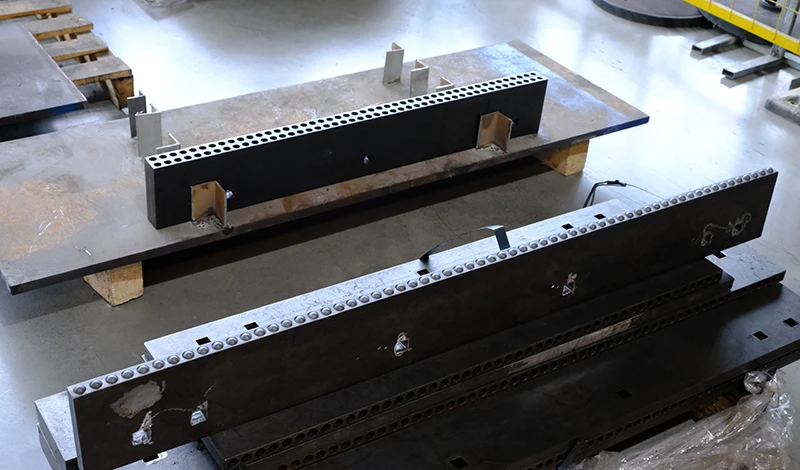
Mounting style decides how the shoe is replaced, and it is usually settled by the condition of the blade rather than by preference. Bolt-on shoes use the original mount: two or more fasteners through the moldboard or a dedicated bracket, with the pad hanging below the edge. Weld-on shoes replace the mount itself, with a base plate welded to the blade structure and the pad attached to that plate.
- Choose bolt-on when the original mount is intact and the fleet rotates blades between trucks, because the shoe comes off with hand tools and no hot work.
- Choose bolt-on when the same blade must run different shoes for different routes, for example carbide for ice routes and polymer for paver work.
- Choose weld-on when the mount is cracked, missing or has oval holes that no longer hold a fastener at the correct height.
- Choose weld-on when the profile has to stay low and the design has no room for a bolted bracket.
- Plan around the weld where the base is hardened steel, because local heating alters the properties of the parent metal and distortion can pull the plate out of alignment.
Whichever route you take, the hardware is part of the assembly, not an afterthought. Incomplete fastener sets are a documented cause of premature shoe loss, which is why the shop-prep approach in SENTHAI’s guide to complete plow shoe replacement kits treats the fastener system as a specified component with its own torque requirement.
Wear patterns that reveal a setup problem
The wear face of a shoe is a record of how the blade has been working, and reading it is faster than working backwards from surface damage. Before replacing pads, look at both shoes together and compare the wear faces. Most setup problems announce themselves in one of five patterns.
| Pattern on the pad | What it usually means | First action |
|---|---|---|
| Even taper from front to back | Blade pitch is steep enough that the leading edge takes load first | Correct pitch or down-pressure before raising the shoes |
| Wear concentrated on one side of the machine | Blade not level, or one mount carrying the weight | Inspect hangers, pivots and pins on that side |
| Pad worn through to the fastener | The shoe has become the scraping surface | Raise the setting and replace both pads |
| Elongated or oval bolt holes | Loose hardware moving under load | Replace fasteners and check hole condition |
| Polished, rounded pad with little material loss | Low-friction pad gliding, often with too much lift on gravel | Lower the setting on paved routes, keep it on gravel |
Two habits make this diagnosis useful rather than academic: inspect both shoes at the same time, and write down the adjuster position when new pads go on. A fleet that records settings can see whether a route change or a driver change caused a wear change, instead of replacing shoes on a schedule that never matched the route.
Why does the cutting edge still gouge pavement?
The edge is sitting below the plane the shoes control.
Gouging usually means the shoes are set too high to hold the edge off the surface, the pads have worn through, or one corner is carrying the load while the other digs in.
Work through the causes in the order that costs least time. Check that both pads still have material and are not riding on a fastener. Check that both ends of the blade are set to the same height, because a blade that is level end to end behaves very differently from one set by eye. Check the mounts for a bent bracket or an elongated hole, which lets the shoe move up under load. Then check pitch, because a blade pitched too steeply presents the edge first and will mark pavement no matter where the shoes sit.
Some gouging is not a setup fault at all. Crowned roads, frost heave, a raised manhole cover or a driveway apron built above the road surface can all put the edge into contact on a setting that works everywhere else. That is the case for adjusting by route rather than setting once in October, and it is why operator training material from the National Local Technical Assistance Program Association and state maintenance programmes such as MnDOT maintenance guidance treat blade adjustment as a per-route skill. The Federal Highway Administration road weather FAQ is a useful reference for how those surface and weather decisions are framed at agency level.
Selection table by surface and plow type
Use the table below as a starting point, then confirm it against the route. The two columns that decide most outcomes are the mounting type and the surface the machine spends most of its miles on, because those two together determine whether the shoe exists to protect the surface or to protect the blade.
| Machine and blade type | Typical mounting | Setting priority |
|---|---|---|
| Truck-mounted straight plow, municipal or contractor | Bolt-on shoes at the outer ends of the moldboard | Surface protection on mixed routes; check both ends for equal height |
| V-plow | Bolt-on shoes at the outer wings | Keep the wings clear of curbs and joints in the scoop position |
| Wing or underbody scraper | Depth control may be a shoe or a wear strip behind the edge | Protect the surface behind the mouldboard; expect higher edge load |
| UTV or ATV blade | Bolt-on or spring-mounted feet | Drag control first; a small machine cannot afford a heavily loaded edge |
| Compact tractor blade | Bolt-on, spring or caster-mounted feet | Absorb hidden obstacles; float on gravel, protect on pavement |
| Loader or back-drag blade | Bolt-on shoes or replaceable wear strips | Protection in reverse, where the machine loads the blade differently |
The conclusion is narrow enough to carry in a parts book. Skid shoes and plow feet are the same component in most catalogues, so order by model, mount and measurement rather than by name. Pick the pad material from the surface, set height by testing on the worst surface on the route, and read the wear faces at every service before something expensive fails underneath. Record the setting each time, because the number that worked last season is the cheapest piece of maintenance data a fleet owns.
A route-by-route shoe plan is usually two or three pad types, a defined setting for each surface, and a recording habit at service time. SENTHAI manufactures carbide wear parts and snow plow blades in Rayong, Thailand, with an in-house chain that runs from powder metallurgy and robotic pressing to automated induction brazing, and quotes depth-control and wear-part requirements against a supplied measurement or drawing.
FAQ
Do I need plow shoes or feet if I only plow my own paved lot?
Yes, if the lot has expansion joints, patched slabs, sealcoat, speed bumps or drainage grates. A bare edge scrapes marginally cleaner but transfers every bump straight into the cutting edge, the mount and the trip hardware. Shoes with polymer pads are the usual compromise on private pavement because they protect the surface while keeping drag low enough for a half-ton truck or a UTV to push a full-width blade.
Can a snow plow run without skid shoes at all?
It can, and some operations do it deliberately. Running edge-only suits smooth, sound asphalt where clean scrape matters more than surface protection, and it removes a part that needs setting and replacing. The cost appears later as edge wear, gouged joints and damaged driveway aprons. Deciding by route rather than by habit is the practical rule: edge-only on sound pavement, shoes on everything mixed, cracked or unpaved.
Why do plow shoes wear faster on one side than the other?
Uneven pad wear usually tracks back to the machine rather than to the shoes. A blade that is not level, a bent or loose hanger on one side, worn pivot pins, or a route that is predominantly crowned will all load one shoe harder. Both shoes on a correctly hung blade should wear at a similar rate. If they do not, measure the gap at each end and inspect the mounting hardware before ordering replacement pads.
How often should plow skid shoes be checked during a season?
Check them at the start of the season, after the first heavy storm, and then at each fuel or maintenance interval. Wear accelerates once a pad starts riding on a fastener instead of a face, and that stage damages the blade as well as the shoe. Recording the adjuster setting and pad thickness at each check turns replacement into a planned parts order instead of a mid-storm improvisation.
Send SENTHAI your plow model, mounting type, hole pattern and route surfaces for fitment validation and a quotation on depth-control and wear parts. Measurements can be checked against AASHTO and DIN bolt patterns and held to a dimensional tolerance of plus or minus 0.02 mm. Write to [email protected] or use the contact form to start a specification review.
Related articles
 Best Snow Plow Blade Family for Your Fleet: Top 5 ScenariosKnowledge
 Top 10 Snow Plow Blade Types for Winter Fleets (Ranked by Duty Fit)Knowledge
 Top 5 Best Carbide Blade Configurations for Highway PlowingKnowledge
 Best Snow Plow Blade Materials Ranked: Steel vs Carbide vs Cladding vs Rubber-CarbideKnowledge