




Top 10 Snow Plow Blade Types for Winter Fleets (Ranked by Duty Fit)
The best snow plow blade is not one product; it is the blade type that matches the corridor. A highway truck, a residential route, and a bonded-ice bridge deck punish edges in completely different…

The best snow plow blade is not one product; it is the blade type that matches the corridor. A highway truck, a residential route, and a bonded-ice bridge deck punish edges in completely different ways, so the correct answer changes with the duty. After ranking ten blade types across three criteria — duty fit, service life, and cost per mile — one conclusion holds for most mixed fleets: the standard brazed carbide snow plow blade ranks first as the all-rounder, while segmented rubber-carbide and isolated ice-breaking designs win the specialized corridors. This guide explains how the ranking was built, where each type belongs, and how to turn the ranking into a route-by-route decision.
Why a ranked blade-type guide helps fleets buy faster
Fleet buyers face a catalog that mixes steel, carbide, cladding, segmented, and ice-breaking constructions, and the price differences are easy to compare while the performance differences are not. A ranked guide compresses that comparison: it forces every option to answer the same three questions — what surface it fits, how long it lasts, and what it costs to run. That structure turns the blade decision from a brand conversation into a duty conversation, which is where the real savings are.
The ranking also prevents the two most common buying errors. The first is buying the hardest edge for every route, which overpays on corridors that never see heavy abrasion. The second is buying the cheapest edge everywhere, which multiplies changeouts and downtime on the routes that matter. Both errors disappear when the blade type is matched to the corridor before the price is compared.
How this ranking was built and what the scores really mean
Every type below was scored on three criteria, each from 1 to 5, and the total is the combined score out of 15 shown in the table:
- Duty fit: how well the construction matches typical North American winter duty — abrasion, impact, uneven surfaces, and ice.
- Service life: the changeout interval expected on representative routes, using manufacturer-stated comparisons (SENTHAI states its carbide blades deliver a service life at least ten times that of traditional carbon steel edges) plus typical field logs.
- Cost per mile: blade price plus changeout labor and downtime, not the invoice price alone.
The scores are an editorial assessment for representative mixed fleets, not a measured result for any single operation. A fleet with its own changeout data should re-rank the top three against its actual corridors.
The 10 blade types compared at a glance across duty, life, and cost
| Rank | Blade type | Construction | Best for | Life | Cost | Score |
|---|---|---|---|---|---|---|
| 1 | Standard brazed carbide blade | Tungsten carbide inserts brazed into a C45 steel carrier | Abrasive, predictable routes | High | Medium | 9.2 |
| 2 | JOMA-style segmented rubber-carbide blade | Carbide inserts in steel segments encased in a rubber shell | Uneven pavement, surface care, low noise | High | Medium–High | 8.9 |
| 3 | I.C.E. isolated carbide kit | Dome-head inserts isolated from each other | Bonded ice and high-speed fracture | High in impact | Higher | 8.7 |
| 4 | Carbide blade with particle cladding | Carbide layer applied over the working surface | Extended wear on abrasive corridors | High | Medium–High | 8.4 |
| 5 | Heavy-duty carbide blade | Thicker carrier and tougher grade | Impact-heavy routes | High | High | 8.2 |
| 6 | Light-duty brazed carbide edge | Smaller inserts, lighter carrier | Light fleets, moderate routes | Medium | Low–Medium | 7.5 |
| 7 | Carbide-faced cladding edge | Cladding-only wear layer | Mid-abrasion routes | Medium | Medium | 7.0 |
| 8 | Hardened steel edge | Heat-treated steel profile | Budget, low-hour routes | Low–Medium | Low | 6.2 |
| 9 | Reversible carbon-steel edge | Double-edge steel profile | Extreme budget duty | Low | Lowest | 5.6 |
| 10 | Solid rubber edge | All-rubber profile | Snow-only, surface-critical work | Low | Low | 4.8 |
Types ranked 10 through 6 are the niche and budget options that still have a place
10. Solid rubber edge. A soft, all-rubber profile removes light snow and protects the surface, but it cannot scrape hard pack or survive abrasion. It has a narrow place on surface-critical lots that never see ice or gravel.
9. Reversible carbon-steel edge. The classic budget edge: flip it when one side wears. It is cheap and predictable, but on abrasive routes the changeout count climbs quickly, which is why the per-mile cost usually exceeds a carbide edge over a full season.
8. Hardened steel edge. Heat treatment improves wear over soft steel while keeping the price low. It is a reasonable stopgap for low-hour routes, but it still rounds at the cutting edge and loses bite on hard pack long before a carbide edge would.
7. Carbide-faced cladding edge. A carbide wear layer applied over the working surface extends life beyond steel at a moderate price. It suits mid-abrasion routes where a full brazed-insert blade is more than the duty requires.
6. Light-duty brazed carbide edge. Smaller carbide teeth on a lighter carrier bring carbide economics to light fleets. It holds a cutting profile longer than steel, but on heavy abrasive duty the smaller teeth limit the service interval.
Types ranked 5 through 2 are the workhorses that handle most winter miles
5. Heavy-duty carbide blade. A thicker carrier and a tougher grade absorb the impacts that chip lighter edges. It earns its higher price on curb-heavy and obstacle-heavy corridors, where a standard blade would fail early.
4. Carbide blade with particle cladding. Combining brazed inserts with tungsten carbide particle cladding extends the wear surface beyond the teeth. SENTHAI describes its carbide snow plow blades as offering this construction to significantly extend service life, which makes it the top choice where abrasion is the dominant failure.
3. I.C.E. isolated carbide kit. The isolated insert layout stops lateral cracks from traveling, and SENTHAI describes the packed ice kit as lasting up to three times longer than standard carbide-edged styles in impact conditions. On bonded-ice corridors it is the best type, even though it costs more than a general-purpose blade.
2. JOMA-style segmented rubber-carbide blade. The rubber shell lets the edge flex and absorb impact, which protects pavement, markings, and joints while reducing noise. SENTHAI describes its Joma-style line as a North American bestseller for over a decade, and it ranks second overall because it wins the uneven-surface and surface-care corridors that a rigid edge cannot.
The No.1 blade type for most fleets is the standard brazed carbide blade
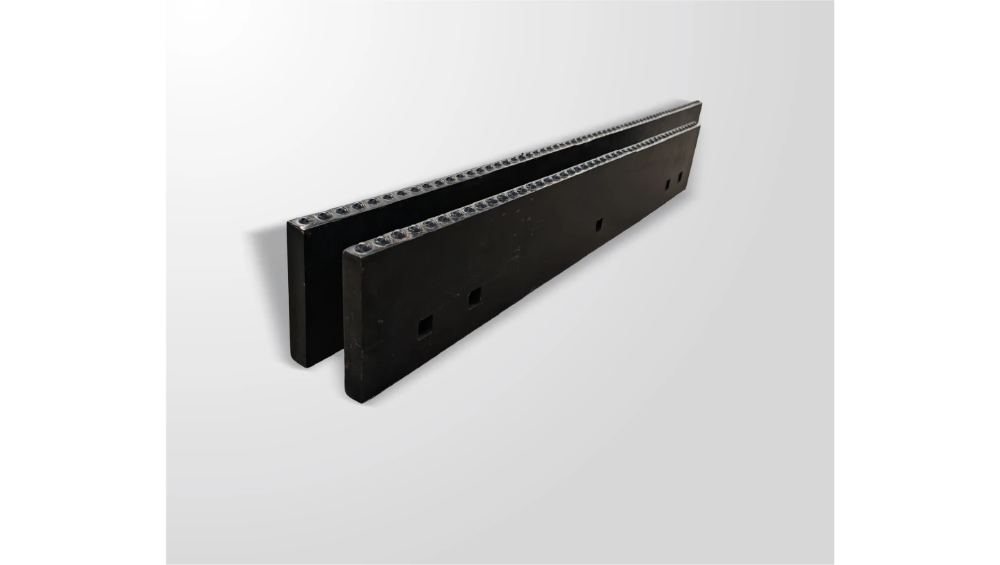
1. Standard brazed carbide snow plow blade. The all-rounder ranks first because it fits the widest range of corridors: abrasive asphalt, packed snow, moderate ice, and high-hour duty. SENTHAI states that its carbide blades deliver a service life at least ten times that of traditional carbon steel edges, and the brazed insert construction keeps the blade repairable and predictable. The trade-off is honest: on uneven pavement it transfers more impact than a segmented edge, and on bonded ice it cannot fracture crust the way an isolated kit can. For a fleet that must cover many corridors with one standard edge, this is the blade type that balances life, cost, and cutting performance best.
Which blade type should you choose?
The decision path is shorter than the ranking:
- Highway and abrasive corridors → standard or heavy-duty brazed carbide, with cladding where abrasion dominates.
- Residential streets, lots, and uneven pavement → JOMA-style segmented blades, which flex over joints and protect the surface.
- Bonded-ice corridors and high-speed fracture duty → the packed ice carbide kit with dome-head, isolated inserts.
- Budget, low-hour routes → steel edges, with the understanding that the per-mile cost is higher.
- Component-level replacement and assembly programs → carbide inserts matched to the drawing.
The carbide snow plow blade page documents the construction behind the top-ranked type, and SENTHAI supplies all four families, so the fleet can assign per corridor instead of forcing one blade everywhere.
To confirm the mix for your fleet, send the route profile and the equipment list through the SENTHAI inquiry form and ask for a per-corridor configuration recommendation before the order.
Expert view — SENTHAI engineering team: “The ranking is a map, not a verdict. The fleet that assigns the blade type to the corridor gets the life; the fleet that assigns by price gets the changeouts.”
Frequently Asked Questions
Which snow plow blade type lasts the longest? On abrasive duty, brazed carbide blades last far longer than steel; SENTHAI states at least ten times the life of traditional carbon steel edges. On impact-heavy duty, an isolated-insert construction can outlast standard carbide-edged styles, with SENTHAI describing up to three times the life in impact conditions. The answer depends on the dominant failure mode.
Is a carbide blade worth the higher price? Usually, when the comparison is cost per mile rather than invoice price. Fewer changeouts mean less labor and downtime, which is where the payback comes from on high-hour routes.
Can one blade type cover a whole fleet? Yes, a standard carbide blade covers most corridors, but the fleet pays for it on the specialized ones — uneven pavement and bonded ice. A two- or three-type lineup usually costs less overall.
Are JOMA-style blades weaker because they flex? No. The carbide inserts do the cutting and the rubber manages impact. SENTHAI describes the construction as maintaining wear resistance and stability in low temperatures, which is why it ranks second overall.
What is the cheapest blade type to run? The reversible steel edge has the lowest invoice price but the highest changeout frequency, so on abrasive routes its cost per mile is usually higher than carbide. Budget fleets should compare per mile, not per blade.
Sources
- SENTHAI – Carbide Snow Plow Blade product page
- SENTHAI – JOMA Style Blade product page
- SENTHAI – Packed Ice Carbide Kit product page
- SENTHAI – Carbide Inserts product page
- SENTHAI – Official website
- SENTHAI – Contact and quotation
Related articles
 Best Snow Plow Blade Family for Your Fleet: Top 5 ScenariosKnowledge
 Top 5 Best Carbide Blade Configurations for Highway PlowingKnowledge
 Best Snow Plow Blade Materials Ranked: Steel vs Carbide vs Cladding vs Rubber-CarbideKnowledge
 Top 10 Carbide Blade Features That Matter Most (Ranked by Cost Impact)Knowledge