




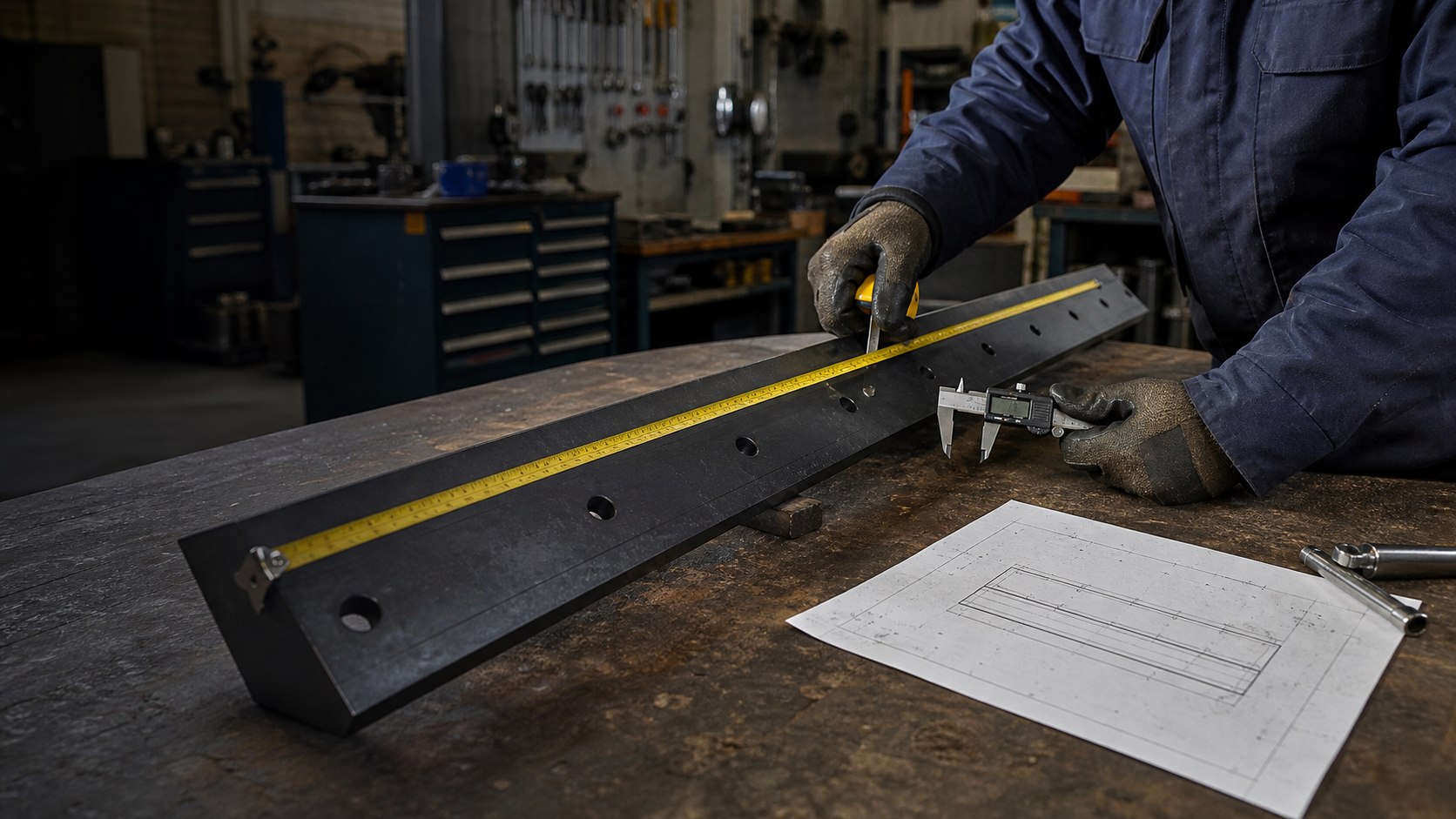
Take length, width, thickness, hole diameter and hole spacing at both ends of the old edge. A worn edge measures differently at each end, and the difference tells you whether the carrier is still straight.
Length that is short leaves uncovered road at the ends. Width that is wrong changes the scraping angle. Thickness decides flex and down-pressure. Hole diameter decides whether the bolts go through. Hole spacing decides whether the blade goes on at all. Fix them in that order of consequence.
An elongated hole or a bent moldboard will make a correctly sized edge fail in weeks. If the old edge came off distorted, or the holes have ovaled, the carrier is part of the requirement and should be repaired or replaced as part of the same job.
Most compatibility problems come from the hole pattern and the mounting arrangement rather than from overall length.
These three cover the majority of North American fleets, and an aftermarket edge for any of them succeeds or fails on hole spacing and thickness. V-plow edges add a centre joint that carries its own share of the impact load, so check the middle section as carefully as the ends.
Compact equipment has far less standardisation, so the machine model matters as much as the blade. Bucket-mounted and quick-attach systems move the load path, which changes both the edge specification and the hardware it needs.
Lay the old edge on the new one, if you have both, and put a bolt through each hole. That single test catches the errors that measurement alone misses.
A photograph of the edge laid flat with a tape measure along it, a second photograph of the mounting area on the plow, and the machine model and year. Engineers can read hole spacing off a photograph when the tape is legible, which avoids shipping a sample across a border.
For a first order with a new supplier, or any custom pattern, one unit or one small batch before the bulk release is the cheapest insurance available. Approve it dimensionally and, where the duty is severe, on a short field trial.
Often yes, if the hole pattern and thickness match and the mounting position allows it. Compatibility is a geometry question; the brand name only tells you which pattern is most likely underneath.
Treat the difference as a carrier problem until proven otherwise. Measure the moldboard and the mounting surface; if the carrier is distorted, no correctly sized edge will stay flat against the road.
No. Dimensions plus a legible photograph usually settle it. A drawing becomes necessary when the part is custom or when the same pattern has to be reproduced across multiple orders.
Compare it against what the plow was designed to carry, then against the down-pressure the machine can apply. Going thicker increases impact resistance and also increases the load the machine has to hold.
Yes, unless you are deliberately changing specification. Mixed spares on the same fleet is the most common cause of a blade that fits one truck and not the next.
Turn the measurements into a document a supplier can be held to.
The bolts, washers and shoes that decide whether fitment holds.
Once it fits, compare what it costs to run.
Give us the five measurements and a photograph of the mount and we will confirm whether a standard edge fits or a custom pattern is required.
✓ Length, width, thickness
✓ Hole diameter and spacing
✓ Plow make, model and year
✓ Photograph of the mounting area
Email: [email protected]