




Underbody Scraper Blade Wear: Setup, Edge Selection, and Full-Width Scraping Problems
An underbody scraper's hardest problem is not the ice — it is keeping the full width of the edge in contact with the road. Mounted under the truck, the scraper presses the machine's weight…
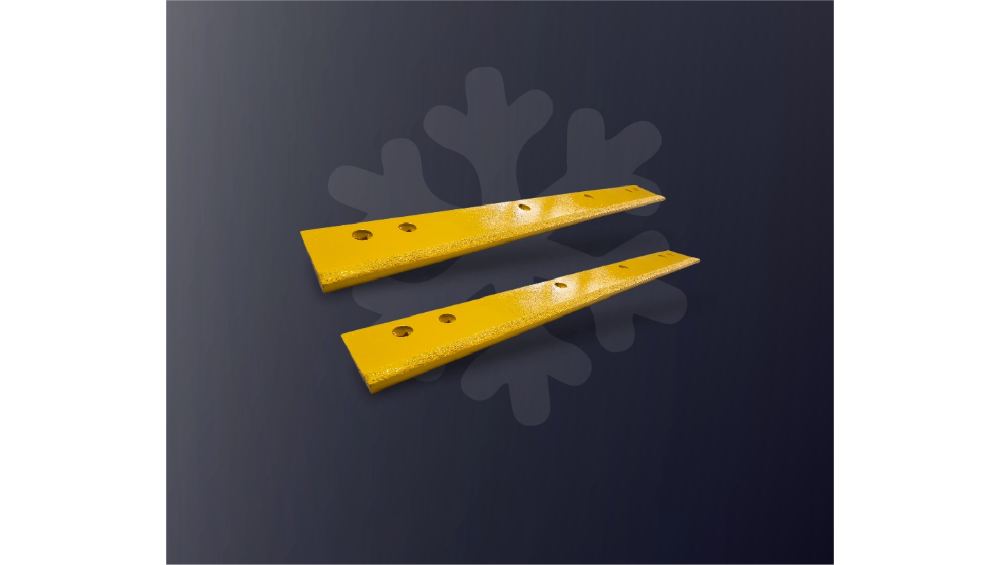
An underbody scraper’s hardest problem is not the ice — it is keeping the full width of the edge in contact with the road. Mounted under the truck, the scraper presses the machine’s weight through the edge while it slides at highway speed, and any unevenness in the mount, the road, or the blade shows up as a wear pattern that tells you exactly what is wrong. This guide is about the underbody-specific mechanics: division of labor with front and wing plows, full-width contact, and how to tell a mounting problem from a material problem.
Underbody vs Front and Wing Plows: Division of Labor
The three plow positions on a highway truck do different jobs:
- Front plow leads, cuts through the snow, and opens the lane
- Wing plow pushes material off the shoulder and manages the road edge
- Underbody scraper runs behind and scrapes the full lane width down to pavement
The underbody scraper is the finishing tool. It carries the highest contact pressure of the three, runs the flattest, and its edge wear is the most uniform — which makes any non-uniform wear a diagnostic signal rather than background noise.
Why Full-Width Contact Is the Hardest Part
The edge must stay flat across the lane as the truck rolls over road crowns, bridge approaches, and settled patches. When contact is uneven, the load concentrates:
- Center wear → the mount or moldboard is bowed, or the road crown concentrates load mid-blade
- End wear → the scraper is angled or the mount is twisted
- Diagonal wear → the mount is out of level side to side
Read the wear map before changing edges. If the pattern shows concentration, a new edge will wear the same way — the fix is leveling the mount, not buying more carbide.
Work Condition → Recommended Setup → Risk
| Work condition | Recommended setup | Primary risk |
|---|---|---|
| Clean interstate, packed ice | Harder carbide grade, flat profile | Chipping on bridge joints |
| Jointed concrete, manholes | Tougher grade or segmented design | Insert loss on impact |
| Gravel shoulders on the route | Tougher grade, thicker carrier | Carrier damage |
| Frequent road crowns | Verify mount level first | Center wear misread as material failure |
| High-speed plowing | Confirm torque and hardware grade | Bolt shear from vibration |
This table replaces a generic carbide-vs-steel argument: on an underbody scraper, the setup and the route decide the risk more than the material family does.
When the Problem Is the Mount, Not the Edge
Before blaming the edge, check the mounting beam, the scraper geometry, and the level:
- Is the mount straight, or is the scraper riding on one corner?
- Are the wear pads and pivot points worn, changing the blade angle?
- Is the full width contacting, or is the center carrying the load?
If the mount is out of level, no grade of carbide fixes the wear pattern. Level the scraper, verify the geometry, and then evaluate the edge.
Bridge Joints, Manholes, and Reflector Pins
Underbody scrapers run over everything a highway has: expansion joints, manhole covers, raised reflectors, and debris. Each is an impact event at speed. Balancing ice-cutting ability against impact survival is the underbody edge-selection tradeoff — tougher grades and segmented designs trade some wear life for the ability to take hits without chipping. Match the choice to the actual obstacle density of your routes, not to a catalog description.
Carbide Grade and Carrier for Underbody Duty
When the mount is sound and the route is abrasive, carbide earns its cost: high contact pressure and continuous sliding are exactly its conditions. The carrier spec matters as much as the grade — a thicker steel backing adds impact margin at highway speed, which is why carrier thickness is a legitimate specification question, not a footnote. Confirm the carrier recommendation against your mount design before ordering.
Maintenance and Validation
Inspect underbody edges after every significant storm: check carbide for chips, bolts for looseness, and the wear map for concentration. Clean the mounting seat at each change, re-torque after first use, and track hours per edge per route group. SENTHAI builds underbody scraper edges and other high-pressure winter cutting edges at its factory in Rayong, Thailand, matching them to customer drawings and duty descriptions; validate the grade and carrier on your routes before fleet-wide adoption.
FAQ
Why does an underbody scraper wear unevenly across its width?
Uneven wear means uneven contact: a bowed mount, an out-of-level scraper, or road crown concentrating load. Read the wear map and level the mount before replacing the edge.
Can a front plow edge be used on an underbody scraper?
No. Underbody scrapers use different mounting, carrier, and profile requirements, and the pressure and speed differ. Use an edge specified for underbody duty.
When is a wear problem actually a mounting problem?
When the wear concentrates in a pattern — center, end, or diagonal — that repeats on new edges. If the same pattern returns after replacement, the mount or geometry is the cause.
Related
- Winter Road Maintenance Wear Parts — the fleet-level parts map
- Underbody Scraper Carbide Blades for Winter Operations
- Why 3/4 Steel Backing Is Critical for High-Speed Underbody Scrapers
- How to Reduce Snow Plow Blade Wear — wear pattern diagnosis and prevention
Sources
Related articles
 Plow Skid Shoes vs Plow Feet: What They Do and How to Set ThemCore Topics
 What Is a Packed Ice Carbide Kit? The I.C.E. Blade System ExplainedCore TopicsCost-per-Mile for Plow Blades: A KPI Buyers Can Actually UseCore Topics
 Why Carbide Blades Crack in Deep Cold: Stress Relief, Brazing, and HandlingCore Topics