
Carbide Grade Selection for Cold and Abrasive Conditions
Carbide grade selection for cold and abrasive winter duty: how hardness, grain size and binder content are matched to a route before a quote is issued.

Grade selection is the point where a wear part programme either becomes technical or stays a commodity purchase. Two inserts with identical dimensions can differ in hardness, grain size and binder content, and those three properties decide whether the edge survives a winter of abrasive snow or chips out in the first hard freeze. Cold weather adds a constraint that warm-weather wear parts do not face: the same impact loads arrive with less tolerance for brittleness.
Which Carbide Grade Selection Points Decide Performance in Cold Conditions
Hardness, grain size and binder content set the balance.
Hardness on the HRA scale sets resistance to abrasion; grain size and binder content set resistance to chipping. Cold conditions change the impact side of that balance, not the abrasion side.
Cold weather does not soften the road, so abrasive load stays high while the material’s tolerance for shock is tested by frozen debris, ice ridges and pavement breaks. A grade specified purely for maximum hardness will hold its geometry well on smooth abrasive surfaces and fail abruptly where the edge meets a hard obstruction. A grade with more toughness gives up some abrasion resistance in exchange for absorbing those loads.
The specification needs to state all three properties in a form a supplier can be measured against: hardness range, grain size, and binder content or the toughness property derived from it. Requests that state only the material leave the balance to whoever fills the order. A structured approach to that conversation is set out in the winter maintenance grade consultation guide, and this article covers the specification points that make the resulting decision enforceable.
How Cold and Abrasive Conditions Change Material Behaviour
Cold raises impact risk without lowering abrasive load.
Low temperatures reduce the toughness margin carbide depends on, so an obstruction that would dent an edge in mild weather can chip it in a hard freeze. Abrasive behaviour stays broadly similar.
That asymmetry is why winter duty is specified differently from general wear duty. On a route where snow is dry and wind-packed, abrasion dominates and a harder grade earns its place. Where the route also carries embedded obstacles, the same grade becomes the weak point, and the failure moves from gradual material loss to fracture. Photographs of returned edges distinguish the two cases more reliably than a description, because the location of loss matters as much as its amount.
Surface temperature and treatment practice interact as well. Where liquid de-icing is applied ahead of a storm, the edge may meet a wet, refrozen surface that loads the contact area differently from dry snow. Where abrasives are spread, the material itself becomes part of the wear environment, and the regulatory context that many agencies plan material use against is set out in the EPA’s municipal stormwater guidance.
Grade, Geometry and Material Choices for Winter Wear Parts
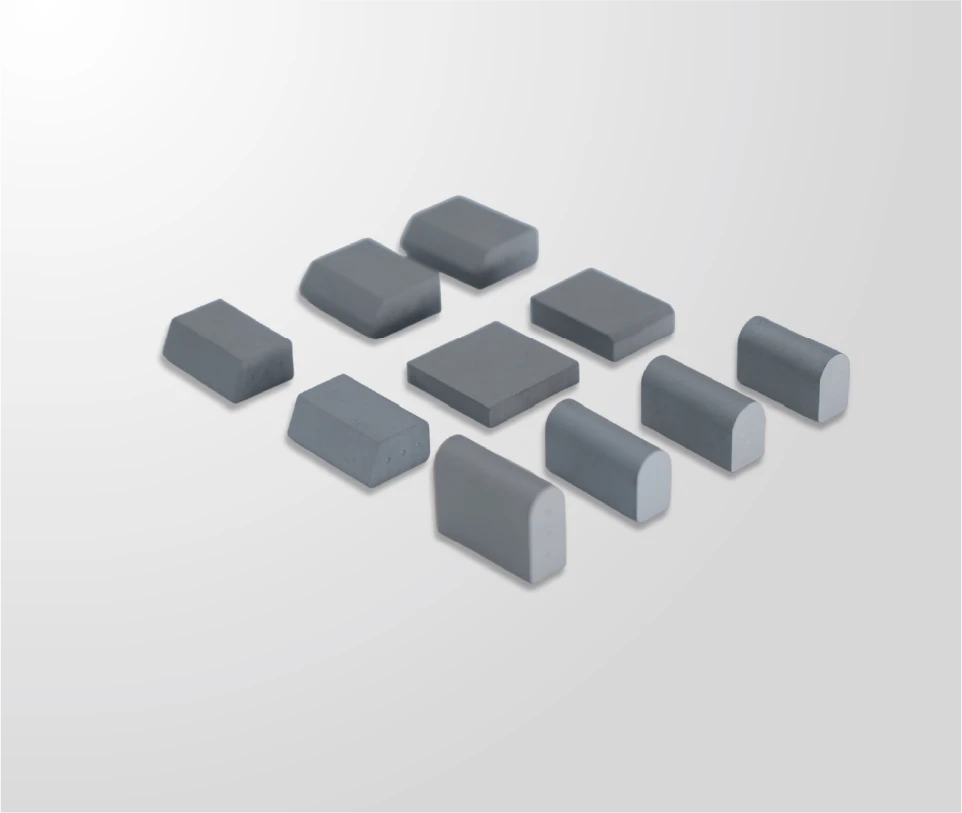
Grade and geometry cannot be specified independently. A trapezoid insert working directionally loads its structure along a defined axis, while a bullnose insert spreads contact over a curved face; the grade that suits one is not automatically right for the other. SENTHAI engineers the hardness and toughness balance using hardness on the HRA scale together with carbide grain size, and supplies micro grain inserts in both trapezoid and bullnose shapes, so the grade is matched to the shape and the route rather than chosen in isolation.
Production control is what makes a grade repeatable. SENTHAI manufactures in Rayong, Thailand, in a US-invested plant using non-China raw materials, with powder preparation, robotic pressing at up to 500 tons, vacuum and low-pressure sintering, automated high-temperature induction brazing and finishing under one roof. Because the powder and pressing stages are controlled in-house, a grade specified for a route can be reproduced in the next order instead of drifting toward whatever is available.
Independent material references are useful when a grade decision has to be explained beyond the maintenance team. ASM International publishes materials engineering resources that help a procurement manager read a grade sheet and understand which property is being traded away.
Fitment and Tolerance Requirements for a Specified Grade
A grade decision is only useful if the part fits. SENTHAI works to plus or minus 0.02 mm dimensional tolerances on carbide components and validates fitment against AASHTO and DIN bolt patterns before release, with AASHTO published standards as the reference for agency specifications and DIN covering European and export conventions.
Tolerance and grade interact in a way that is easy to overlook. An insert that sits correctly in its pocket transfers load evenly into the joint; one that sits proud or at an angle concentrates load on a corner, and the resulting stress can exceed what even a tough grade will absorb. That is why a grade change should be accompanied by a fitment check rather than treated as a material substitution alone.
Where a fleet is standardising across several plow makes, the specification should list each pattern with the grade specified for it. A single grade for a whole fleet is a legitimate outcome, but it should be a decision made against the routes rather than a default imposed by the stores system.
Measuring for that check takes a few minutes per blade. Record the insert seat depth, the condition of the seat surface and the position of each insert relative to the drawing, and compare the result with the tolerance the supplier quoted. Where a seat has deformed, replacing it is cheaper than accepting a grade change on a component that will concentrate load at one corner regardless of how tough the material is. Keeping the measurements with the grade record gives the next order a starting point instead of an estimate.
Evidence to Request With the Grade Quote
Grade claims are verifiable, which makes documentation the fastest way to compare suppliers. Ask for hardness and grain-size data for the grade offered, referenced to a recognised test method such as those published by ASTM, together with the dimensional tolerance held at the insert’s locating features. SENTHAI inspects and archives every batch, so the batch record behind a shipment is available on request.
Two items complete the set. Lot-level traceability should link delivered inserts to their production batch and to the grade actually used, and the supplier should be able to describe how bond integrity is controlled where inserts are supplied fitted to a blade, since brazing carries load from the insert into the blade body. A supplier who can answer both questions in writing is a supplier whose grade claim can be audited.

Common Grade Selection Errors and Their Cost
The most expensive error is specifying hardness alone. A fleet that switches to a harder grade to solve even wear on an abrasive route can introduce chipping on the same route if it also carries embedded debris, and the failure then arrives suddenly rather than gradually. The second is specifying a grade from a previous fleet or a previous machine without checking how route conditions differ, which is a common result of standardising too quickly.
The third error is accepting equivalence without a basis. A tender that permits an equivalent grade without stating hardness range, grain size and test method cannot reject a substitute, because there is no defined property to test. The fourth is failing to record what was supplied. Without a record linking each consignment to a grade, a fleet cannot tell whether a change in performance came from the material, the route or the equipment, and the next specification is written on impression rather than evidence.
Each of these errors shows up in the same place: cost per metre of edge rises while the reason stays unclear. Keeping the returned edges, the grade record and the route conditions together turns grade selection from a recurring argument into a repeatable decision.
A useful discipline is to change one variable per season. Where a fleet alters grade, edge angle and insert spacing at the same time, the season’s outcome cannot be attributed to any of them, and the next specification starts from uncertainty again. One deliberate change, recorded against the routes it ran on, produces evidence that survives staff turnover.
Writing the Grade Requirement Into a Tender
A tender should state the grade as a set of properties: hardness range with the test method, carbide grain size, and the binder or toughness requirement. Add the insert or blade dimensions with tolerances, the pattern the part must fit with its reference standard, and the documentation required with each delivery. Where an equivalent is permitted, define the properties the equivalent must match rather than leaving equivalence to negotiation.
Where the programme is publicly funded, referencing the relevant AASHTO standards and requiring a declaration of conformity keeps offers comparable, and the winter operating context published by the Federal Highway Administration is useful background for a performance clause tied to road class. Add one practical clause: require the supplier to state the grade they will ship in the quotation, so the accepted offer names the material rather than describing a capability.
Grade selection for cold and abrasive duty comes down to one balance: hardness against toughness, expressed as hardness range, grain size and binder content. Abrasion and impact are separate failure modes, and a grade optimised for one will not cover the other.
Specify all three properties with a named test method, confirm the part still fits before production, and keep the grade record with the edge it was supplied on. That combination is what allows a fleet to change grade deliberately, and to know afterwards whether the change was the reason the season went better.
Send SENTHAI your route classes, surface mix and photographs of the last set of worn edges, and the technical team will review the grade, shape and tolerance that suit your conditions.
Frequently Asked Questions
What information is needed to select a carbide grade for winter duty?
Four inputs get the discussion started: the surface mix the edge works on, from bare asphalt to unsealed gravel; the plow class and down-pressure available; the approximate speed range; and photographs or samples of the last worn edges. The wear pattern is the most informative input, because it shows whether the dominant failure is gradual abrasion or impact damage at specific positions along the blade.
Does a harder grade always last longer in cold weather?
No. Hardness improves resistance to abrasion, which is useful where the edge wears evenly. In cold conditions the same hardness reduces the margin available for shock loads, so a route with embedded debris can produce chipping instead of even wear. The correct grade balances the two properties against the dominant failure mode rather than maximising either one.
Can a grade be changed without changing the blade design?
Usually yes, because the grade and the blade geometry are separate specification points, but the change should be followed by a fitment check. Insert position, pocket condition and the retention method determine how load reaches the joint, and a grade change on a poor fit will not deliver the expected result. Confirm dimensions, tolerance and pattern at the same time as the grade.
How should grade equivalence be evaluated in a tender?
State the properties an equivalent must match: hardness range with the test method, carbide grain size, and binder or toughness requirement. Without those, equivalence becomes a commercial argument rather than a technical test. Require the supplier’s documentation to reference the batch supplied, so conformity can be checked against delivered parts rather than against a general product description.


