



Municipal Plow Blade Bid Specification: Writing the Technical Section
How to write a municipal plow blade bid specification: the technical points to state, the fitment clauses to require and the evidence bidders must provide.

A municipal edge tender usually fails in the technical section rather than the commercial one. When the specification describes the blade by product name or by a previous award, bidders cannot be compared on any objective basis, and the evaluators end up comparing prices for products that are not the same. Writing the technical section as a set of measurable requirements is what makes the rest of the process defensible.
Which Municipal Plow Blade Bid Specification Points Decide Performance
Six points carry the performance of a municipal edge.
Edge geometry, edge thickness, grade and grain size, insert type and spacing, mounting pattern with tolerances, and the documentation package. Length, width and quantity describe scope rather than performance.
Stating those six as requirements produces offers that can be compared attribute by attribute rather than on price alone. It also allows an agency to justify a decision when a bidder challenges it, because the basis for evaluation is written into the document that every bidder received. Where the requirement references a published standard such as an AASHTO standard, the reference should identify the standard and the property it covers rather than implying general conformity.
One practical rule saves evaluation time: every requirement should be capable of being answered with a measurement, a certificate or a drawing. A requirement that can only be answered with a description of capability cannot be evaluated, and including it in the specification creates disputes rather than clarity.
How the Technical Variables Interact on Municipal Routes
Geometry and material settings interact on municipal routes.
A municipality often runs mixed route classes with one vehicle group, so a specification that suits arterial roads may not suit residential streets. Edge angle, thickness and grade are chosen against the dominant surface.
The interaction is visible in two common cases. Increasing edge thickness to extend life lifts the contact point, which reduces scraping on residential streets unless the edge angle is revisited at the same time. Increasing harness for abrasion on arterial routes reduces tolerance for the shock loads that embedded debris produces, so a grade chosen for a smooth highway route can chip on a route with rail crossings.
Spacing interacts for the same reason. Closer insert spacing concentrates carbide where the edge meets the road and can extend the interval, at a higher cost per metre of edge and with more mass at the leading edge. On a municipal fleet where one specification covers several vehicle types, the spacing that suits a heavy carrier may change the behaviour of a lighter one, and the specification should acknowledge that. Where the fleet genuinely spans different requirements, the honest approach is to divide the scope into vehicle groups and specify each separately.
Grade, Geometry and Material Requirements in the Bid
Grade requirements should be written as properties. State the hardness range with its test method, the carbide grain size and the binder or toughness requirement, and define the properties an equivalent material must satisfy. Where the agency intends to accept an equivalent, it should also state the evidence required to demonstrate equivalence, because an equivalence claim without a test method cannot be evaluated. Property test methods published by ASTM are the usual reference point for cemented carbide measurement.
SENTHAI engineers the hardness and toughness balance for specific service conditions using hardness on the HRA scale together with carbide grain size, and works to plus or minus 0.02 mm dimensional tolerances on carbide components. Those figures are worth requiring from any bidder as stated values rather than as ranges that happen to include them, because a range wide enough to include everything describes nothing.
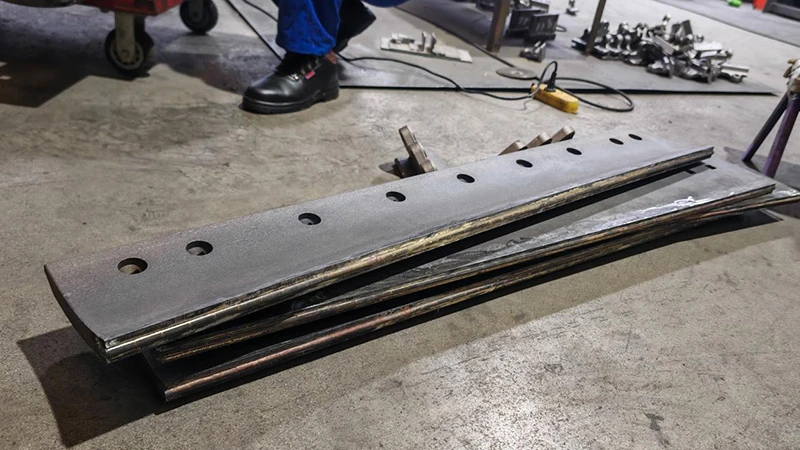
Geometry belongs in a drawing attached to the specification, with the production-critical dimensions repeated in the technical section: profile, thickness at the cutting edge, edge angle, and the position and size of the mounting holes. Where a dimension affects fitment, its tolerance should appear with the dimension rather than in a general note that bidders may overlook.
Fitment and Tolerance Clauses for Public Contracts
Fitment clauses should be written as acceptance conditions. State the mounting pattern with its reference standard, the hole diameter and centre spacing, and the tolerance accepted at the mounting holes and cutting edge. Require the bidder to confirm fitment in writing against the agency’s drawing before production, and make that confirmation part of the delivery documentation. Where an OEM mounting interface is involved, SAE standards for mobile machinery document the interface the equipment was designed around.
The acceptance condition should be stated in operational terms as well as dimensional ones. An edge that does not seat flat against the moldboard, or that requires force to bring the mounting holes into alignment, is non-conforming, and the specification should say so. Written that way, a receiving inspection can identify the problem at delivery rather than at fitting, which is where rework becomes expensive.
Where an agency maintains equipment across several makes, the specification should list each pattern and require confirmation per group. A single confirmation covering an order that contains several patterns is not a fitment validation, and it creates ambiguity about which configuration was accepted. Reference standards published by DIN are relevant where European equipment is in the fleet.
Evidence and Documentation to Require From Bidders
Documentation requirements belong in the invitation to bid, not in the contract administration that follows. Require lot-level traceability linking each delivery to its production batch and the carbide grade used, dimensional inspection results at the mounting holes and cutting edge, and grade data with reference to a test method. Where inserts are supplied fitted, require a description of the joining process and how bond integrity is controlled, since the joint carries load from the insert into the blade body; background on the process is published by TWI.
Also require the bidder to state, in the bid, the grade and tolerances they will supply. A bid that offers a capability rather than a commitment cannot be evaluated on the technical criteria, and the resulting contract has no measurable technical baseline. Where the agency reports on winter operations or participates in regional programmes, the operating context published by the Federal Highway Administration can be referenced to explain the performance assumptions behind the requirement.
Two administrative items are worth confirming early because they affect delivery rather than price. Supplier registration for federal awards is handled through SAM.gov, and general procurement guidance is published by GSA. Where a regional purchasing consortium is used, its own registration requirements should be stated in the same section so bidders do not discover them after award.
Common Bid Specification Errors and Their Cost
The most common error is specifying by reference to the previous award. A specification that names the incumbent’s product number restricts competition and does not describe the requirement, so the agency cannot evaluate improvements or alternatives on their merits. The second is permitting an equivalent material without defining the properties it must match, which turns a technical decision into a negotiation after the bids are opened.
The third error is omitting quantities per vehicle group. A single quantity across a mixed fleet forces bidders to price an average, which either overprices the work or concentrates risk in a way that shows up as a variation later. The fourth is leaving the documentation requirement out of the bid documents and requesting it after award, which usually produces partial records because the supplier did not plan for them.
Each of these errors has the same practical consequence: the agency ends up managing the contract rather than the requirement. Edge specifications that survive municipal procurement state measurable attributes, define equivalence, list quantities by group and require the evidence package up front. A cost comparison across a season is then possible, and the material for it is covered in the guidance on cost per season budgeting.
Writing Evaluation Criteria That Do Not Favour One Bidder
Evaluation criteria should follow directly from the specification, so that each requirement can be scored without interpretation. Assign weight to technical attributes, evidence quality and delivery performance separately, and state what evidence satisfies each. Where technical merit is scored, describe how a stated hardness range with a test method is assessed differently from an unsubstantiated claim.
Where a sample or a first-article inspection is part of the evaluation, define the test conditions in advance: which dimensions are checked, which documentation is reviewed and what constitutes a pass. A first-article process with criteria written after the sample arrives is difficult to defend, and it undermines the objectivity the tender was written to protect.
Finally, keep the technical and commercial evaluation separate until both are complete. Where price is opened before the technical assessment, the technical score tends to converge on the cheapest compliant bid, and requirements that distinguish real capability get discounted. Separating the stages is what preserves the value of writing the technical section carefully in the first place.
A municipal edge specification is a technical document that happens to be procured. It works when every requirement is measurable, equivalence is defined by properties rather than by assertion, and the evidence package is required before award rather than requested after it.
Write the six performance points as requirements, state fitment as an acceptance condition, list quantities by vehicle group, and keep technical evaluation separate from price. A specification built that way produces comparable offers and a contract the agency can administer without renegotiating what was bought.
Send SENTHAI your vehicle list, measured blade patterns and the routes each group runs, and the technical team will review the specification points, fitment clauses and documentation package for your tender.
Frequently Asked Questions
Should a municipal specification name a brand or a specific product number?
It should describe the requirement instead. Naming a product restricts competition, ties the agency to one supplier for the life of the specification and does not describe the performance required. Where an equivalent is acceptable, define the properties the equivalent must match and the evidence needed to demonstrate it. That approach allows objective evaluation and produces more comparable bids.
What documentation should be required with each delivery?
Require lot-level traceability linking the delivery to its production batch and carbide grade, dimensional inspection results at the mounting holes and cutting edge, and grade data referenced to a recognised test method. Where inserts are supplied fitted to a blade, add the joining process and how bond integrity is controlled. Requiring these in the bid documents rather than after award is what produces complete records.
How should quantities be structured in a municipal edge tender?
List quantities by vehicle group rather than as a single fleet total, because groups differ in pattern and route class and bidders otherwise price an average. Include the option to adjust quantities within a stated band, so seasonal variations do not require a new procurement. Clear quantity structures also make the bid comparison more accurate and reduce the risk of post-award variations.
Can an agency require a specific carbide grade or grain size?
It can require stated values for hardness range, grain size and binder or toughness, referenced to test methods, which achieves the same practical purpose without restricting the field to one producer’s designation. Requiring a named grade limits competition and can be difficult to justify. Requiring measurable properties and the evidence to support them gives the agency control over performance while keeping the requirement objective.
Related articles
 Plow Blade Cost Per Mile: The Inputs That Decide the AnswerSnow plow blade programme & selection
 Plow Blade Wear Measurement: When to Replace and When to RotateSnow plow blade programme & selectionFleet Plow Blade Standardisation: Cutting the Cost of VariationSnow plow blade programme & selection
 How to Write a Snow Plow Blade Specification That Survives a Full SeasonSnow plow blade programme & selection