




Plow Blade Failure Modes: What Each One Tells You
Plow blade failure modes explained: even wear, scalloping, chipping and joint failure, what each one points to and the evidence to collect first.
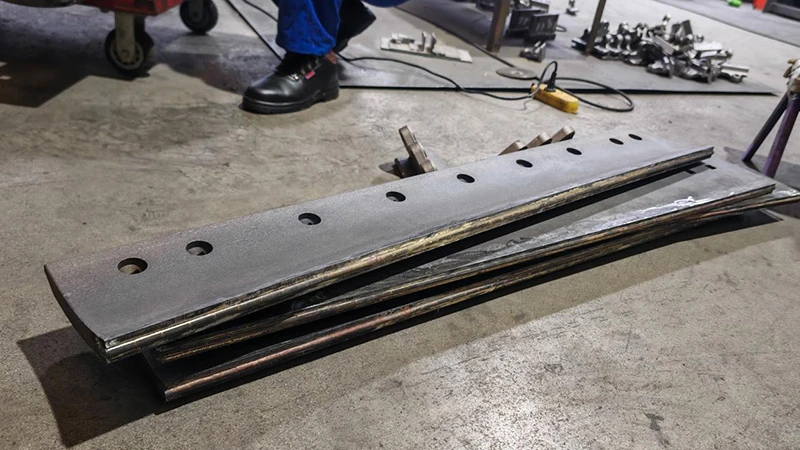
An edge that failed early is evidence, and an edge that was discarded without inspection is a lost opportunity. The failure mode identifies the mechanism, and the mechanism identifies the remedy: only one of the common modes is addressed by changing the material, which is why reading the failure correctly saves a season of misdirected specification changes.
What Plow Blade Failure Modes Tell You
They separate abrasion, impact, retention and fitment.
Even material loss across the working width indicates abrasion, localised loss or chipping indicates impact, movement without wear indicates retention, and damage concentrated at one end indicates fitment or alignment. Each has a different remedy.
The separation matters because the remedies are not interchangeable. A fleet that changes grade to solve a fitment problem spends a season testing the wrong variable; one that adds thickness to solve a retention problem buys material that will fail the same way. The purpose of reading the failure is to reduce the possible causes to one before anything is ordered.
The evidence needed is mostly free. The failed edge itself, photographs taken before it is cleaned, the measured wear at fixed points, the position of the failure on the blade, and the route and hours involved. Where the edge was one of several on the same vehicle, the position matters as much as the part, because failures concentrated at the ends of a moldboard point somewhere different from failures in the centre. The narrower question of when inserts reach the end of their service is covered in the material on carbide insert wear.
Failure Modes and the Cause Behind Each One
Even wear is not a failure in the engineering sense; it is the interval, and its value is the measurement it produces. Scalloped wear, where loss concentrates at particular positions along the blade, points to contact that is not consistent across the working width. The usual causes are a mounting face that is not flat, a carrier that is not running level, or a route whose surface varies in a regular pattern that the blade meets at the same positions each pass.
Chipping or fracture points to shock loading, and its position is the strongest clue. Damage on the sections that meet rail crossings, drain covers or pavement breaks indicates the surface; damage at the same relative position across different blades indicates the equipment. Where the failure appears as inserts sitting proud of their neighbours, the cause is seating rather than material, and the mechanism is described in the analysis of edge seating failure.
Detachment with little wear is a retention signature, read along the joint rather than at the working face. Discolouration or uneven appearance along the bond line suggests the joining process rather than the grade, and technical background on brazing is published by TWI. Failure concentrated at one end of a blade, whether wear or damage, usually involves alignment, seated height or a mounting face that has distorted.
Inspection Points and What to Record on a Failed Plow Blade
Five points should be recorded when an edge fails: the failure mode, its position along the blade, the measured wear at the fixed points, the hardware condition including torque history, and the route and hours involved. Photographs taken before cleaning complete the set, because surface condition is part of the evidence and cannot be recovered afterwards.
The record should also carry the specification the edge was produced to and the batch reference from its delivery documentation. SENTHAI inspects and archives every batch, and works to plus or minus 0.02 mm dimensional tolerances on carbide components and validated fitment against AASHTO and DIN bolt patterns, so a documented failure can be reviewed against the production record rather than discussed in general terms; the quality control and traceability page describes what that record contains.
Keeping the failed part matters, but keeping it with its record matters more. An edge in the corner of the workshop with no photographs, no position and no hours is a curiosity; the same edge with a measurement sheet and four photographs is a finding a supplier can act on.
A useful discipline is to inspect the failure while the edge is still on the vehicle where conditions allow. Seated height, hardware condition and the flatness of the mounting face can all be checked in place, and those three facts often explain the failure more directly than the worn part does. Removing the edge first and inspecting it on a bench removes the context that made it fail, and the analysis becomes a description of consequences rather than causes.
Conditions That Produce Each Plow Blade Failure Mode
Abrasion is a function of surface, speed and distance. Unsealed gravel routes and abrasive wind-packed snow consume material at a rate that becomes predictable once measured, and the remedy is reserve, grade and interval rather than diagnosis. Impact is a function of what the edge meets, and the remedy involves grade, retention quality and, where the problem is severe, an honest look at operating practice on the affected sections.
Retention failure is a function of the joining process and the load it carries. A joint with voids or incomplete fill concentrates stress until it releases, and the evidence appears along the bond line. Fitment failure is a function of tolerance, seating and mounting face condition: SENTHAI validates fitment against AASHTO and DIN bolt patterns before release, with AASHTO published standards as the agency reference and DIN covering European and export conventions, which is what makes the comparison against a drawing possible.
Seasonal conditions change which mode dominates. Refrozen, hard-packed surfaces reduce contact and encourage compensating down-pressure, so failures appear at the mounting interface rather than at the working face. Routes with embedded debris produce impact damage. Maintenance practice across ice-affected networks is covered in the pooled research published by Clear Roads, and grade properties can be checked against the methods published by ASTM.
Repair, Rotation or Replacement Decisions on a Failed Edge
The analysis should produce a decision rather than a conclusion. Where a failure is isolated to one position and the rest of the edge is sound, the practical response is to document it, address the cause if it is identifiable, and shorten the inspection interval on that edge. Where the same failure recurs at the same position on different edges, the cause is the equipment or the route, and changing the edge specification will not address it.
Where a section of the bond has failed or inserts have detached, the edge should be treated as unserviceable rather than monitored, because continuing with it transfers unpredictable load into the mounting interface and puts the blade body at risk. Where wear has reached the working threshold with an even pattern, the edge has performed normally and the useful output is the measured interval.
Rotation applies where the failure is wear-driven and concentrated in part of the working width, because spreading exposure uses remaining material. It is not appropriate where the mechanism is retention or fitment, since moving the edge moves the cause without correcting it. A written threshold for what constitutes a repeat failure is worth having, because a second edge failing at the same position is a pattern rather than a coincidence.
Tools and Safe Handling During a Failure Inspection
The tools for a failure inspection are simple: a straight edge or gauge, a light, a torque wrench and hand protection. Their calibration matters more than their complexity, because a failure analysis built on readings from an out-of-calibration gauge produces a precise conclusion with an unknown basis.
Handling is the main physical risk, since edges are heavy, often sharp and awkward to move. Assessment principles for load handling are published by the UK Health and Safety Executive, and general workshop requirements for hand and power tool use are set out in the OSHA occupational safety and health standards.
Where the failure raises a material question, the useful references are the test methods published by ASTM and the material background published by the International Tungsten Industry Association. Together they let a non-specialist ask a precise question rather than accept a general answer.

Recording Plow Blade Failures So Patterns Emerge
Individual failures are expensive; patterns are informative. A single record that captures the failure mode, position, truck, route and batch makes it possible to see whether failures cluster by truck, by position, by route or by production run. Each cluster points to a different owner of the problem, and naming the owner is what allows it to be resolved.
The record should also capture what was done in response. Where a failure was attributed to fitment and the mounting face was corrected, the following season shows whether the correction worked. Where a grade was changed, the record shows whether the failure mode changed with it. Without that loop, the fleet replaces parts and repeats the same investigation annually.
The review should happen at a fixed point in the season rather than continuously. Sorting a season’s failure records by mode, position and vehicle is what makes clustering visible, and clustering is what identifies the owner of a problem: the equipment, the route, the specification or the supply. A review conducted at the same point each year also allows one season to be compared with the last, which is how a fleet establishes that a correction actually worked.
Finally, the failure record should be readable by someone who was not present. Photographs, measured values, positions and a batch reference do that; a written description of a bent blade does not. Where the record is complete, a supplier can investigate against its own production data, and the fleet’s contribution to the discussion is evidence rather than recollection.
Plow blade failure modes separate abrasion, impact, retention and fitment, and only one of the four is a material problem. Reading the mode before ordering anything is what prevents a season spent testing the wrong variable.
Photograph the edge before cleaning, record the position, hours and batch, and send the record rather than a description. Logged consistently, those records reveal patterns that no single incident shows, and the specification improves on evidence rather than on response.
Send SENTHAI photographs, measurements and the batch reference for a failed edge, and the technical team will review the failure against the production record and the specification.
Frequently Asked Questions
What does scalloped wear across a blade indicate?
It indicates that contact is not consistent across the working width, so some positions are doing more of the work than others. The usual causes are a mounting face that is not flat, a carrier that is not running level, or a route whose surface varies in a pattern the blade meets at the same positions each pass. Check the equipment before changing the specification.
Why does chipping on some inserts matter more than the amount of wear?
Because it identifies a different mechanism. Chipping points to shock loading rather than abrasion, and the position of the damage tells you whether the surface or the equipment is responsible. A grade change addresses one of those possibilities, and only after the position has been established is it clear which one applies.
What should be photographed after a failure?
The whole edge, the failure position close up, the bond line along the insert bases and the mounting face, all before cleaning or dismantling and in good light. Four to six images are usually enough for a supplier to review the failure against the production record, and the surface condition cannot be recovered once the edge is washed.
When is an edge unserviceable rather than repairable?
Where a section of the bond has failed, where inserts have detached, or where the edge no longer seats flat. Continuing with an edge in that condition transfers unpredictable load into the mounting interface and risks the blade body, which costs more than the edge. Isolated damage at one position can be documented and monitored with a shorter inspection interval.
Related articles
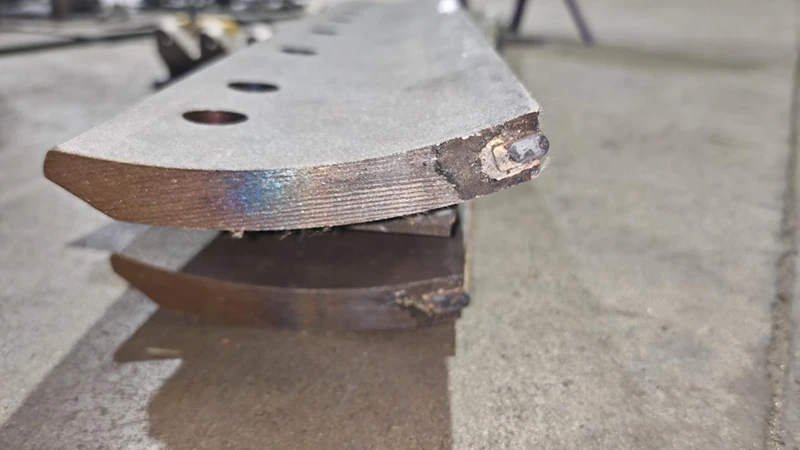 Plow Edge Rotation Programme: Running It on EvidenceSnow plow blade programme & selection
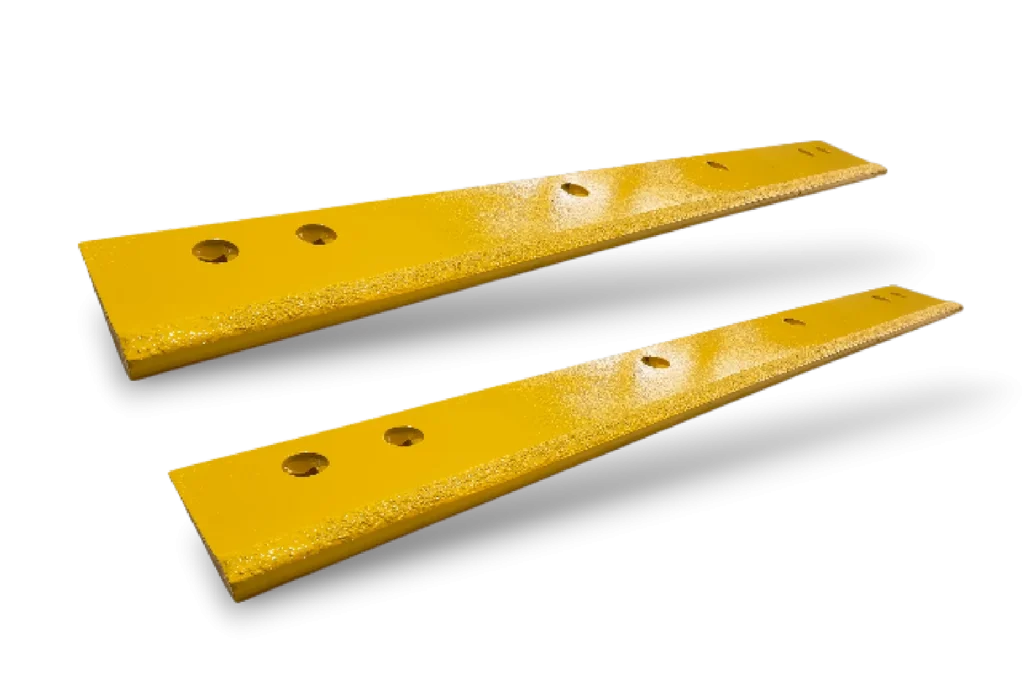 Plow Blade Length and Thickness by Truck ClassSnow plow blade programme & selection
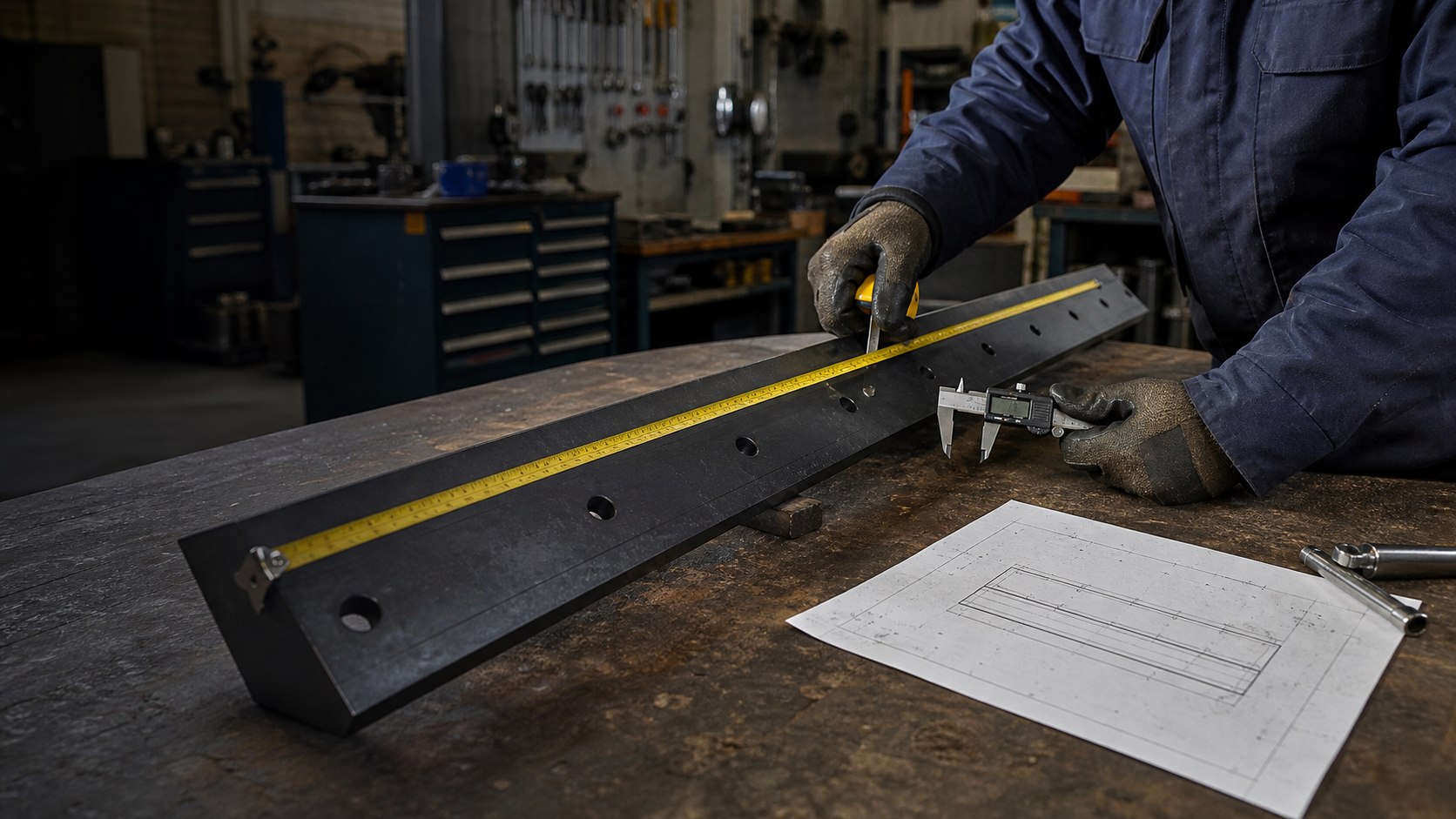 Snow Plow Blade Bolt Pattern: Verifying It Before You OrderSnow plow blade programme & selection
 Underbody Plow Blade Specification: How Mounting Position Changes ItSnow plow blade programme & selection