Micro Grain Carbide Inserts vs Standard Grain Grades: Choosing by Wear Mechanism
Micro grain carbide inserts compared with standard grain grades on hardness, chipping and fitment, plus the specification points to fix before ordering.

An insert that chips out on a route with rail crossings and broken pavement is not necessarily the wrong grade; it may be the right grade working against the wrong failure mode. Fleets and distributors that order micro grain carbide inserts because the term sounds more advanced often pay a premium for a property they did not need, while a route that genuinely destroys edges through impact keeps receiving standard grain material because that is what the stores system has in stock. The choice belongs to the wear mechanism, and the specification exists to name it.
Which Specification Points Separate Micro Grain Carbide Inserts From Standard Grades
Grain size, binder content and hardness separate the two.
Grain size sets how the material resists chipping under impact; binder content and the resulting HRA hardness set how it resists abrasion. The two grades trade those properties differently.
Cemented tungsten carbide is a composite: hard carbide particles held together by a metal binder. Reducing the grain size of those particles produces a finer, more uniform structure that resists crack initiation and chipping; increasing binder content generally increases toughness at some cost to hardness. A specification that names only the material and not the grade leaves those two properties to whoever fills the order, which is how two consignments with the same product description end up behaving differently on the same route.
The terminology itself is covered on the page explaining what micro grain carbide inserts are, so this article stays with the decision. What a buyer needs to pin down is grain size, binder content or hardness range, and the basis for accepting an equivalent in a follow-on order. Those three items are what make two quotes comparable.
How Grain Size Changes the Way an Insert Wears
Finer grains resist chipping; harder grades resist abrasion.
A micro grain structure spreads load across more particle boundaries, slowing crack initiation when the edge meets embedded debris. Harder grades lose less material to steady abrasion.
The failure modes look different in the yard. Insert loss from impact appears as chipping, fracture or complete loss of individual inserts, often concentrated on the section of blade that meets crossings, covers and pavement breaks. Abrasive loss appears as an even reduction in insert height across the full working width, with the steel body exposed only at the end of the interval. Identifying which one is happening is the first step in specifying correctly, and it costs nothing but a look at the last set of edges returned to the workshop.
The decision also interacts with retention. An insert that is well matched to the grade but poorly bonded will still leave the blade early, and a grade change will not mask that. Readers looking at the joint itself can follow the comparison of insert retention designs, which sits alongside the retention question rather than replacing it.
Reading the evidence is the step most fleets skip. The table below maps what returned edges usually show to the property worth changing, and it is worth completing before any grade request goes to a supplier:
| What the returned edges show | Likely dominant failure | What to prioritise |
|---|---|---|
| Chipped or missing inserts on part of the blade width | Impact from embedded debris | Finer grain structure for crack resistance |
| Even loss of insert height across the working width | Abrasion | Higher hardness for resistance to material loss |
| Inserts intact but detached, steel body exposed | Retention or bond failure | Brazing process control rather than a grade change |
| Loss concentrated at the ends of the blade | Alignment or contact pressure | Fitment and edge angle review before any grade change |
Grade, Geometry and Material Choices Across Insert Grades
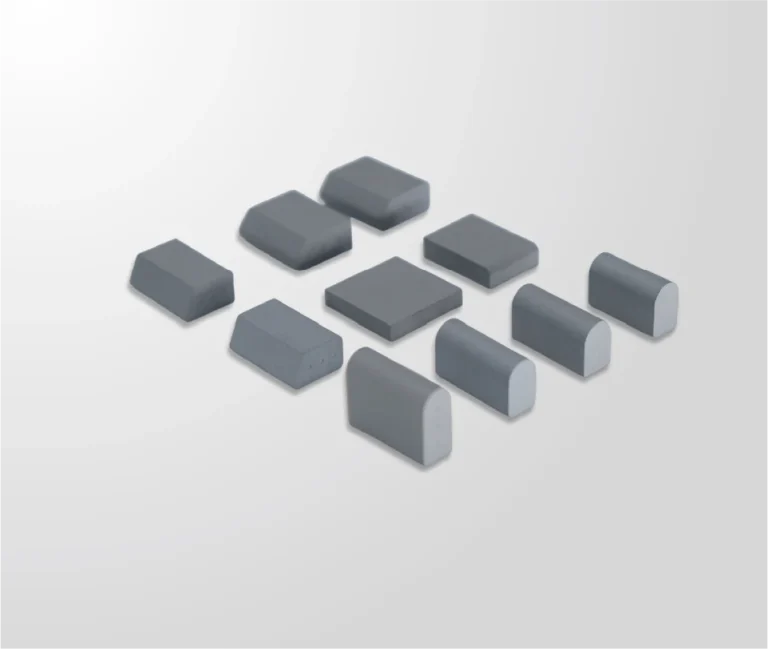
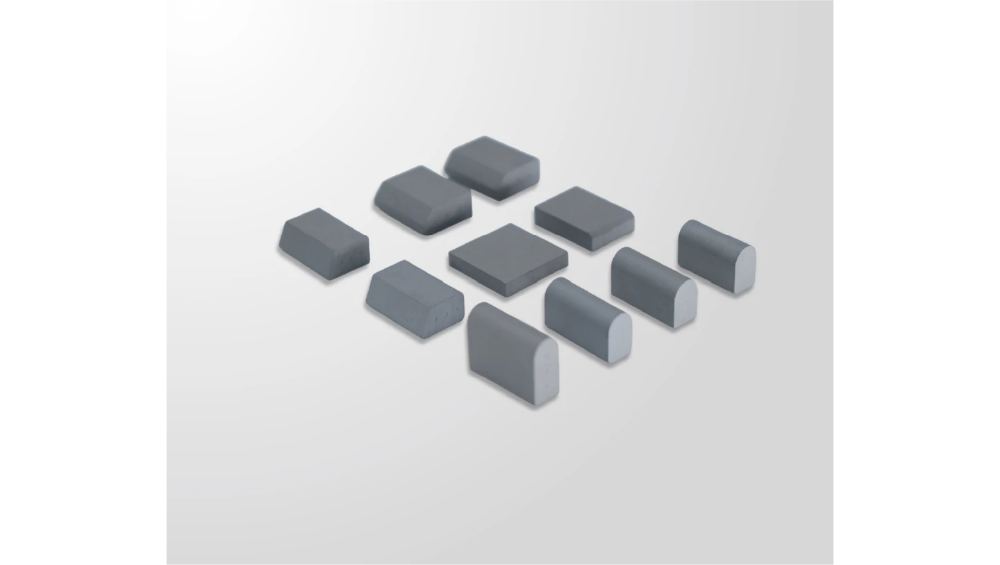
Grade selection is only meaningful when it is paired with geometry. SENTHAI supplies micro grain carbide inserts in trapezoid and bullnose shapes and engineers the grade for a stated service condition using hardness on the HRA scale together with carbide grain size, so the shape and the material are specified together rather than chosen separately. A trapezoid insert working directionally on hard-packed surfaces loads its own structure differently from a bullnose insert riding across irregular ground, and the tolerance to impact that each one needs is not identical.
The manufacturing sequence matters to grade consistency. SENTHAI produces in Rayong, Thailand, in a US-invested plant using non-China raw materials, with an in-house chain that runs from wet grinding and robotic pressing at up to 500 tons through vacuum and low-pressure sintering, automated high-temperature induction brazing and finishing. Because the powder preparation and pressing steps are controlled in-house, the grade delivered in a follow-on order is the grade that was specified, which is the property a distributor needs to resell with confidence.
Background on how cemented carbide behaves in wear applications is published by the International Tungsten Industry Association and by ASM International, and both are useful when a procurement team has to justify a grade change to a manager who is not a materials engineer.
Fitment and Tolerance Requirements for Replacement Inserts
Replacement inserts have to fit the pocket or the blade they are going onto, which makes tolerance a specification point rather than a manufacturing detail. SENTHAI works to plus or minus 0.02 mm dimensional tolerances on carbide components and validates fitment against AASHTO and DIN bolt patterns before release. On a replacement programme, that tolerance is what decides whether an insert seats cleanly into an existing position or leaves a gap that concentrates load and shortens retention.
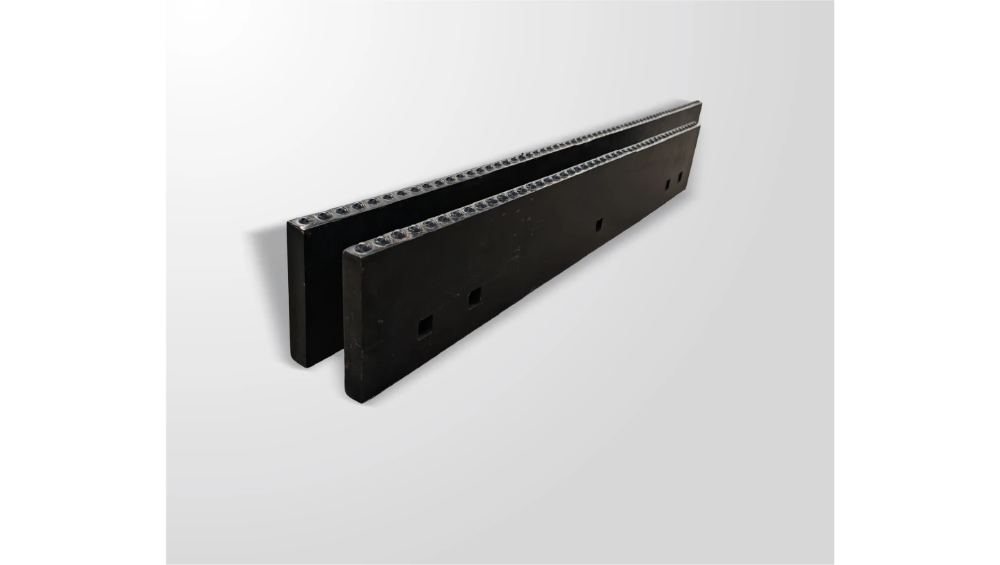
Two dimensions drive the fit: the insert’s own profile and the mounting arrangement it sits in. Distributors supplying aftermarket replacements should confirm the blade’s original specification before committing stock, because a near match on overall size can still be wrong on the locating features. Where a pattern standard is quoted, AASHTO published standards remain the reference for agency specifications, with DIN covering the equivalent European and export conventions.
Measurement discipline is the practical part. Record the insert dimensions, the blade position and the mounting pattern from the edge in service rather than from a manual, and treat the resulting drawing as the order specification. ASTM publishes the test methods used for cemented carbide property measurement, which is what makes a grade certificate checkable rather than promotional.
Where inserts are supplied loose for workshop fitting, the pocket or seat depth matters as much as the insert profile. A seat that is not clean or not to depth will hold the insert at an angle, and the resulting contact pattern concentrates load on one edge of the carbide face. Clean the seat, check it for wear before fitting, and replace any seat that has deformed rather than attempting to build it back up.
Evidence to Request Before Accepting an Insert Grade
Grade claims are easy to make and simple to verify, which makes documentation the fastest filter between suppliers. Ask for the hardness and grain-size data for the grade offered, referenced to a recognised test method, and for the tolerance held at the locating features of the insert. SENTHAI inspects and archives every batch, so this is a routine request; the quality control and traceability page describes what those batch records contain.
Two further items belong with it. Lot-level traceability should link the delivered inserts to the batch that produced them, including the carbide grade. And the supplier should be able to explain how bond integrity is controlled if the inserts are supplied fitted to a blade, since brazing is the joint carrying the load. A supplier that cannot describe either process in one paragraph is unlikely to be able to hold a grade over repeat orders.

Insert Grade Specification: Where It Usually Goes Wrong
The most common error is specifying a grade by reputation rather than by failure mode. Insert loss from chipping and insert loss from abrasion call for different properties, and a fleet that switches to a harder grade to solve abrasion can make chipping worse on the same route. The wear pattern on returned edges is the evidence that settles it, and it should be photographed and kept with the order history.
The second error is allowing equivalence without a basis. A tender that accepts an equivalent grade without stating the basis for equivalence gives away the specification, because a supplier can offer a cheaper material and argue it is equivalent after the fact. State hardness range, grain size, and the test method, then require the supplier’s certificate to match.
The third is treating the insert as an isolated purchase. Inserts that are bought separately from the blades they fit create a fitment risk on every order, and inserts bought without a grade record create a performance risk that cannot be traced. The fourth is the reverse of the first: paying for a fine micro grain grade on a route that only ever wears edges evenly, where a tougher grade delivers the same interval at a lower price per insert. Neither error shows up in a purchase order, and both show up in the cost per metre of edge at the end of the season.
Writing the Insert Grade Into a Tender
A tender should treat the insert as a specified component: shape, dimensions with tolerances, grade with hardness and grain size, the test method used to demonstrate them, and the retention method if inserts are supplied on a blade. Add the blade or pocket pattern the inserts must fit, the quantity basis, and the documentation required with each delivery.
Where the inserts feed an agency maintenance programme, referencing the relevant AASHTO standards and requiring a declaration of conformity keeps offers comparable, and the winter operating context published by the Federal Highway Administration is useful background for a performance clause. One final clause is worth writing: require the supplier to quote the grade they will actually ship, not the grade they can achieve on request.
Micro grain and standard grain inserts are not a hierarchy; they are two answers to different failure modes. Grade selection follows from what the last set of edges looked like when it came off the truck, and the specification exists to record that decision in a form a supplier can be held to.
Four points make the order defensible: grain size and hardness with a named test method, dimensions with their tolerance, the pattern the insert must fit, and documentation that ties delivery to a batch. Specify those and the difference between two quotes becomes visible before the season rather than after it.
Send SENTHAI photographs of your last set of worn edges together with the blade pattern, and the team will review grade, shape and tolerance against the failure mode you are seeing.
Frequently Asked Questions
Are micro grain carbide inserts always the better choice?
No. Micro grain structures are chosen for their resistance to chipping and crack initiation under impact. Where a route wears edges evenly without much embedded debris, a harder standard grade can deliver a comparable interval at a lower cost per insert. Match the grade to the failure mode visible on returned edges rather than to the more advanced-sounding description.
What information should accompany a grade certificate?
A usable certificate names the grade, states hardness on the HRA scale and carbide grain size, and references the test method used to measure them. It should identify the production batch the certificate covers so it can be tied to delivered parts. Without the batch reference, the document describes a material rather than the shipment you received.
Can inserts of different grades be mixed along the same blade?
It is possible but rarely useful. Mixing grades along one edge complicates the wear record and makes it harder to interpret the pattern when the blade is inspected, because differences in insert height can come from grade or from position. Where a route has genuinely different sections, a better approach is to specify the grade for the dominant condition and rotate edges to even out exposure.
How do I compare insert prices between suppliers?
Compare cost per metre of edge rather than price per piece, and confirm what each quote includes: grade, tolerance, retention method and documentation. Two inserts with the same footprint can differ in grade and in the tolerance held at the locating features, and those differences decide how long the insert stays in the blade. Ask both suppliers to quote against the same written specification.