How to Write a Snow Plow Blade Specification That Survives a Full Season
How to write a snow plow blade specification that holds up for a full season, from edge geometry and grade to fitment, documentation and acceptance.

A blade specification fails in one of two ways. Either it is so vague that any supplier can satisfy it with anything, or it is so detailed that nobody can tell which requirement caused the edge to fail. The specification that survives a season sits between those extremes: it names measurable attributes, states the fitment it must satisfy and defines what evidence arrives with the delivery. This article covers how to write one, and what to leave out.
Snow Plow Blade Specification: The Points That Decide a Season
Six points decide how a blade performs across a season.
Edge geometry, edge thickness, carbide grade and grain size, insert type and spacing, mounting pattern with its tolerance, and the documentation that travels with delivery. Everything else in a specification is either a restatement of one of those or an operational note.
The reason to fix the list is that suppliers quote against what is written, not against what was intended. A specification that names the blade type and a length but leaves grade and edge angle to the supplier will produce offers that cannot be compared, and a fleet that accepts one of them has effectively delegated the technical decision to the lowest bidder. The specification walkthrough covers how these points are recorded in practice, and this article covers how to write them into a document that can be enforced.
Two constraints frame the whole exercise. The first is the equipment: pattern, moldboard width and available down-pressure fix the envelope. The second is the route: surface type, road class and whether refrozen ice recurs decide how the edge will be loaded. A specification written without both will satisfy the buying process and fail on the truck.
How the Specification Variables Interact on the Truck
Geometry and material cannot be specified in isolation.
Edge angle determines how aggressively the blade bites and how much protection the carbide receives; thickness sets the reserve; grade sets how the material responds to abrasion and shock. Change one and the others usually need revisiting.
A practical example is the most common specification error in the field. A fleet adds thickness to extend wear life, which lifts the effective contact point and reduces scraping contact, so operators respond with more down-pressure. The additional load then accelerates wear on the trip mechanism and mounting hardware, and the fleet concludes that the thicker edge did not work. Nothing was wrong with the thickness; the specification changed one variable without adjusting the two that interact with it.
Spacing works the same way. Closer insert spacing concentrates carbide at the contact area, which can extend the interval between rotations while raising the cost per metre of edge and adding mass at the leading edge. On a light carrier, that mass changes behaviour. On a heavy carrier with plenty of down-pressure available, it is absorbed. The specification has to state the carrier as well as the spacing, because the same number produces different results on different trucks.
Grade, Geometry and Material Choices in the Specification
Grade should be written as properties rather than as a name. State the hardness range with the test method, the carbide grain size and the binder or toughness requirement, and define what an acceptable equivalent has to match. A named grade alone is not a specification, because a supplier can offer a substitute under a different designation and argue equivalence afterwards.
SENTHAI engineers the hardness and toughness balance for specific service conditions using hardness on the HRA scale together with carbide grain size, and manufactures in Rayong, Thailand, in a US-invested plant using non-China raw materials. The process chain runs from wet grinding and robotic pressing at up to 500 tons through vacuum and low-pressure sintering, automated high-temperature induction brazing, vulcanization and finishing, with stage-by-stage quality control. Where a specification requires a brazed assembly, that process detail belongs in the quality section rather than in the drawing, because it is what the supplier is being held to.
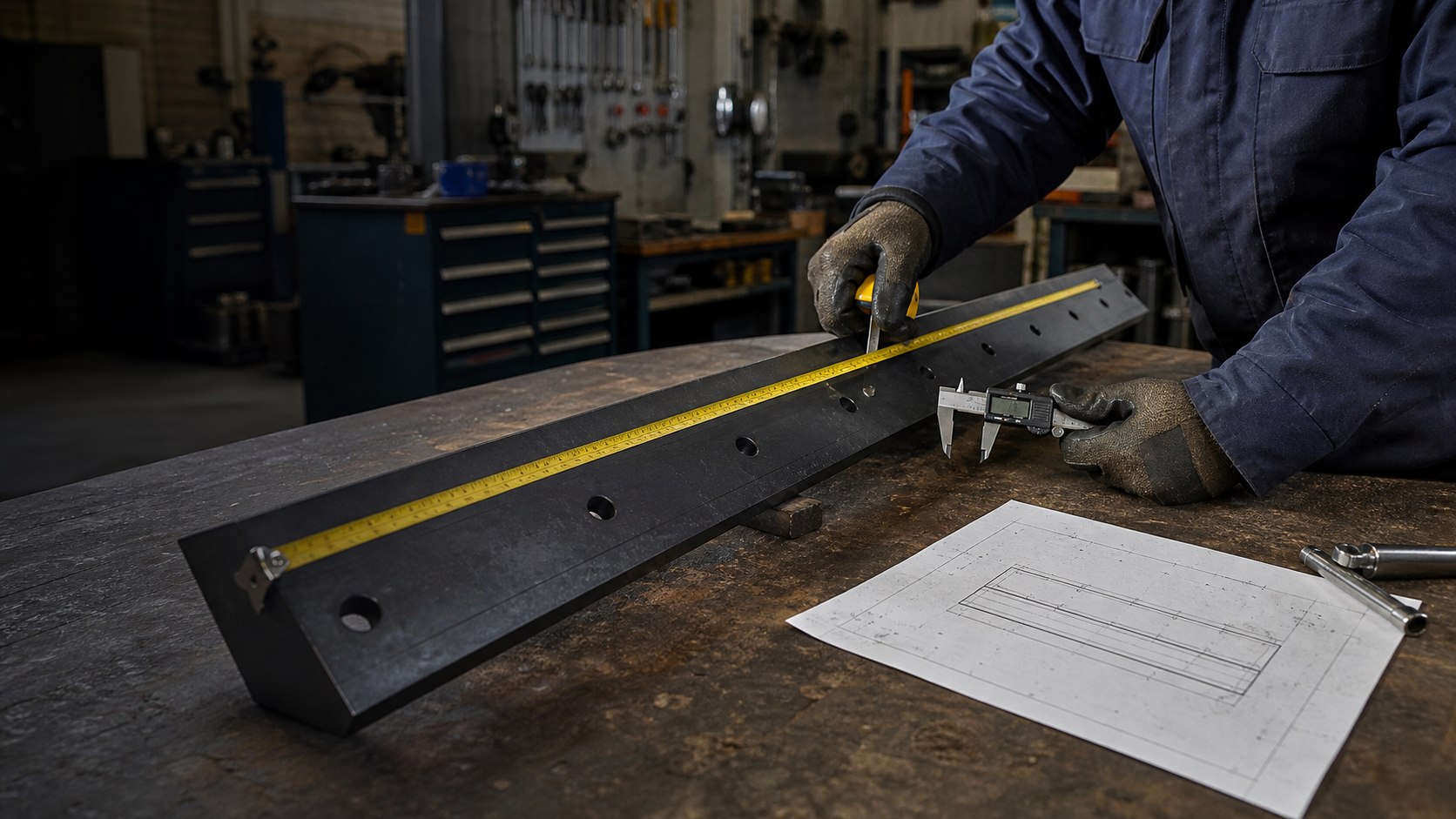
Geometry belongs in the drawing with tolerances. Repeat the dimensions that are production-critical rather than describing them: the profile, thickness at the cutting edge, edge angle and the position of the mounting holes. Where a dimension is critical to fitment, state its tolerance on the drawing, because a tolerance written only in the narrative section is the one most likely to be missed.
Fitment and Tolerance Requirements to Write Into the Spec
Fitment should be stated in measurable terms: pattern with its reference standard, hole diameter, centre-to-centre spacing, and the tolerance accepted at the mounting holes and the cutting edge. SENTHAI validates fitment against AASHTO and DIN bolt patterns before release and works to plus or minus 0.02 mm dimensional tolerances on carbide components, with AASHTO published standards as the reference for agency specifications and DIN covering European and export conventions.
Write the requirement as an acceptance condition rather than a preference. An edge that does not seat flat against the moldboard, or that requires force to bring the holes into line, is outside the fitment requirement and should be identifiable as such on receipt. That language is what allows a receiving inspection to reject non-conforming material without an argument.
Where an OEM mounting interface is involved, reference it explicitly. SAE standards for mobile machinery document the interfaces equipment was designed around, and a specification that names the interface is easier for a supplier to validate against. Where a fleet runs several plow makes, list the pattern for each and require confirmation per group rather than one confirmation for the order.
Evidence to Attach to the Specification
The documentation requirement belongs in the specification itself, not in the correspondence that follows it. Ask for lot-level traceability linking the delivery to its production batch and the carbide grade used, dimensional inspection results at the mounting holes and cutting edge, and grade data referenced to a test method such as those published by ASTM. SENTHAI inspects and archives every batch, which makes these routine requests rather than special ones.
Where inserts are supplied fitted to a blade, add the joining process and how bond integrity is checked, because the joint carries load from the insert into the body and is not visible after assembly. Background on the process is published by TWI. Where the fleet measures performance against a winter severity assumption, the operating context published by the Federal Highway Administration and the seasonal guidance from the National Weather Service are useful supporting references for a performance clause.
One further clause is worth more than it costs to write: require the supplier to state, in the quotation, the grade and tolerances they will ship. A specification that is met by a capability rather than by a commitment is not a specification.

Common Specification Errors and Their Cost Over a Season
The most common error is writing a specification by product name. A blade described as heavy-duty or by an internal part number carries no measurable requirement, so a follow-on order can arrive different from the first and no one can demonstrate the difference. The cost appears as inconsistent performance between trucks.
The second is specifying for the worst case across the fleet. One heavy profile applied to light carriers spreads down-pressure too thinly and reduces scraping performance, which operators compensate for by changing how they work. The third is omitting the route description. A grade and edge angle chosen without reference to surface type may be internally consistent and wrong for the roads the fleet runs.
The fourth error is leaving documentation out of the specification and then requesting it after delivery. Suppliers organise around what they have committed to, and a documentation request that arrives late is answered late. The cumulative cost of these four errors is not visible in the parts line but in the maintenance line, where extra changes, hardware interventions and unplanned workshop time accumulate across a season. Tracking that cost is what makes the next specification better; SENTHAI’s cost per season budgeting material sets out the categories to record.
Writing the Specification Into a Tender or Purchase Order
In a tender, the specification becomes the technical section, and its value depends on being complete and comparable. Include the scope with vehicle groups and quantities, the technical requirements by measurable attribute, the fitment requirements with the pattern for each group, the documentation package, and the acceptance conditions including how non-conforming material will be identified and returned.
Keep the commercial and technical sections separate but cross-referenced, so that a change in quantity does not disturb the specification and a specification clarification does not require the pricing to be reopened. Where an equivalent material or product is permitted, define the properties the equivalent must match, and state the evidence required to demonstrate it.
The purchase order should mirror the technical section rather than summarising it, because the order is the document the supplier ships against. Where the specification references the blade selection guidance in the blade selection guide or the wider snow plow blade range, keep those references informative rather than restrictive, so the requirement remains the measurable attributes rather than a prescribed product.
A blade specification survives a season when it names measurable attributes, states the fitment requirements with tolerances, and defines the documentation that arrives with the delivery. Everything else is context.
The workable sequence is to fix the equipment envelope first, describe the routes second, then write geometry, grade, spacing and tolerance as requirements a supplier can be held to. Add the acceptance conditions and the evidence package, and a receiving inspection can confirm the order that arrived is the order that was placed.
Send SENTHAI your vehicle groups, route descriptions and existing blade drawings, and the technical team will review the specification points, fitment requirements and documentation package for each group.
Frequently Asked Questions
How detailed should a snow plow blade specification be?
Detailed enough that a receiving inspection can confirm the delivery, and no more. Six attributes carry the performance: edge geometry, edge thickness, carbide grade and grain size, insert type and spacing, mounting pattern with tolerance, and the documentation package. Length, width and quantity belong in the same document, but they do not decide how the blade performs, so they do not need the same level of technical description.
Should a specification name a brand or a single supplier?
Naming a brand restricts competition and does not describe what the fleet needs. Describe measurable attributes and, where an equivalent is acceptable, define the properties the equivalent must match along with the evidence required to demonstrate it. That keeps the requirement objective, allows competing offers and gives the fleet a defensible basis for accepting or rejecting a product.
What acceptance criteria should be written into the order?
State the dimensional tolerance at the mounting holes and cutting edge, the requirement that the edge seats flat against the moldboard, and the pattern it must match. Add the documentation package, including batch traceability and inspection results. Written that way, a non-conforming delivery is identifiable on receipt, which is far cheaper than discovering the problem once the edge is on a truck.
How should a fleet handle specification changes mid-season?
Record the change with the reason and the date, and keep the previous revision with the fleet records so the performance of both can be compared later. Changing a specification mid-season without recording when it changed removes the ability to attribute the result to anything. Where a change is made, apply it to a defined group of trucks so the comparison is meaningful at the end of the season.