




Snow Removal Contracting Industry Report 2026: Margins, Equipment & the El Niño Winter
Executive summary. Snow removal contracting is a fixed-cost business with event-driven revenue: contracts are priced on a season, yet costs land per storm. With forecasters favoring a strong El Niño winter and above-normal snowfall across…

Executive summary. Snow removal contracting is a fixed-cost business with event-driven revenue: contracts are priced on a season, yet costs land per storm. With forecasters favoring a strong El Niño winter and above-normal snowfall across the Southwest and an active storm track in the central and eastern U.S., the 2026–27 season puts a premium on uptime. The contractors who protect margin this winter are the ones who control the two biggest variable costs: labor and consumables — and the cutting edge is the consumable that decides both.
1. How the Contracting Business Works
Snow contractors sell certainty and buy risk. Season contracts guarantee a response threshold (for example, a trigger depth or storm declaration), while per-event pricing covers work beyond that threshold. Revenue is lumpy: a mild January with two big events can outperform a snowy November with ten small ones, because each mobilization carries fixed labor and equipment costs. This structure means contractors care less about total snowfall than about event frequency, event size, and their ability to respond without downtime.
2. Margins Are Won or Lost on Uptime
The economics are simple to state and hard to execute: margin = contract revenue − (labor + fuel + equipment + consumables + liability). Two levers dominate:
- Labor efficiency. Every plow that goes down mid-storm costs a route, an overtime shift, or a subcontracted replacement — all at premium rates.
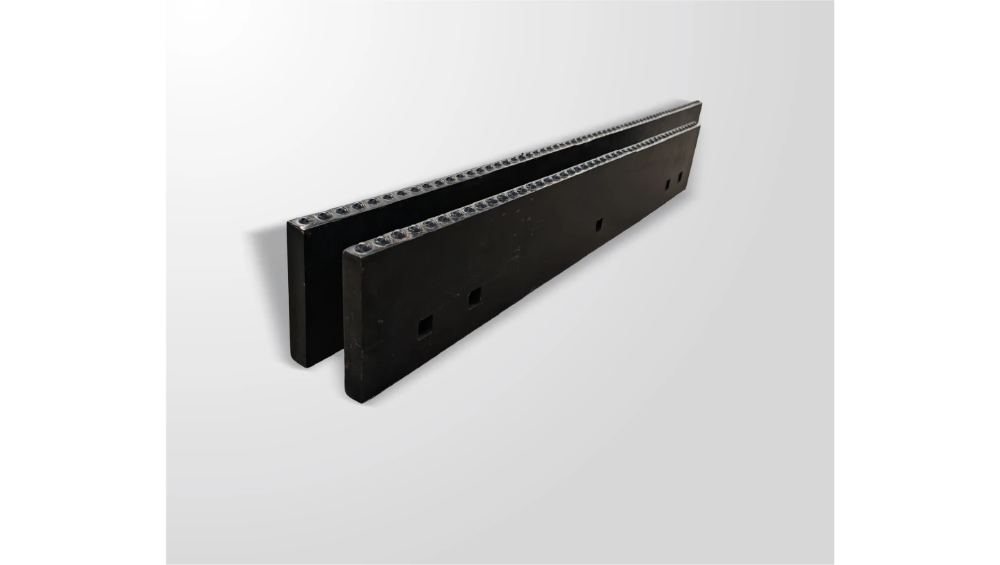
- Consumables. Cutting edges, skid shoes, and hardware are replaced seasonally or per-event. On abrasive surfaces, steel edges can fail mid-season; carbide-tipped edges last multiples of steel and reduce changeout labor.
Contractors that track cost per operating hour — rather than price per edge — consistently make better equipment decisions. The upgrade math favors carbide on high-mileage and abrasive routes, and rubber-flex edges on sensitive pavement where damage claims are a liability risk.
3. Equipment Mix and the Edge Decision
The typical contractor fleet mixes pickup plows, truck plows, skid steers, and loaders — each with different edge sizes and bolt patterns. That mix creates a procurement problem: edges must be matched per machine, and fitment errors are the top source of returns and downtime. Two practices separate professional fleets:
- Standardize on one edge supplier. A single supplier with documented quality and fitment confirmation reduces stock complexity across mixed brands (Western, Fisher, BOSS, Hiniker, Meyer).
- Build matched changeout kits. Edge + bolts + skid shoes per machine, pre-assembled, so a swap takes minutes instead of a shop trip.
For the product options and material logic, see carbide snow plow blades and JOMA-style rubber-flex blades.
4. What the 2026–27 Outlook Changes
A strong El Niño forecast changes the risk mix. Above-normal snowfall in the Southwest and southern Rockies means longer seasons and more events on abrasive mountain routes — the highest edge-consumption scenario. An active central/eastern storm track means big single events with back-to-back mobilization. For contractors, the forecast is a calendar:
- Audit and order before October, when lead times are shortest and hot sizes are in stock.
- Hold one spare edge per plow through the core season as insurance against mid-storm failure.
- Review the outlook monthly and adjust stock as the CPC forecast is revised.
5. Technology and the Changing Contractor
The industry is becoming more data-driven. Spreader controllers meter salt and brine by pavement temperature; telematics record route proof and machine utilization; and edge wear is increasingly tracked by hours rather than calendar. These tools shift procurement from reactive to planned: fleets that know their cost per hour per route can price contracts with real data instead of gut feel, and they buy consumables on schedule instead of in a panic. The contractors adopting this discipline are the ones winning multi-year municipal and commercial contracts.
6. Recommendations for the 2026–27 Season
- Know your cost per hour. Track edge life, changeout labor, and downtime by route before pricing next season.
- Match material to surface. Carbide for abrasive and ice-contact routes; rubber-flex for sensitive pavement.
- Standardize and kit. One edge supplier, matched changeout kits per machine.
- Buy before the storm. Order stock in August–October and hold spares through the season.
- Require documentation. Carbide grade, braze process, and inspection records protect both uptime and liability.
Protect Your Margin This Winter
Uptime is margin. Compare carbide snow plow blades, replaceable carbide inserts, and packed ice carbide kits, then contact the SENTHAI team to build a standardized edge program for your fleet before the first storm.
Related articles
 How to Source Snow Plow Blades: OEM, Distributor, or Direct2026News
 Top 10 Agricultural Equipment Manufacturers in 2026: Tractors, Harvesters & Precision Farming2026News
 Carbide Cutting Edge Industry Report 2026: Materials, Manufacturing & Supply Chain2026News
 Top 5 Snow Plow Cutting Edge Brands for Winter 2026–272026News