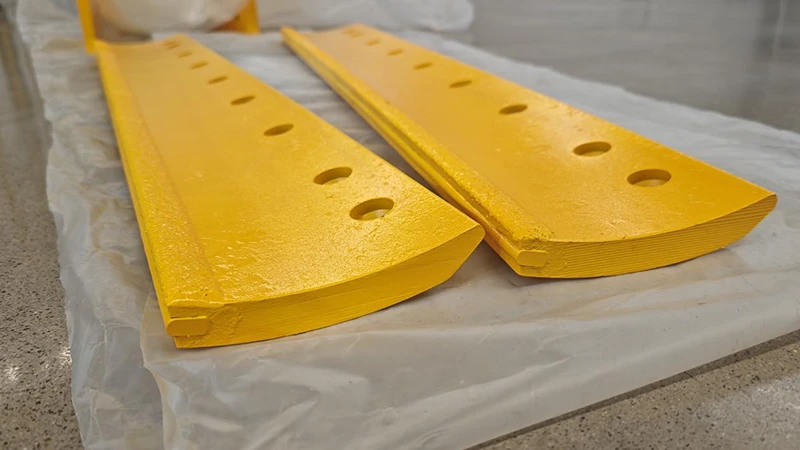
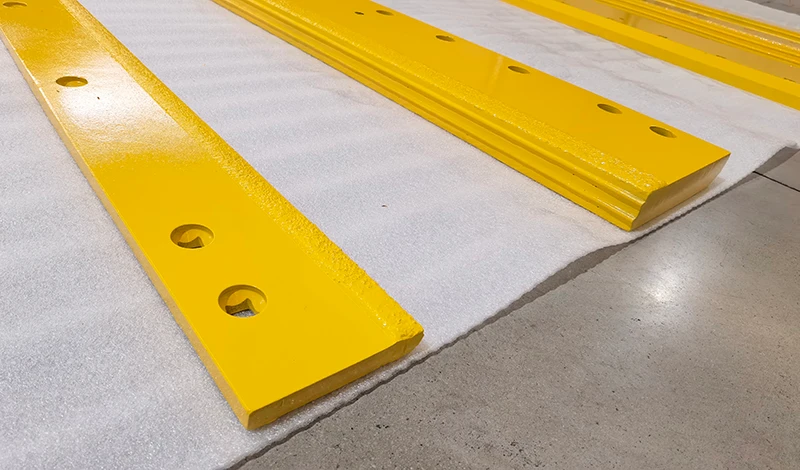
Carbide vs Steel Plow Edges: Cost Per Mile Compared
Carbide vs steel plow edge compared on wear behaviour, fitment and cost per mile, with the model inputs that turn a unit price into a seasonal decision.
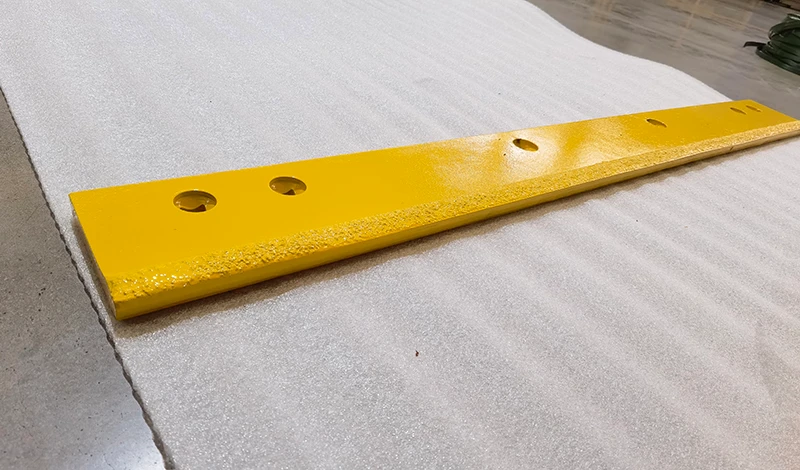
The unit price difference between a carbide and a steel cutting edge settles nothing. One number describes what you pay today, and the other describes what you pay across a winter of abrasive routes, mid-season changes and workshop hours. Fleets that compare the two on price alone tend to buy the same edge twice, while fleets that compare them on metres plowed per dollar tend to end up with a mixed fleet. This comparison sets out where each option genuinely earns its place.
What Each Edge Option Is Designed For
Steel suits light duty; carbide suits high mileage.
A steel edge is a consumable: low unit cost, replaced on a planned interval. A carbide edge is designed to hold a working edge longer under abrasive load, at a higher unit price and with a longer interval between changes.
The distinction is about what the fleet is buying. Steel buys a cheap unit and accepts repeated replacement labour. Carbide buys interval length and accepts a higher entry price. Neither is better in the abstract; the question is which one costs less per metre plowed on a specific route with a specific carrier.
That reframing matters for procurement because it changes the unit of comparison. Available weight and down-pressure set what an edge can achieve, and route length sets how often a replacement interval is triggered. A short residential route with frequent raising punishes a steel edge much less than a long highway route running abrasive, wind-packed snow. The blade selection guide covers how route and carrier characteristics map to edge type, and the wider carbide snow plow blade range shows how the profiles are organised for those applications.
Carbide vs Steel Plow Edges: How Service Life Differs
Carbide holds a working edge longer under abrasion.
Steel loses material across the whole leading face, so scraping performance degrades gradually. Carbide resists that loss at the contact point and keeps its geometry until the reserve behind it is consumed.
The difference is most visible in what happens between replacements. A steel edge that has worn past its working shape clears less effectively, which encourages more down-pressure and faster wear: a cycle operators recognise as an edge that has stopped earning its place. A carbide edge maintains contact geometry for longer, so the fleet reaches the end of a rotation cycle with the same clearing result it started with.
Service life also depends on the failure mode, and the two materials do not fail the same way. Steel generally retires from gradual abrasion. Carbide generally retires when the reserve behind the working edge is exhausted or when the bond between carbide and steel body has been compromised by shock. That second failure mode is why braze quality is part of the comparison rather than a manufacturing detail: the joint is what allows the carbide to do its job on an edge that meets embedded debris. Background on the joining process is published by TWI.
Surface and Condition Differences Between the Two
Abrasion and impact separate the two options more clearly than any other condition. Long routes over dry, wind-packed snow remove steel steadily and let a carbide edge demonstrate its advantage; routes with frequent impacts from broken pavement, manhole edges and rail crossings stress the bond between carbide and body instead, and a steel edge simply absorbs that damage by deforming.
Surface hardness matters as well. On unsealed gravel shoulders and dirt roads, the surface acts as an abrasive that consumes a plain steel edge quickly, while a carbide edge keeps a defined scraping shape for longer. On polished, refrozen surfaces, neither option alone solves the problem: contact pressure and edge profile matter more than material, which is the case a packed-ice programme is designed for. Where a fleet runs a mix of surfaces on the same route, the practical approach is to compare the two options against the dominant condition rather than the worst one, then rotate edges to even out the exposure.
Treatment decisions belong in the same discussion. Where a programme relies heavily on de-icing chemicals and abrasives, the resulting slurry changes the wear environment for both materials, and the EPA’s municipal stormwater guidance sets out the regulatory context many agencies now work within when they plan material use. That context can shift the balance toward holding a working edge longer with fewer passes.
Operational Trade-Offs Beyond Wear With Carbide and Steel Edges
Weight and handling are the first operational difference a crew notices. Carbide edges carry more mass at the leading edge, which changes how the blade behaves in the trip mechanism and how it is lifted and stored. That mass is an advantage when contact pressure is the problem and a complication when carriers are light or when the same edge has to be handled by one person during a changeover.
Second, the failure behaviour differs in a way that matters for planning. A worn steel edge degrades predictably, so it can be scheduled. A carbide edge that loses bond integrity can fail suddenly, which makes inspection of the braze line part of routine checks rather than an annual event. Teams that inspect at rotation get the benefit of the longer interval; teams that do not may find the advantage disappears in a single storm.
Third, downtime cost changes the arithmetic. A replacement interval that falls inside a storm cycle is expensive in a way no unit price captures: crews available at the wrong time, equipment out of service when the fleet is fully committed, and workshop hours that could have been spent elsewhere. Where a fleet’s peak demand and its maintenance windows do not line up well, that risk alone can justify the higher unit price on its own.
Fitment and Equipment Compatibility for Carbide and Steel Edges
Both edge types mount on the same interfaces, which is why the comparison usually comes down to pattern rather than type. AASHTO and DIN bolt patterns are the common conventions, and AASHTO published standards remain the reference for agencies specifying around them, with DIN covering European and export specifications. Switching from steel to carbide does not change the pattern, but it can change the hardware requirement, because a carbide edge is usually the heavier of the two and carries load into the mounting interface differently.
Tolerance becomes more consequential as the section gets heavier. SENTHAI works to plus or minus 0.02 mm dimensional tolerances on carbide components and validates fitment against AASHTO and DIN bolt patterns before release. An edge that does not seat flat concentrates load on a few fasteners, and a heavier edge that is not seated flat will loosen sooner than a lighter one. Bolt length, washer type, torque specification and the condition of the moldboard holes belong in the changeover plan rather than in the workshop’s discretion.
Check the carrier’s own limits before specifying. Trip spring settings, shoe contact and the moldboard’s structural condition all interact with a heavier edge, and where an OEM mounting interface is involved, SAE standards for mobile machinery describe the interfaces those designs were built around. A fitment validation from the supplier, in writing, costs nothing and removes the most common source of returns.
Cost Per Mile Compared
Cost per mile is the only figure that compares the two options on equal terms, and it is built from a small set of inputs. The general model is set out on the cost per mile page; what matters here is which inputs move when the material changes.
| Input | Steel edge | Carbide edge |
|---|---|---|
| Purchase price per edge | Lower unit cost, more units across a season | Higher unit cost, fewer units across a season |
| Replacement interval | Reached sooner on abrasive routes | Reached later, which is where the price difference is earned back |
| Labour per change | Multiplied by the number of changes | Applied fewer times, which is the largest hidden saving |
| Downtime risk | Changes more likely to fall inside a storm cycle | Fewer change windows overall, but inspection of the braze line must not be skipped |
| Hardware and consumables | Lower cost per change | Hardware may need changing with the edge type |
| Scrap and disposal | Higher volume of scrap material | Lower volume, higher material value |
Two cautions belong with that table. The first is that service interval is an input, not a result: a fleet that assumes an interval rather than measuring its own replacement history is modelling an opinion. The second is that the comparison should be run per truck group, not per fleet, because carrier class and route length change the interval enough to reverse the answer between groups. Material background for the carbide side of the calculation is published by the International Tungsten Industry Association.

The Point Where the Choice Becomes Operational
The decision usually resolves into three cases. Where routes are long, surfaces abrasive and carriers heavy, a carbide edge changes the maintenance plan rather than the purchase plan, and the interval gained is the whole argument. Where routes are short, surfaces mild and the fleet changes edges in a workshop anyway, a steel edge often holds the lower cost per mile and adding carbide simply ties up capital at the leading edge.
The mixed case is the common one: a fleet with several route classes and several carrier types, where the right answer differs by truck group. That is an operational decision rather than a purchasing one, and it is best handled by specifying per group, measuring replacement intervals by group, and reviewing after a season rather than arguing the case in advance. Documenting what came off each truck is what makes the second season’s decision evidence-based instead of theoretical.
Carbide and steel edges are not competing products so much as two different ways to buy wear life. Steel minimises the unit price and accepts repeat labour; carbide raises the entry price and returns the difference through longer intervals and fewer changeovers, provided the bond and the fitment hold up in service.
The comparison only becomes a decision once it is run per truck group, using the fleet’s own replacement records, with the mounting pattern and hardware requirement confirmed in writing before the order. That keeps the argument on measurable ground rather than on a unit price that describes the beginning of the season and nothing after it.
Send SENTHAI your route classes, carrier types and one season of replacement records, and the team will work through the cost per mile comparison against the profile and fitment each truck group requires.
Frequently Asked Questions
Is a carbide edge always cheaper per mile than steel?
No. It is cheaper per mile when the surface is abrasive and the route is long enough for the extended interval to be reached. On short routes with mild surfaces and frequent blade raising, the lower unit price of steel often wins, because the interval advantage is never fully realised. Run the comparison per truck group using your own replacement records rather than a general assumption.
Do carbide and steel edges use the same mounting hardware?
The bolt pattern can be identical, but the hardware set often needs reviewing because a carbide edge is usually heavier. Longer bolts under the same torque value stretch differently, and worn moldboard holes lose preload faster on a heavier section. Confirm bolt length, washer type, torque specification and hole condition, and ask the supplier to confirm compatibility in writing before the order is placed.
What should a cost per mile model include beyond the blade price?
Include the purchase price per edge, the interval your fleet actually reaches, labour per change, the cost of a change that falls inside a storm cycle, hardware and consumables, and scrap or disposal. The interval is the input most often assumed rather than measured, and it is the one that decides the answer. Track replacement dates and metres plowed for one season to replace the assumption with data.
Can a fleet run both edge types at the same time?
Yes, and many do. The usual arrangement is carbide on long abrasive highway routes with heavy carriers and steel on short residential routes or older equipment where a heavier leading edge would change behaviour. The practical requirement is to keep the two specifications separate in the tender and in the stores system, so that a replacement truck receives the edge its route was specified for rather than whichever unit is closest to hand.