




Which Carbide Teeth for Forestry Mulchers Offer the Best Value and Durability?
What Makes Carbide the Superior Choice for Forestry Mulcher Teeth? Compared to hardened steel, tungsten carbide retains a sharp cutting edge 10–20 times longer in abrasive conditions like soil, sand, and wood grit. However,…
What Makes Carbide the Superior Choice for Forestry Mulcher Teeth?
Compared to hardened steel, tungsten carbide retains a sharp cutting edge 10–20 times longer in abrasive conditions like soil, sand, and wood grit. However, mulcher teeth need a balance of hardness for cutting wood and toughness for surviving rock impacts. Coarse-grain carbide with higher cobalt binder content delivers the impact resistance required for rocky land clearing.
Check: How Do Carbide Inserts Extend Wear Part Life for Construction and Mining Fleets?
- Hardened steel teeth are cheaper but wear quickly in abrasive soils.
- Carbide’s extreme hardness (1600–1900 HV) resists abrasion from grit and silica.
- Too much hardness leads to brittleness; the right grain size and binder ratio prevent chipping.
Carbide Grade Selection for Forestry
| Grain Type | Hardness (HRA) | Best Use Case | Relative Wear Life |
|---|---|---|---|
| Fine Grain | 88–92 | Wood-only mulching, no soil contact | 1x (baseline) |
| Medium Grain | 86–89 | Mixed brush and light soil | 1.5–2x |
| Coarse Grain | 84–87 | Rocky land clearing, stumps, frozen ground | 2–3x |
How Does Vacuum Sintering Impact Tooth Durability?
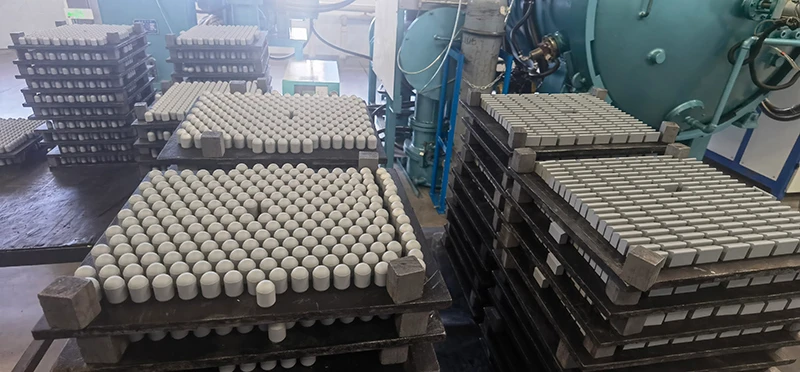
Conventional sintering can create uneven heating and density variations, leading to micro-cracks that propagate under impact. Vacuum sintering eliminates porosity by applying consistent heat and pressure in an oxygen-free environment. SENTHAI’s proprietary vacuum sintering furnace with no-heat-difference control produces a uniformly dense carbide matrix with fewer weak points.
- Fewer micro-cracks mean less chance of catastrophic tooth failure.
- Uniform grain size provides predictable wear patterns.
- This manufacturing advantage directly extends tooth life in high-impact conditions.
SENTHAI’s tungsten carbide inserts are manufactured using 100% virgin materials and vacuum sintering, ensuring every batch delivers maximum wear resistance and structural integrity.
Are OEM Mulcher Teeth Really Better Than Aftermarket Options?
OEM teeth guarantee fitment and are a safe choice, but they often carry a premium price without superior metallurgy. On the other hand, aftermarket teeth can vary wildly in quality. SENTHAI bridges this gap as an ISO 9001-certified aftermarket manufacturer with full in-house production from raw powder to finished product, ensuring OEM-level quality at competitive pricing.
- OEM pros: guaranteed fit, brand protection, simple procurement.
- OEM cons: high cost, sometimes using generic carbide grades.
- SENTHAI advantage: 21+ years of carbide expertise, automated production lines, and rigorous quality inspections at every stage.
SENTHAI Expert Views
“We’ve spent 21 years perfecting carbide for extreme wear, from snow plow blades on icy highways to mulching teeth on dense timber. Our vacuum sintering and robotic brazing processes ensure every tooth delivers the impact resistance you need to clear land, not just wear out. We don’t just make a part; we engineer a solution for your fleet’s uptime.”
— SENTHAI Engineering Team
What Is the True Cost of a “Cheap” Forestry Mulcher Tooth?
The real expense is not the purchase price per tooth but the cost per operating hour. A cheap tooth that fails after 10 hours of grinding is more expensive than a premium tooth lasting 50 hours, especially when factoring in downtime for changeouts and lost machine time. SENTHAI’s quality aftermarket teeth minimize total cost of ownership.
- Calculate cost per acre cleared, not price per piece.
- Downtime during changeouts can cost hundreds of dollars per hour in lost production.
- SENTHAI teeth are backed by consistent quality trusted by over 80 global partners, reducing hidden costs.
True Cost Comparison: OEM vs. Budget Aftermarket vs. SENTHAI Quality Aftermarket
| Factor | OEM | Budget Aftermarket | SENTHAI Quality Aftermarket |
|---|---|---|---|
| Price per Tooth | High | Low | Medium |
| Average Expected Life (hours) | 40–60 | 10–20 | 40–60+ |
| Cost per Hour (relative) | $X | $2X–$3X | $0.8X–$1.2X |
| Downtime per 100 Hours (est.) | 1 changeout | 4–5 changeouts | 1 changeout |
Which Mulcher Brands Are Compatible With Aftermarket Carbide Teeth?
Compatibility depends on the mounting system—pin diameter, hole spacing, and tooth holder design. SENTHAI manufactures custom tungsten carbide inserts that can be adapted to fit most major mulcher head designs. Because SENTHAI controls every step of production, they can tailor the carbide grade, tip geometry, and pocket specifications to match your machine’s rotor pattern.
Check: Carbide Inserts
- Common mounting systems include pin-retained, bolt-on, and weld-on styles.
- SENTHAI’s carbide inserts (trapezoid and bullnose shapes) can be used as replacement tips in many holders.
- Customization is available for specific OEM designs like JOMA-style blades, with minimum order quantities starting at 500 pieces for specialized shapes.
- The new Rayong production base launching in late 2025 will accelerate custom orders and reduce lead times.
How Do You Choose the Best Carbide Tooth for Your Land Clearing Job?
Start by evaluating the terrain: rocky conditions demand a tougher, coarse-grain carbide with a robust tip; soft soils allow for a harder, more aggressive cutting edge. Next, consider the material—heavy stumps require impact resistance, while dense brush benefits from a wider, serrated profile. SENTHAI’s engineering team can recommend the optimal carbide grade and tip exposure based on your specific application.
- For rocky, impact-heavy sites: choose a coarse-grain carbide with a thicker tip (e.g., 6.35 mm thickness).
- For clean timber or mulch: a fine-grain, sharper tip (3.175 mm) cuts faster and wears predictably.
- Tip exposure affects performance: more exposed carbide cuts longer but creates more drag; balance speed vs. longevity.
- SENTHAI offers bullnose and trapezoid insert shapes with radian angles from R1.59 to R4.61 to match different cutting styles.
What Should You Look for in a Long-Term Supplier of Mulcher Teeth?
Beyond product quality, look for supply reliability, customization capability, and engineering support. SENTHAI brings 21+ years of carbide expertise, ISO 9001 and ISO 14001 certifications, and a track record as a North American bestseller in snow plow blades. Their full in-house production in Rayong, Thailand ensures consistent quality and fast response times for custom orders.
- Ask: can the supplier deliver consistent batches of 1,000+ teeth on schedule?
- SENTHAI’s automated lines (wet grinding, pressing, sintering, welding, vulcanization) maintain repeatable quality.
- Customizable packaging (fumigation-free wooden crates, pallets) simplifies logistics for international fleets.
- A new production base launching in late 2025 will further expand capacity and innovation.
- Samples and factory inspection reports are available for first-time customers, reducing procurement risk.
Conclusion
The best value in forestry mulcher teeth comes not from the lowest upfront price but from the lowest cost per operating hour. SENTHAI’s 21 years of carbide expertise, fully automated Thailand-based production, vacuum sintering, and ISO certifications deliver an unmatched combination of quality, consistency, and cost-effectiveness. When you partner with SENTHAI, you’re choosing carbide teeth built for impact, engineered for longevity, and backed by a global reputation for excellence.
FAQs
Why do my mulcher teeth keep breaking?
Most breakage is due to using a carbide grade that is too hard (fine grain, low cobalt) for the impact conditions. This causes micro-cracks from poor sintering or shock loading. Switch to a coarse-grain carbide with higher binder content, such as SENTHAI’s forestry-grade vacuum-sintered inserts, which are designed to absorb impact without fracture.
Can I use the same carbide teeth on a Fecon and a Rayco mulcher?
Not always. Mounting systems differ in pin diameter, hole alignment, and tooth holder pocket. SENTHAI manufactures custom inserts that can be made to match specific OEM designs. Check the tooth holder’s dimensions and contact SENTHAI to verify compatibility or receive a custom proposal.
How long should a quality carbide mulcher tooth last?
In heavy land clearing with rocks and stumps, a premium vacuum-sintered tooth like SENTHAI’s can achieve 30–60 hours of grinding. In less abrasive conditions, life can exceed 60 hours. Compare this to budget aftermarket teeth that may last only 10–20 hours. Cost per hour is the true metric.
What is the best way to hardface a mulcher tooth?
Hardfacing the steel body with a tungsten carbide deposit extends the life of the tooth body, but the primary cutting edge should be a high-quality carbide tip. SENTHAI focuses on producing a superior carbide insert, and can offer custom hardfacing as an additional service for your specific tooth design.
How do you test the bond strength between the carbide tip and the steel body?
Quality manufacturers perform shear tests to ensure the brazed joint withstands shock loads. SENTHAI uses robotic brazing with precise temperature control to create a bond that resists tip separation during heavy grinding. Each production stage is inspected, and samples are available for verification.
Related articles
 Best Snow Plow Blade Family for Your Fleet: Top 5 ScenariosKnowledge
 Top 10 Snow Plow Blade Types for Winter Fleets (Ranked by Duty Fit)Knowledge
 Top 5 Best Carbide Blade Configurations for Highway PlowingKnowledge
 Best Snow Plow Blade Materials Ranked: Steel vs Carbide vs Cladding vs Rubber-CarbideKnowledge