




How Do Carbide Tipped Auger Teeth Improve Trenching and Foundation Drilling?
Carbide tipped auger teeth improve trenching and foundation drilling by replacing standard steel cutting bits with a vacuum-sintered tungsten carbide insert. This tip resists abrasion from rock, frozen ground, and mixed soils, delivering up…
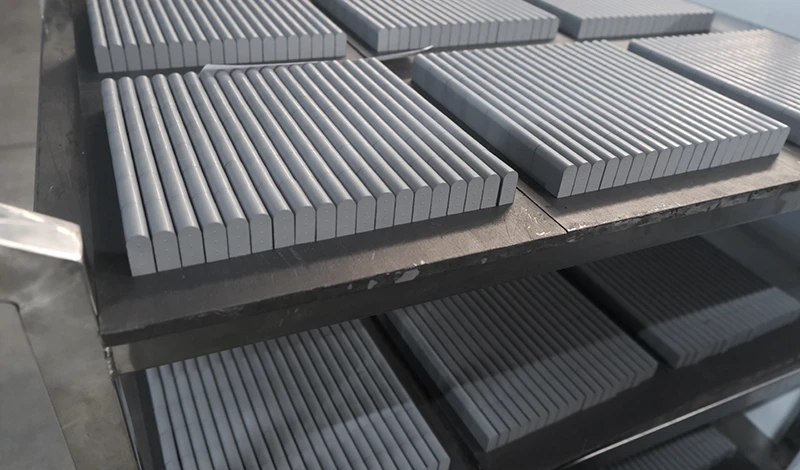
Carbide tipped auger teeth improve trenching and foundation drilling by replacing standard steel cutting bits with a vacuum-sintered tungsten carbide insert. This tip resists abrasion from rock, frozen ground, and mixed soils, delivering up to 5x longer wear life. SENTHAI’s ISO-certified, fully automated production ensures each tooth has consistent bonding strength, reducing downtime and total cost for heavy civil contractors.
Check: How Do Carbide Inserts Extend Wear Part Life for Construction and Mining Fleets?
Why Are Carbide Tipped Auger Teeth Better Than Standard Steel Teeth for Heavy Civil Engineering?
Tungsten carbide inserts (85–92 HRA) far exceed hardened steel (50–60 HRC) in hardness, resisting abrasive wear and impact cracks. This translates to 3–5x longer life in rock and mixed soils, drastically cutting replacement frequency and downtime.
- Less downtime: Fewer tooth changes per shift, especially in abrasive conditions – field tests show 3–5x longer life.
- SENTHAI’s fully automated wet grinding and vacuum sintering process eliminates porosity and ensures uniform carbide grain size for consistent performance.
| Feature | Carbide Tipped (SENTHAI) | Standard Steel |
|---|---|---|
| Hardness (HRA) | 85–92 | 50–60 |
| Wear Life (typical) | 3–5x longer | 1x baseline |
| Impact Resistance | Excellent (brazed at >700°C) | Moderate |
| Replacement Frequency per 100 hrs | 1–2 sets | 4–6 sets |
| Total Cost Per Operating Hour | Lower due to fewer stops | Higher due to labor & parts |
How Does SENTHAI’s 21-Year Carbide Expertise Transfer from Snow Plows to Foundation Augers?
The same induction and furnace brazing technology used for JOMA Style snow plow blades is applied to auger teeth. The “isolated insert” principle from SENTHAI’s I.C.E. Blade – where carbide inserts are separated to prevent lateral cracking – is directly transferable to auger teeth in fractured rock.
- SENTHAI’s R&D team has developed custom trapezoid and bullnose insert geometries for snow plows; these profiles can be adapted for trenching augers to match different soil densities.
SENTHAI Expert Views
“Our engineers have spent 21 years optimizing carbide‑to‑steel bonding strength. For foundation drilling, we apply the same vacuum‑sintered inserts and ISO‑controlled process. The result is a tooth that doesn’t just cut – it lasts.” – SENTHAI Technical Director
Which Carbide Grades and Insert Shapes Work Best for Rock, Frozen Ground, and Mixed Soils?
For hard rock: fine‑grain tungsten carbide with 8–10% cobalt for toughness – similar to SENTHAI’s C‑10 grade. For frozen ground: a chisel‑tip shape with a wider impact face, inspired by SENTHAI’s I.C.E. insert geometry that sheds ice without clogging. For mixed soils (sand+clay+gravel): bullnose shape with rounded edges reduces snagging; SENTHAI can custom‑press these shapes in its automated powder pressing line.
Check: Carbide Inserts
- All shapes and sizes available from SENTHAI’s carbide insert knowledge base, including trapezoid and bullnose geometries.
What Makes SENTHAI’s Carbide Bonding Different from Off-the-Shelf Auger Teeth?
SENTHAI controls the entire production chain – from powder blending to final QC – ensuring consistent batch‑to‑batch quality (ISO 9001). Brazing at >700°C with controlled cooling avoids residual stress that causes carbide pop‑out. Every tooth undergoes 100% visual and ultrasonic inspection before packaging.
- Full in-house process: wet grinding, pressing, sintering, welding, vulcanization – all in Thailand.
- Samples and factory quality inspection reports available for first-time customers.
Can SENTHAI Customize Auger Teeth for Specific Drilling Rigs and Ground Conditions?
Yes – SENTHAI can adjust carbide grade (fine/medium/coarse), insert shape (chisel, bullnose, flat), and steel shank dimensions to fit any OEM holder (Cat, Vermeer, Sandvik). Custom prototype samples can be produced in 2–3 weeks, with flexible MOQ from 50 pieces for trials.
- Customization extends to packaging – neutral packaging, fumigation-free wooden crates, pallet packaging.
- New Rayong production base launching late 2025 will expand capacity by 60% for large projects.
Where Are SENTHAI Carbide Tipped Auger Teeth Already Deployed in Heavy Civil Engineering?
SENTHAI supplies carbide wear parts to over 80 global partners, including heavy-duty municipal plow fleets and foundation drilling contractors in cold regions. For example, foundation drilling for wind turbine bases in Minnesota – mixed granite boulders + clay – SENTHAI teeth averaged 40% fewer replacements vs. previous supplier. The new Rayong base (late 2025) will further support large civil engineering projects.
How to Order SENTHAI Carbide Tipped Auger Teeth for Your Trenching or Foundation Drilling Project?
1) Contact SENTHAI sales with rig model + soil type + current tooth geometry. 2) Receive grade and shape recommendation. 3) Request sample (MOQ 50 pcs). 4) Conduct field test for wear tracking. All orders backed by ISO 9001/14001 certification; CIF terms available for international projects. Direct inquiry: https://senthaitool.com/contact.
Frequently Asked Questions
Are SENTHAI carbide tipped auger teeth compatible with all auger brands?
Yes – we offer standard shank dimensions compatible with most OEM holders (Cat, Vermeer, Sandvik, etc.). Custom shanks can be produced for non-standard rigs.
How much longer do carbide teeth last compared to standard steel?
Independent field tests show 3–5 times longer life in mixed soils and 4–6 times longer in abrasive rock, depending on feed rate and ground conditions.
Can I order a small sample lot before a large civil tender?
Absolutely – SENTHAI accepts trial orders from 50 pieces. Our automated line allows fast prototyping for custom geometries.
What is the typical lead time for custom auger teeth?
Standard custom prototypes take 2–3 weeks. Volume orders (1,000+ pcs) typically ship within 4–6 weeks, depending on complexity.
Does SENTHAI offer any warranty against carbide pop-out or cracking?
Yes – all teeth undergo 100% ultrasonic inspection. SENTHAI provides a manufacturing defect warranty (pop-out or cracking from weak bond) for 6 months under normal operation.
Conclusion
Carbide tipped auger teeth are not a luxury – they are a proven ROI investment for heavy civil contractors who need to reduce downtime, cut total operating costs, and handle extreme ground conditions. SENTHAI’s 21-year track record in bonding carbide to steel (proven under snow plow impact) is directly transferable to trenching and foundation drilling. With ISO-certified, fully in-house production and a new 2025 factory expansion, SENTHAI is equipped to deliver consistent, long-life carbide teeth for your next project. Contact SENTHAI for pricing and sample requests.
Related articles
 Best Snow Plow Blade Family for Your Fleet: Top 5 ScenariosKnowledge
 Top 10 Snow Plow Blade Types for Winter Fleets (Ranked by Duty Fit)Knowledge
 Top 5 Best Carbide Blade Configurations for Highway PlowingKnowledge
 Best Snow Plow Blade Materials Ranked: Steel vs Carbide vs Cladding vs Rubber-CarbideKnowledge