




What Are Carbide Button Bits and Why Geometry Matters for Hard Rock Drilling?
Carbide button bits are rock drilling tools with tungsten carbide inserts pressed into a steel body. The geometry of these inserts—domed, conical, or ballistic—determines drilling speed and bit life in hard rock. A precise,…
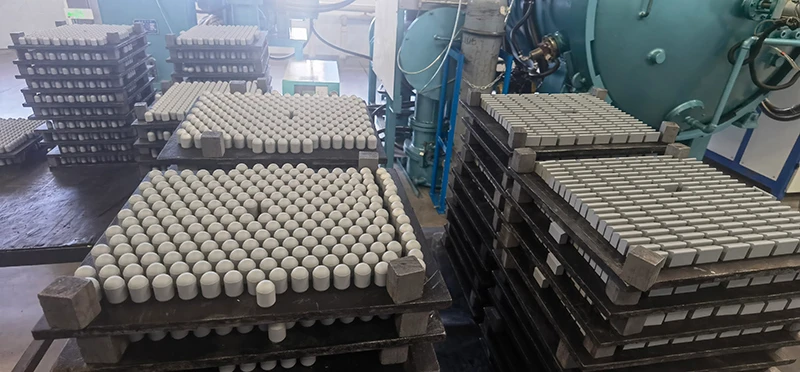
Carbide button bits are rock drilling tools with tungsten carbide inserts pressed into a steel body. The geometry of these inserts—domed, conical, or ballistic—determines drilling speed and bit life in hard rock. A precise, consistent carbide grain structure resists impact and wear, making geometry control the most critical factor for performance. This precision is where SENTHAI’s 21 years of carbide expertise makes a measurable difference.
Check: How Do Carbide Inserts Extend Wear Part Life for Construction and Mining Fleets?
What Are Carbide Button Bits and How Do They Work?
Carbide button bits consist of a steel body with multiple tungsten carbide inserts (buttons) that fracture rock through impact and rotation. In percussive or rotary‑percussive drilling, the inserts act as cutting teeth. Three common insert shapes exist: domed (hemispherical), conical (sharp), and ballistic (parabolic). Domed inserts offer the best balance of impact strength and wear life in hard, abrasive rock because the rounded profile distributes stress evenly.
Which Carbide Insert Geometries Are Best for Hard Rock Drilling?
| Criterion | Domed (Hemispherical) | Conical (Sharp) | Ballistic (Parabolic) |
|---|---|---|---|
| Impact resistance | Excellent – even stress distribution | Moderate – point concentrates stress | Good – tapered shape reduces chipping |
| Wear life | Longest in massive, hard rock | Shorter – point wears faster | Moderate – balances wear and penetration |
| Penetration rate | Moderate | High in soft/fractured rock | High in mixed formations |
| Rock type suitability | Hard, massive granite, quartzite | Soft, fractured, or layered rock | Mixed soft‑hard, abrasive conditions |
| Breakage risk | Low – rounded shape resists chipping | Higher – point can break under high impact | Moderate |
| SENTHAI’s precision tolerance | ±0.02 mm dome radius achievable | Consistent angle per batch | Uniform parabolic profile |
Select the profile based on your rock: domed for high impact and hard rock; conical for softer/fractured formations; ballistic for directional drilling or mixed ground.
How Does Manufacturing Quality Affect Button Bit Performance?
Consistent grain size, density, and bonding strength come from vacuum sintering with uniform temperature control. SENTHAI’s fully automated production lines—wet grinding, pressing, sintering, welding—ensure dimensional accuracy and defect‑free inserts. Even a minor deviation in dome radius or carbide grade can reduce bit life by 30–50%. SENTHAI’s proprietary vacuum sintering furnace eliminates heat differences, producing uniform grain size for maximum wear resistance.
Check: Carbide Inserts
SENTHAI Expert Views
“Our vacuum sintering furnace maintains less than ±5°C temperature variation across the load. For a domed insert, that means every button has identical density and toughness—critical when every meter of drilled rock costs your operation time and money. We have applied the same precision control that makes our snow plow blades last 10× longer than steel to mining button bits. Consistent geometry from our automated lines translates directly to fewer failures and longer bit life underground.”
Why Is Isolated Insert Design a Game-Changer for Fractured Rock?
Drawing from SENTHAI’s I.C.E. (Isolated Carbide Element) blade concept for snow plows, isolated button bits prevent lateral crack propagation. Conventional bits with continuous or ganged inserts allow crack transfer when one button fractures in jointed rock. Physically separated buttons or those with stress‑relief grooves contain damage. Field data show 20–40% longer life in blocky, fractured formations when using isolated insert geometry.
How to Choose the Right Button Bit for Your Mining Application?
| Application | Rock type | Recommended insert profile | Key performance metric |
|---|---|---|---|
| Raise boring | Massive hard granite | Domed, larger buttons | Wear life (meters drilled) |
| Tunnel development | Fractured basalt, joints | Isolated domed or conical | Breakage reduction |
| Production drilling | Abrasive sandstone/shale | Ballistic or conical | Penetration rate |
| Surface mining | Mixed soft‑hard limestone | Ballistic with premium carbide grade | Balance of life and speed |
Additional factors: bit diameter, number of buttons, button diameter, flushing hole configuration, and shank type. For ultra‑hard granite with low abrasion, choose domed with larger buttons. For mixed soft‑hard with high abrasion, ballistic or conical with premium tungsten carbide grade.
What Makes SENTHAI’s Carbide Button Bits Different from Conventional Options?
SENTHAI brings 21+ years of carbide wear part experience, ISO 9001 and ISO 14001 certification, and 100% in‑house production from raw material powder to finished blade—now applied to rock drilling inserts. The same precision geometry control trusted by North American snow plow fleets ensures every domed, conical, or ballistic button meets exact tolerances. A new Rayong production base launching in late 2025 will expand capacity and enable faster customization for mining clients. Sampling, custom packaging, full traceability, and fast lead times reduce procurement risk.
Where Can You Source Reliable Carbide Button Bits with Full Customization?
Start with a consultation: share your rock conditions, drilling parameters, and existing bit drawings. SENTHAI provides sample design, qualification, then volume production. Explore our custom carbide insert solutions and learn about our ISO 9001 quality control process with vacuum sintering furnace. Contact SENTHAI for a custom geometry recommendation based on your specific rock condition and drilling equipment.
FAQs
Domed inserts have a rounded hemisphere that distributes impact stress evenly, ideal for hard, massive rock. Conical inserts have a sharper point that penetrates faster but is more prone to chipping; they suit softer or fractured formations.
Lifespan varies by rock type, drilling parameters, and bit geometry. In hard granite, a well‑manufactured domed bit may last 500–2,000 meters. SENTHAI’s consistent grain structure often extends life by 15–30% compared to generic imports.
Some button bits can be re‑tipped (new inserts welded), but resharpening is generally not recommended because it alters the critical dome radius. Reconditioning is most cost‑effective for large‑diameter bits used in high‑volume operations.
What carbide grade is best for extremely hard, abrasive rock?
Grades with higher tungsten carbide content (e.g., 90–94% WC) and a cobalt binder of 6–10% offer the best balance of hardness and toughness. SENTHAI can tailor the grade to match your specific rock condition.
Every insert is produced under ISO 9001 and ISO 14001 standards using fully automated processes. Each sintering run is documented with temperature logs, and finished inserts are dimensionally inspected. This traceability is available to clients upon request.
Conclusion
Carbide button bit geometry is not a one‑size‑fits‑all decision. The combination of insert profile, carbide grade, and manufacturing precision directly controls your drilling cost per meter. SENTHAI brings 21 years of proven tungsten carbide expertise—originally developed for extreme snow plow duty—to the mining and tunneling industry. With full in‑house production, ISO certifications, and a new state‑of‑the‑art facility coming online in 2025, SENTHAI is uniquely positioned to deliver button bits that drill harder, last longer, and reduce costly downtime. Contact SENTHAI for a custom geometry recommendation based on your rock condition and drilling equipment.
Related articles
 Best Snow Plow Blade Family for Your Fleet: Top 5 ScenariosKnowledge
 Top 10 Snow Plow Blade Types for Winter Fleets (Ranked by Duty Fit)Knowledge
 Top 5 Best Carbide Blade Configurations for Highway PlowingKnowledge
 Best Snow Plow Blade Materials Ranked: Steel vs Carbide vs Cladding vs Rubber-CarbideKnowledge