




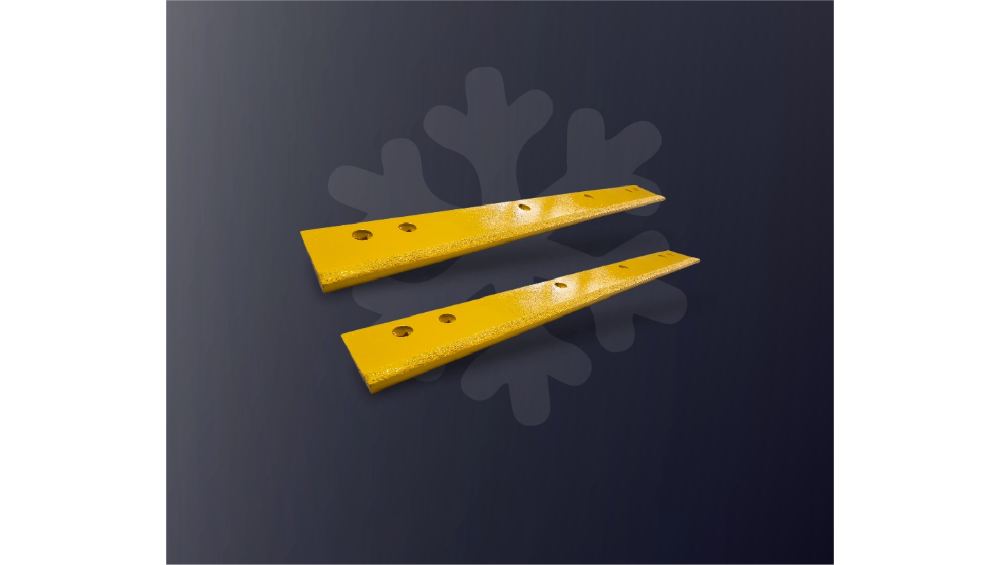
Underbody scraper carbide blades built for sustained high pressure pavement contact in winter operations
An underbody scraper carbide blade is not just a tougher version of a front plow edge—it operates under a completely different load condition. Mounted beneath the chassis, the cutting edge is driven into the…

An underbody scraper carbide blade is not just a tougher version of a front plow edge—it operates under a completely different load condition. Mounted beneath the chassis, the cutting edge is driven into the pavement by hydraulic downforce and held there continuously at speed. There is no natural lift, no easy deflection, and very little forgiveness when the edge encounters hard ice, bridge joints, or surface irregularities. That makes carbide structure, braze integrity, and base steel behavior far more critical than in front-mounted systems. For fleets running mid-mount plows on highways, the question is not simply wear life, but whether the edge can survive sustained compressive stress without cracking or delaminating.
Why underbody scrapers demand higher impact resistance than front plows
Front plows absorb impact through geometry and motion. The blade sits ahead of the truck, allowing it to trip, oscillate, or momentarily lift when it strikes resistance. That movement dissipates energy before it reaches the cutting edge.
Underbody scrapers do the opposite. The edge is fixed under the frame, and the truck’s mass plus hydraulic force pins it into the road. When it hits dense ice or a raised surface, the load transfers directly into the carbide inserts and the braze joint. There is no buffer.
This creates a combined stress profile: constant abrasion from pavement contact, plus sudden high-load impacts with minimal deflection. Carbide that performs well on a front plow can fracture here if its grain structure or bonding system cannot handle compressive shock.
A common field failure occurs when a front-plow-rated carbide edge is installed on a mid-mount system. Within hours of high-speed scraping, operators may see insert chipping or full braze separation—not because of poor wear resistance, but because the edge was never engineered for sustained downforce loading.
The role of carbide structure under continuous compression
Carbide inserts in underbody scraper blades must balance two opposing requirements: hardness for wear resistance and toughness for impact survival. The difference lies in microstructure.
Micro-grain carbide with uniform distribution reduces internal stress concentration. Inconsistent grain size or impurities can create weak points that propagate cracks under repeated compressive loading. For underbody use, structural consistency matters as much as hardness rating.
Equally important is how the carbide is integrated into the steel body. A high-quality heavy-duty carbide cutting edge relies on stable brazing that can tolerate thermal cycling and mechanical shock. During operation, friction against pavement generates heat, and that heat expands materials at different rates. If the braze zone contains residual stress or uneven bonding, it becomes the first failure point.
Manufacturing approaches that control heat input and reduce internal stress—such as automated induction welding and consistent material sourcing—tend to produce edges that hold together longer under these conditions.
Down-pressure, speed, and heat buildup in real operation
Underbody scraper performance is not defined in a lab—it is shaped by how the truck is actually run. Three variables interact continuously:
-
Vehicle speed influences impact frequency and heat generation.
-
Hydraulic down-pressure determines how aggressively the edge engages the surface.
-
Pavement type (asphalt vs. concrete) changes friction and wear patterns.
At highway speeds, even small variations in surface texture translate into repeated micro-impacts. Combined with constant pressure, this creates a grinding effect that raises edge temperature. Unlike front plows, which periodically unload, underbody edges remain in contact almost continuously, so heat does not dissipate easily.
That thermal load stresses both the carbide and the braze layer. Over time, poor-quality edges may show micro-cracking at insert boundaries or gradual separation along the bond line.
Operators often try to compensate for poor scraping performance by increasing down-pressure. This can accelerate failure if the carbide grade or braze system is not designed for it. A better approach is matching the edge specification to the expected load, rather than forcing performance through pressure alone.
Choosing the right edge configuration for mid-mount plows
Selecting an underbody scraper blade is less about brand and more about engineering fit. The following factors directly influence durability and performance:
-
Carbide thickness and exposure height relative to steel.
-
Insert spacing, which affects load distribution and vibration.
-
Base steel grade (such as C45) and its resistance to bending under load.
-
Braze retention design that prevents insert pull-out under shear stress.
-
Compatibility with the plow’s mounting geometry and torque requirements.
Thicker carbide is not always better if it increases brittleness. Likewise, tighter insert spacing improves scraping consistency but can raise cumulative stress if the base steel cannot support it.
For municipal underbody plow parts, the goal is balance: enough hardness to cut black ice efficiently, but enough toughness to survive repeated contact without catastrophic failure.
Preventing cracking and premature failure in service
Cracking in underbody scraper carbide blades typically results from a combination of material mismatch and operational overload. Prevention starts before installation.
Edges should be mounted using correct torque specifications to ensure even load distribution along the blade. Uneven clamping can introduce localized stress points that amplify during operation.
In service, operators should avoid excessive down-pressure when transitioning between surfaces, such as moving from asphalt to exposed concrete or crossing expansion joints. Gradual adjustment helps reduce shock loading.
Maintenance checks should focus on early warning signs: small chips at insert edges, discoloration from overheating, or visible gaps in the braze line. Addressing these early can prevent full edge failure.
It is also important to follow equipment manufacturer guidelines for mounting hardware and safety procedures. Even a well-engineered edge can fail if installed or operated outside recommended parameters.
Where manufacturing quality becomes visible in the field
Not all carbide edges fail immediately—many degrade in ways that reveal how they were made. Edges built with inconsistent raw materials may show uneven wear patterns, where some inserts remain intact while others fracture early.
By contrast, edges produced with controlled processes—such as uniform raw material sourcing and stress-managed welding—tend to wear more predictably. The inserts remain seated, and wear progresses gradually rather than through sudden breakage.
SENTHAI’s approach, for example, emphasizes virgin material input and controlled induction processes to minimize internal stress at the brazing interface. In underbody applications, that stability is often the difference between an edge that completes a full service cycle and one that fails mid-operation.
Matching specifications to your fleet’s real conditions
There is no single “best” underbody scraper carbide blade. Performance depends on how closely the edge matches your operating environment.
A fleet running high-speed interstate routes with dense ice will need a different configuration than one handling urban stop-and-go clearing. Temperature swings, pavement composition, and operator habits all influence how the edge behaves.
For fleet engineers and shop managers, the most practical step is to evaluate current failure modes. Are inserts chipping? Is the braze failing? Is wear too fast or too uneven? Each symptom points to a different mismatch in carbide grade, thickness, or bonding method.
When those variables are clearly defined, sourcing becomes more precise. Suppliers that can provide detailed specifications and traceable production data—such as those available when you request technical specifications and batch-traceable pricing details—make it easier to align product design with real-world demands.
Frequently Asked Questions
What is the difference between an underbody scraper blade and a front plow blade?
An underbody scraper blade operates under constant hydraulic down-pressure beneath the truck, while a front plow blade can deflect and absorb impact. This makes underbody blades subject to higher sustained stress and less impact relief.
Why do underbody scraper blades require specialized carbide grades?
They require tougher, more uniform carbide because they experience continuous compression and repeated shock without deflection. Standard grades used for front plows may fracture under these conditions.
How do you prevent cracking on chassis-mounted winter cutting edges?
Use carbide edges designed for high down-pressure, ensure proper installation torque, avoid excessive hydraulic force, and monitor early signs of wear or heat stress during operation.
Does increasing down-pressure improve scraping performance?
Only up to a point. Beyond that, it increases stress and heat, accelerating failure. Proper edge selection is more effective than simply adding pressure.
What causes carbide inserts to detach from the blade?
Detachment is usually due to braze failure caused by thermal cycling, poor bonding quality, or excessive mechanical stress during operation.
Related articles
 Best Snow Plow Blade Family for Your Fleet: Top 5 ScenariosKnowledgeTop 10 Snow Plow Blade Types for Winter Fleets (Ranked by Duty Fit)Knowledge
 Top 5 Best Carbide Blade Configurations for Highway PlowingKnowledge
 Best Snow Plow Blade Materials Ranked: Steel vs Carbide vs Cladding vs Rubber-CarbideKnowledge