JOMA Style Blade Design: What Makes It Different in Service
What makes a JOMA style blade different in service: flex behaviour on rough surfaces compared with rigid edges, plus fitment and cost per metre.

A rigid cutting edge and a flexible one can look interchangeable on a quotation and behave completely differently on a broken, unsealed road. A JOMA style blade is built around a rubber-flex segment, and that construction changes how the edge follows the surface, how it behaves when it hits an obstruction and how the fleet replaces it. The difference is easiest to see on the routes that punish a rigid edge: rough shoulders, patched asphalt and roads that change profile across a single pass.
What a JOMA Style Blade Is Designed For
It is designed to follow a surface rather than fight it.
A flexible segment deflects when it meets an obstruction and returns to position, so the edge keeps contact across an uneven profile. That suits unsealed and broken surfaces.
The design intent follows from the surface. Where a road changes angle frequently, a rigid edge transmits every variation into the plow as a shock load, and the operator responds by adjusting height or speed to reduce damage. A flexible segment absorbs part of that variation locally, which keeps more of the edge in contact and reduces the shock reaching the machine. The result is a different wear pattern: material loss distributed along the segment rather than concentrated at the positions that meet the hardest part of the surface.
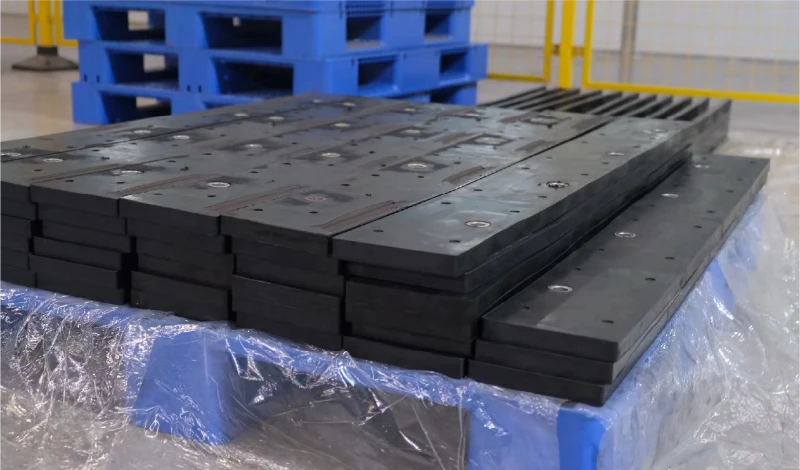
Construction sets the limits as well as the benefits. A flexible segment is supplied in sections rather than as one continuous edge, which is what allows an individual section to be replaced without removing the whole assembly. The SENTHAI range covers JOMA style rubber-flex blades in 3ft and 4ft segments plus custom sizes, and the behaviour described here depends on the segment being fitted correctly; the mounting detail is covered in the JOMA style compatibility guide. Where a segment carries carbide inserts, the material carries the abrasion load while the flex element carries the deflection, which is why insert grade and flex behaviour are specified together; background on tungsten and cemented carbide applications is published by the International Tungsten Industry Association.
How It Differs From a Rigid Edge in Service Life
It trades edge stiffness for contact and shock tolerance.
On rough ground a rigid edge loses contact at high points and takes the full shock at obstructions, while a flexible segment deflects and returns. Wear then develops differently.
Service life follows the same logic as any cutting edge, with one addition. On an abrasive unsealed surface, material loss is driven by the amount of contact and the abrasive content of the material being pushed. A flexible edge that maintains contact may wear faster along its working face than a rigid edge that skips across the surface, while damaging the machine far less. It can also last longer overall, because it is not being replaced after shock damage rather than wear.
Segment construction changes the replacement decision as well. A rigid edge retires as a single unit, whereas a segmented blade allows the section that has worn or been damaged to be exchanged. That is a maintenance advantage in the middle of a season and a cost advantage over the life of the assembly, provided the fleet records which positions wear fastest so rotations can be planned rather than reactive.
Surface and Condition Differences on Rough and Unsealed Roads
The specification earns its place on surfaces with variation rather than on uniform pavement. Unsealed roads, gravel shoulders, patched asphalt and streets with repeated frost heave all present a profile that changes over short distances, which is where a flexible edge maintains contact and a rigid edge alternates between digging in and riding high.
On smooth, high-speed routes the case is weaker. A rigid edge with a defined profile holds a consistent scraping angle across the full width, and the compliance that helps on broken surfaces contributes less where the surface does not vary. Fleets that run both usually specify flexible segments for the routes that need them and keep the rigid profile elsewhere, which is the option with the clearest evidence base after a season.
Seasonal conditions matter as well. Where a route holds refrozen snow, contact becomes the limiting factor for any edge type, and the decision shifts toward the specifications intended for that condition. Where a route is mostly loose snow over an uneven surface, a flexible edge often produces a better result than a stiffer profile. Maintenance practice on ice-covered networks is a recurring theme in the pooled research published by Clear Roads, and the blade selection guide covers how surface and carrier characteristics map to edge type.
Operational Trade-Offs Beyond Wear With JOMA Style Flexible Blades
The first trade-off is inspection. A flexible segment deflects under load, so a quick visual check tells the operator less than it would on a rigid edge. Wear has to be measured at fixed points on each segment, and the segment’s position and hours have to be recorded for the readings to mean anything. Fleets that adopt segmented blades without changing the inspection routine usually discover wear late.
The second is handling and storage. Segments are individual items rather than one long assembly, which makes them easier to move but increases the number of parts to track. Labelling segments by position and keeping them racked flat prevents the common problem of a fleet losing track of which section was replaced and when.
The third is the effect on the machine. Because the flexible edge absorbs part of the shock, the trip mechanism and mounting hardware see less peak load on rough routes, which reduces unplanned workshop time. That benefit does not appear in a parts comparison, and it is one of the reasons a cost per metre calculation run on parts alone usually understates the case for flexible segments.
Fitment and Equipment Compatibility for JOMA Style Flexible Blades
Fitment decides whether the design can be used on a given plow. SENTHAI validates fitment against AASHTO and DIN bolt patterns before release and works to plus or minus 0.02 mm dimensional tolerances on carbide components, with AASHTO published standards as the reference for agency specifications and DIN covering European and export conventions.
The practical check is the same as for any edge: measure the blade being replaced rather than the manual, and record hole diameter, centre-to-centre spacing, the distance from the top edge to the first hole row and the installed length. Where a moldboard is being fitted with segments for the first time, confirm the pattern with the supplier before production, and ask for the confirmation in writing. Where an OEM mounting interface is involved, SAE standards for mobile machinery describe the interface the equipment was designed around.
One compatibility point is specific to segmented blades: the number of segments required depends on the moldboard width and the segment size chosen, and mixing sizes on one blade is possible but complicates rotation and inventory. Settle that decision as part of the specification rather than at fitting time.
Cost Per Metre of Edge Compared Across JOMA Style Flexible Blades
Cost per metre is the comparison that resolves the question. The model structure is set out on the cost per mile page; between a rigid edge and a flexible segmented blade the inputs move as follows.
| Input | Rigid cutting edge | JOMA style blade |
|---|---|---|
| Purchase structure | One assembly per blade | Segments, so the unit of purchase is smaller |
| Replacement unit | Whole edge | Individual segment |
| Contact on rough ground | Alternates between digging in and riding high | Maintains contact by deflecting over variation |
| Shock reaching the machine | Transferred through the edge and mountings | Partly absorbed at the segment |
| Inspection | Visual check plus measured points | Measured points per segment, with position records |
| Inventory | Fewer part numbers | More parts to track, but smaller replacement units |
Two cautions belong with the table. Segmented construction produces a smaller replacement unit but more line items, and the administrative cost of tracking segments is real for a small fleet. And a cost comparison that ignores machine load will favour the cheaper rigid edge on routes where the flexible option prevents workshop time, which is precisely where the specification is most useful.

Fitting the Design Into a Fleet Programme
The design fits fleets whose networks contain a meaningful proportion of uneven surfaces, and it is best introduced on the routes where operators currently report losing contact or hitting obstructions. Those routes generate the shock loads and the repeat passes that a flexible segmented blade is intended to address.
A trial arrangement works in the same way as any other specification change: name the routes, fit the segments to a defined group of trucks, and record measured wear per segment position along with operator feedback and workshop interventions. After one season, the comparison against the rigid profile on comparable routes gives a purchasing decision that can survive review.
Two records make that review workable. The first is a short route description per truck covering surface type, gradient and how often operators report losing contact. The second is a segment log that captures position, hours run and measured wear at fixed points. Together they show whether the flexible specification addressed the condition it was chosen for, and they give the following season a comparison instead of an impression.
A JOMA style blade differs from a rigid edge in how it meets the surface rather than in what it is made of. Flexibility keeps contact on uneven ground, absorbs part of the shock load and divides the blade into replaceable segments, with the trade-off landing in inspection effort and inventory management.
Deciding well means matching the specification to the routes with surface variation, confirming the mounting pattern and segment count before ordering, and measuring wear per segment position so the next season’s plan follows evidence. Used that way, the design complements a rigid profile rather than replacing it.
Send SENTHAI the routes with uneven or unsealed surfaces, your plow models and current edge pattern, and the technical team will review segment size, fitment and hardware for each group.
Frequently Asked Questions
Can a JOMA style blade be used on smooth, high-speed routes?
It can, but the advantage is smaller. A rigid edge with a defined profile holds a consistent scraping angle across the full width, which matters on pavement that does not vary. The flexibility that helps on broken or unsealed surfaces contributes less where the profile is constant, so many fleets keep both specifications and match them to the route rather than standardising on one.
How should segments be inspected for wear?
Measure at fixed points on each segment and record the segment position, the hours run and the route class. A flexible segment deflects under load, so a visual check alone is less reliable than on a rigid edge. Keeping the readings with the position record is what allows sections to be rotated between trucks and replaced on evidence rather than on appearance.
Do flexible segments require different mounting hardware?
The mounting pattern follows the equipment, but the hardware set should be confirmed when changing edge type, because segment thickness and the number of fixing points differ from a one-piece edge. Confirm bolt length, washer type and torque specification with the supplier, and check the condition of the mounting holes before fitting. Reusing hardware from a different edge type is a common source of loosening.
Can segments of different sizes be combined on one moldboard?
It is technically possible where the pattern allows, and it is sometimes used to cover an unusual width, but it complicates rotation and inventory because the sections are no longer interchangeable. Where a moldboard needs an unusual configuration, custom sizes are available. Settle the segment arrangement as part of the specification so the fleet receives a consistent set rather than a combination that has to be tracked individually.