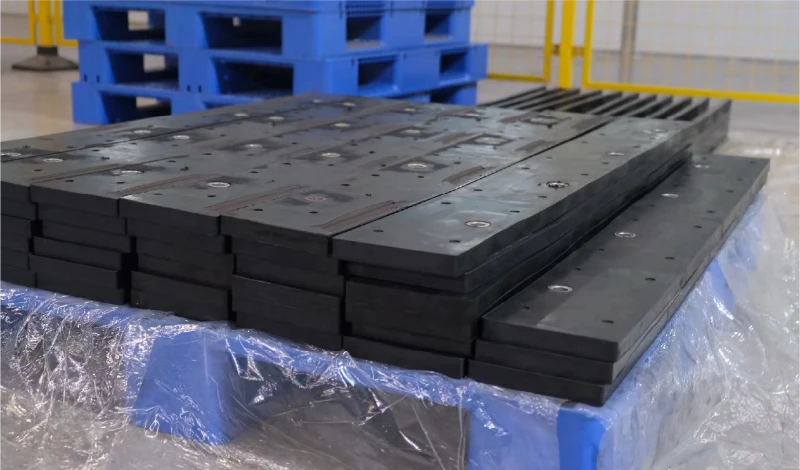
Custom JOMA Style Blades and OEM Programmes
Custom JOMA style blades and OEM programmes: the specification inputs, fitment consequences and continuity planning for non-standard widths.

A standard segment size covers most plow widths and not all of them. Where a moldboard does not divide cleanly, where equipment has been modified, or where an OEM is building around a blade rather than replacing one, a custom length or a bespoke arrangement is the practical answer. Custom production is a specification exercise, and it works when the inputs are measured rather than approximated.
What a Custom JOMA Programme Has to Deliver
It has to deliver fitment without losing the records.
A custom programme succeeds when the blade fits the measured interface, behaves like the assembly it replaces and can be reordered to the same specification, so the fleet’s wear records continue to describe the product it is buying.
That last requirement is what distinguishes a custom programme from a one-off. A blade made to a measured drawing is useful once; a blade made to a recorded specification can be reordered, and its performance can be compared with other groups. Where a custom length is produced without a specification record, the fleet ends up with a part that fits one machine and cannot be repeated.
The measurements a custom specification starts from are set out in the guide to measuring a blade for replacement. The production capability is described in the range of custom JOMA style snow plow blades, which covers non-standard lengths and arrangements as well as standard configurations.
Custom JOMA Style Blades: How They Differ From Standard Programmes
Behaviour should not differ; the administration does.
A standard and a custom blade of the same specification should perform the same in service. What differs is that a custom part has its own number, records and spares holding, and may not be interchangeable with anything else in the fleet.
That isolation is the main risk. A custom segment that fails cannot be replaced from the general rack, so the fleet needs a holding specific to that group. The holding should be calculated from the measured interval and the number of units rather than set as a proportion of the fleet, because a custom group is too small for percentage rules to be meaningful.
The practical response is to treat the custom group as its own small fleet with its own records. Its interval is measured from its own readings, its holding is calculated from its own consumption and its fitting procedure is written for its own arrangement. Where a fleet applies fleet-wide rules to a custom group, the group is either over-supplied or exposed, and neither outcome is visible until a shortage or an overstock appears.
There is a second consequence for records. Where a custom group runs alongside standard groups, its wear record must be kept separately, or a difference in performance cannot be attributed to the specification, the route or the custom arrangement. Keeping the group’s records distinct is what allows the custom specification to be evaluated on its own terms after a season.
Specification Inputs You Need Before Starting Custom and OEM JOMA Programmes
Six inputs define a custom programme. The measured mounting pattern, including hole diameter, spacing, row count and row position. The installed length the blade must cover. The number of units in the group and the plow classes involved. The route classes and surface mix the group works. The grade and arrangement proposed, with the basis for accepting an equivalent. And the documentation package required with each delivery.
Two further items prevent a custom programme from becoming unrepeatable. The first is a drawing, issued and version-controlled, that defines the segment arrangement, the mounting features and the tolerances at each. The second is an agreement that follow-on orders are produced to that drawing rather than to a description. SENTHAI works to plus or minus 0.02 mm dimensional tolerances on carbide components and validates fitment against AASHTO and DIN bolt patterns before release, with AASHTO published standards as the agency reference and DIN covering European and export conventions.
For OEM programmes there is a seventh input: the interface drawing from the equipment manufacturer, since an OEM blade is designed around the machine rather than replacing an existing part. Where an OEM mounting interface is involved, SAE standards for mobile machinery describe the interfaces those designs were built around, and the manufacturer’s own documentation governs.
The matching exercise for OEM interfaces is covered in more detail in the guide to matching JOMA style blades to OEM moldboards.
Fitment, Hardware and Installation Consequences for Custom and OEM JOMA Programmes
A custom length changes the arrangement, and the arrangement changes how the assembly is fixed. More or fewer segments means a different number of fixing positions, different hardware quantities and possibly a different torque value if the fastener specification changes. All of that should be confirmed with the drawing rather than derived at fitting.
Seated height is the second consequence. A custom arrangement meets the moldboard at the positions the drawing defines, and where those positions differ from the unit being replaced, the seated height can differ too. On a flexible blade that affects how the assembly deflects and therefore how it works on rough or uneven surfaces. Confirming seated height at the design stage removes an effect that would otherwise be discovered in service and attributed to the product.
Installation consequences should be written into the programme as a fitting procedure per group: the sequence, the torque value, the inspection points and the hardware set. Where a fleet runs both standard and custom groups, keeping those procedures separate prevents the most common error in a mixed fleet, which is fitting a custom group to the standard procedure and losing the benefit of the custom design.
Where a custom arrangement changes the number of segments, it also changes how the blade behaves across its width. A greater number of shorter segments deflects differently from a smaller number of longer ones, and the working face presented to the surface is not identical. For a fleet moving from a standard arrangement to a custom one on the same route class, the first season’s measurements are the evidence that the change behaved as expected, and they should be recorded as a new baseline rather than compared directly with the previous configuration.
Cost Per Metre and Replacement Logic for Custom Lengths
Cost per metre is calculated in the same way for a custom programme as for a standard one, and the inputs are the ones the fleet records anyway. The model structure is set out on the cost per mile page.
| Input | Standard programme | Custom programme |
|---|---|---|
| Unit definition | Stock segment sizes and arrangements | Drawing-specific segments and arrangement |
| Fitment confirmation | Against a published pattern | Against the measured interface or OEM drawing |
| Spares holding | Shared across groups using the same part | Specific to the group |
| Reorder lead time | Usually shorter, from stock configurations | Confirmed per order against the drawing |
| Record keeping | Comparable with other groups | Kept separately to allow evaluation |
| Specification change | Applies to several groups | Version-controlled on the drawing |
Replacement logic follows the arrangement. Where a custom group is made of segments, individual replacement remains possible, which limits the material retired per event. Where it is produced as a single arrangement, replacement is by unit and the interval is measured accordingly. Both are workable; the fleet should record which it is buying, because the spares holding depends on it.

Documentation and Traceability for OEM Supply
An OEM programme needs the same documentation as any other, applied to the interface it was designed around: dimensional inspection results at the mounting features, grade data referenced to a test method such as those published by ASTM, and lot-level traceability linking delivery to production batch. SENTHAI inspects and archives every batch, and the quality control and traceability page describes what that record contains.
Where inserts are supplied fitted to the blade, add the joining process and how bond integrity is controlled, since an OEM assembly has to perform to the manufacturer’s specification rather than to a generic edge requirement. Two administrative items also matter for public programmes: supplier registration for federal awards is handled through SAM.gov, and general procurement guidance is published by GSA.
Version control is the documentation item that most often fails in practice. Where a drawing is revised, the fleet needs to know which revision each delivery was produced to, and the records have to say which revision was in service when a result was measured. Without that, a specification change cannot be evaluated, because the fleet cannot tell which configuration produced which outcome.
Reorder and Continuity Planning for Custom and OEM JOMA Programmes
Continuity for a custom programme rests on three habits. Reference the drawing revision on every order. Require written confirmation that the order will be produced to that revision. And compare the documentation that arrives against the revision in force, so a change is identified on delivery rather than through performance.
Timing should follow consumption rather than a calendar. Once the group has a measured interval and a known number of units, the reorder quantity is a calculation, and the order date follows from the supplier’s confirmed lead time plus a margin for the weeks when replacements cluster. For a small custom group that calculation matters more than it does for a large standard group, because a shortage cannot be covered from the general rack.
A custom JOMA programme succeeds when it is specified from measurements, drawn and version-controlled, and reordered against the drawing. The technical work is the same as for a standard blade; the discipline is that everything has to be written down.
Measure the interface, state the arrangement and fitment on a drawing, keep the group’s records separate and calculate the holding from its own interval. Done that way, a non-standard blade becomes a repeatable part rather than a one-off that fits one truck.
Send SENTHAI your measured blade dimensions, moldboard widths and OEM interface drawings, and the technical team will review the custom arrangement, fitment and documentation package.
Frequently Asked Questions
When does a fleet need a custom JOMA style blade?
Where the moldboard width does not divide cleanly into standard segment sizes, where the equipment has been modified, or where an OEM is designing around a blade rather than replacing an existing one. A custom arrangement is usually cheaper overall than forcing a standard size to fit by rounding up or down, because it avoids both uncovered ends and overhang.
What information is needed to specify a custom blade?
The measured mounting pattern including hole diameter, spacing, row count and position; the installed length to be covered; the number of units and plow classes; the route classes and surface mix; the grade and arrangement proposed; and the documentation required with delivery. For OEM programmes, add the equipment manufacturer’s interface drawing.
How does a custom blade affect the spares holding?
A custom group cannot draw on the general rack, so its holding has to be calculated from its own measured interval and number of units. Because the group is usually small, percentage rules are not meaningful, and a shortage cannot be covered from stock held for other groups. Plan the reorder against confirmed lead time rather than against a review date.
How should custom blades be documented over time?
Issue a drawing that defines the segment arrangement, mounting features and tolerances, and version-control it. Reference the revision on every order, require written confirmation that the order will be produced to that revision, and keep the group’s inspection and wear records separate so the configuration can be evaluated on its own results.