




Rubber vs Steel vs Rubber-Encased Carbide Snow Plow Edges: Which One Belongs on Your Plow?
The comparison most fleets actually need is not a two-way race. A rubber blade, a steel blade, a carbide blade, and a rubber-encased carbide blade answer different questions, and the right choice is decided…
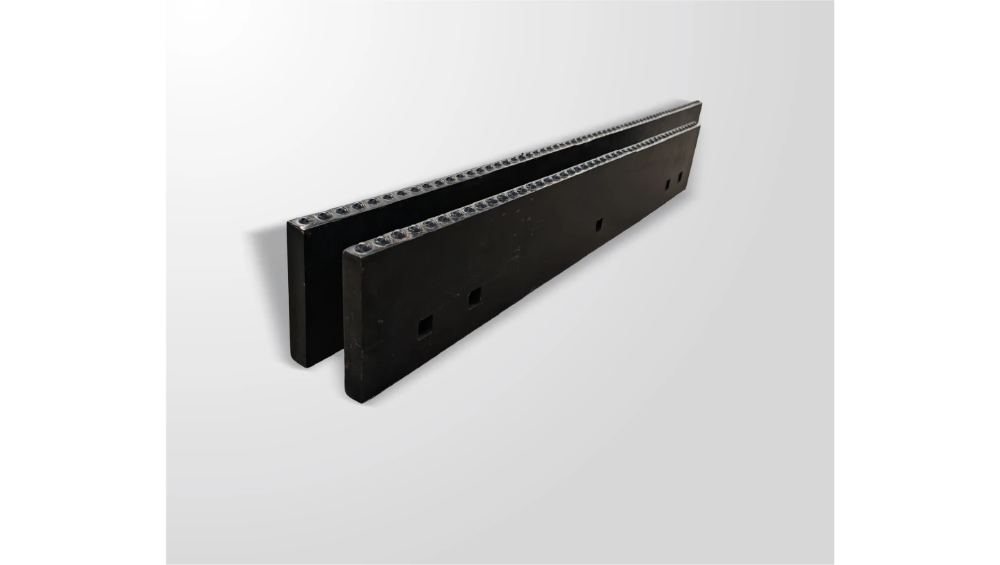
The comparison most fleets actually need is not a two-way race. A rubber blade, a steel blade, a carbide blade, and a rubber-encased carbide blade answer different questions, and the right choice is decided by the surface you plow and how much ice you need to cut. This article compares the four blade families head-to-head on the factors that matter — surface protection, ice-cutting ability, noise, temperature behavior, and typical failures. Route-level selection and cost math are covered in the linked guides at the end, so this page can stay a true comparison.
The Four Blade Families, Clearly Separated
Rubber-only blades are cutting edges made from a rubber compound. They flex over uneven pavement, protect sensitive surfaces, and run quietly, but they cannot cut hard ice.
Steel blades are rigid hardened bars. They cut aggressively and are inexpensive, but they dull quickly on abrasive surfaces and transmit shock and vibration to the truck.
Carbide blades pair a steel carrier with tungsten carbide inserts brazed or mechanically retained along the wearing edge. They hold a cutting profile far longer under abrasion, but the carbide is brittle and can chip on severe impacts.
Rubber-encased carbide blades (JOMA-style) embed steel segments with carbide inserts inside a rubber shell. They add the cutting ability of carbide to the surface protection and vibration damping of rubber — a compromise, not a best-of-everything.
Where Rubber-Based Edges Win
Rubber-based edges earn their keep on surfaces where a rigid edge causes damage. Asphalt parking lots with curbs, concrete with expansion joints, sidewalks, bridge decks, and noise-restricted residential routes are the classic cases. A rigid steel edge catches on joints and protrusions; a rubber edge conforms and slides over them.
The second win is operator and equipment comfort. Rubber dampens vibration and reduces noise, which matters on long night shifts and on plows mounted to lighter trucks. These are real operational benefits, not marketing details.
Where Steel and Carbide Still Win
Ice and hard-packed snow are the rigid edge’s territory. A rubber-only blade flexes instead of cutting on a smooth ice surface, leaving a skim that a carbide edge would scrape. On highways and airfields where cutting performance is non-negotiable, carbide edges remain the standard — and airfield duty adds FOD and retention requirements that change the specification entirely.
The middle ground is rubber-encased carbide: the carbide inserts do the cutting while the rubber manages surface contact and vibration. It is more aggressive than rubber-only and gentler on pavement than a bare steel edge, which is why mixed-route fleets often land there.
Scenario Comparison
| Scenario | Recommended Family | Why |
|---|---|---|
| Parking lot on asphalt, curbs, sidewalks | Rubber or rubber-encased carbide | Protects pavement, quiet, conforms to joints |
| Residential streets, night routes | Rubber-encased carbide | Keeps cut performance while cutting noise and vibration |
| Interstate highway with ice events | Carbide | Long wear life and reliable ice cutting |
| Airport runway | Carbide, airfield-specified | FOD control and retention requirements govern the choice |
| Gravel shoulders and chip seal | Tougher carbide grade | High abrasion plus impact exposure |
Typical Failures by Family
| Blade family | Most common failures | Where to go deeper |
|---|---|---|
| Rubber-only | Tearing on curbs, UV and heat degradation, stiffening in extreme cold | Wear diagnosis guide |
| Rubber-encased carbide | Rubber delamination from the steel carrier, bushing fatigue | Wear diagnosis guide |
| Steel | Dulling, bending under impact | Wear diagnosis guide |
| Carbide | Chipping on chip seal, insert loss at excessive pressure or angle | Wear diagnosis guide |
Failure patterns are diagnostic: a torn rubber strip and a chipped carbide insert point to different setup problems, and neither means the material family itself is wrong.
Testing Without Rebuilding the Fleet
You do not need to convert a whole fleet to learn which family fits. Pick one truck on a sensitive-surface route, run a rubber or rubber-encased edge for a season, and compare noise, pavement damage, and changeout frequency against the steel baseline on the same route. Keep the comparison fair — same route, same operator habits, same tracking. The selection guide covers route-level decisions, and the lifespan guide has the cost-per-mile framework for interpreting the results.
FAQ
Can a rubber blade handle ice?
Rubber-only blades struggle on hard ice because they flex instead of cut. Rubber-encased carbide adds real cutting ability, but for routes dominated by packed ice, a dedicated carbide ice-scraping edge is usually the better tool.
Do rubber-based edges last as long as steel?
It depends on the surface. On sensitive surfaces, rubber-based edges avoid the damage costs that steel creates, which can make them more economical even if the rubber itself wears sooner. On hard ice, rubber wears faster than carbide. Life is route-dependent, not a fixed multiple.
Is rubber-encased carbide the same as a rubber blade?
No. A rubber-only blade has no cutting element. Rubber-encased carbide (JOMA-style) carries carbide inserts inside a rubber shell, so it cuts ice while protecting pavement and damping vibration.
Related
- JOMA-Style Blade — rubber-encased carbide cutting edges
- Snow Plow Blade Materials Compared — steel, rubber, polyurethane, and carbide at a glance
- How to Choose a Snow Plow Cutting Edge — the route-based selection hub
Sources
Related articles
 Best Snow Plow Blade Family for Your Fleet: Top 5 ScenariosKnowledge
 Top 10 Snow Plow Blade Types for Winter Fleets (Ranked by Duty Fit)Knowledge
 Top 5 Best Carbide Blade Configurations for Highway PlowingKnowledge
 Best Snow Plow Blade Materials Ranked: Steel vs Carbide vs Cladding vs Rubber-CarbideKnowledge