
Dozer Cutting Edges: Straight, Semi-U and Angle Blade Choices
A dozer cutting edge is chosen twice: once when the machine is specified and again every time the edge is replaced, and the second decision is usually made worse than the first. A straight…
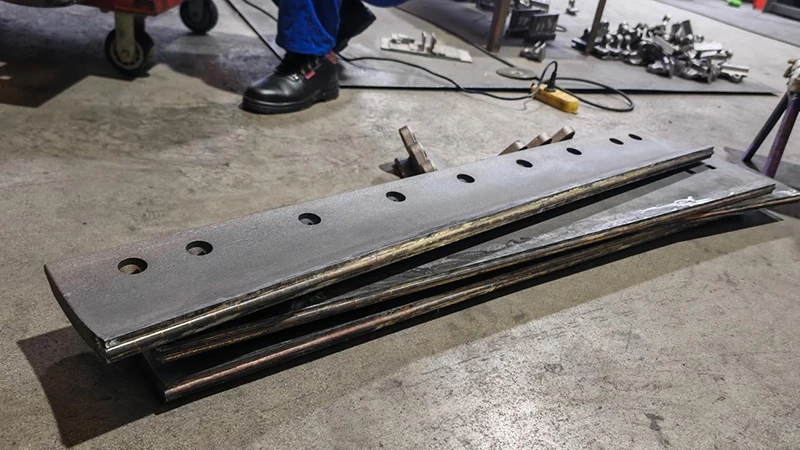
A dozer cutting edge is chosen twice: once when the machine is specified and again every time the edge is replaced, and the second decision is usually made worse than the first. A straight blade pushed into a bulk earthmoving cut wears in the middle, a semi-U blade used for fine trimming loads the wing junctions, and an angle blade spends its life wearing the front corner rather than the centre. Deciding between straight, semi-U, universal and angle edges on the blade form the machine actually carries, and on where its wear concentrates, is what turns a consumable line item into a predictable cost per hour.
What Each Blade Form Is Designed For
Blade form decides which edge profile suits the machine.
Straight blades trim and spread, semi-U blades move material in volume, universal blades push it, and angle blades cast it to one side, so each form loads its edge in a different place.
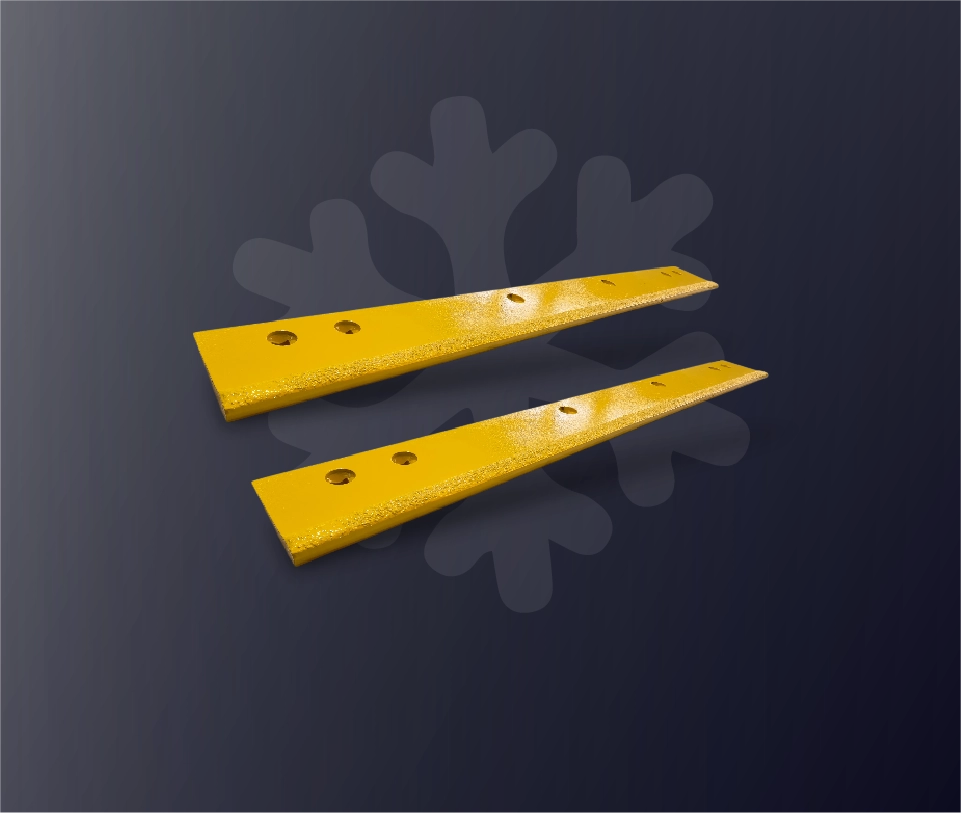
A straight blade carries a flat or lightly curved moldboard and is used for fine grading, backfilling, spreading and trimming. Its edge is loaded comparatively evenly across its length, which is why a straight blade tolerates a simple through-hardened section and a straightforward bolt pattern. A semi-U blade adds a curved, fuller moldboard with wings that roll material toward the centre, and it is the general-purpose choice for earthmoving where a machine has to both cut and carry.
A universal blade is built for volume: it is wide and deeply curved, holding material on the moldboard rather than penetrating with it, so it is specified for bulk pushing of loose material. An angle blade casts material to one side, with hydraulic angling or a fixed angle, and is the form used for ditching, shoulder work and roadside maintenance, where the edge wears at the outer end rather than the centre.
The equipment conventions behind these forms, and the attachment interfaces that carry them, are published by the industry association AEM. Blade form is fixed by the machine and the job, so the edge specification is written against the form rather than a preference for a section.
How Wear Concentrates Differently
Wear sits where each form loads its edge.
Straight edges wear evenly, semi-U edges wear at the centre and wing line, universal edges wear the full face under heavy load, and angle edges wear the front corner and the angled section.
| Blade form | Primary duty | Where wear concentrates | Structure at risk |
|---|---|---|---|
| Straight | Fine grading, spreading, backfill | Evenly along the edge | Moldboard face behind the edge |
| Semi-U | General earthmoving and carrying | Centre and wing junctions | Wing-to-moldboard joint and bowl line |
| Universal | Bulk pushing of loose material | Full edge face, heavy load | Moldboard and push frame |
| Angle | Ditching, shoulder and road work | Front corner and angled end | Front corner, end bit and corner guard |
The wear map matters because it determines the end protection as much as the edge. An angle blade that loses its front corner starts dragging the end of the moldboard through the cut, and the repair is no longer a cutting edge. The abrasion behaviour of the steel being worn is also documented by producers rather than assumed: SSAB publishes abrasion data for its wear-steel grades, and the useful discipline for a buyer is to ask for the conditions behind any comparative wear figure rather than the figure alone.
Two variables move the wear rate more than blade form does. Angular silica-bearing gravel cuts an edge several times faster than limestone or loose sand, and technique matters as much: cut depth, angle of attack and travel speed change the load on the edge more than a step in hardness does. A fleet that records where each edge failed, and on which material, builds a better wear map than any supplier can supply.
Material and Hardness Choices
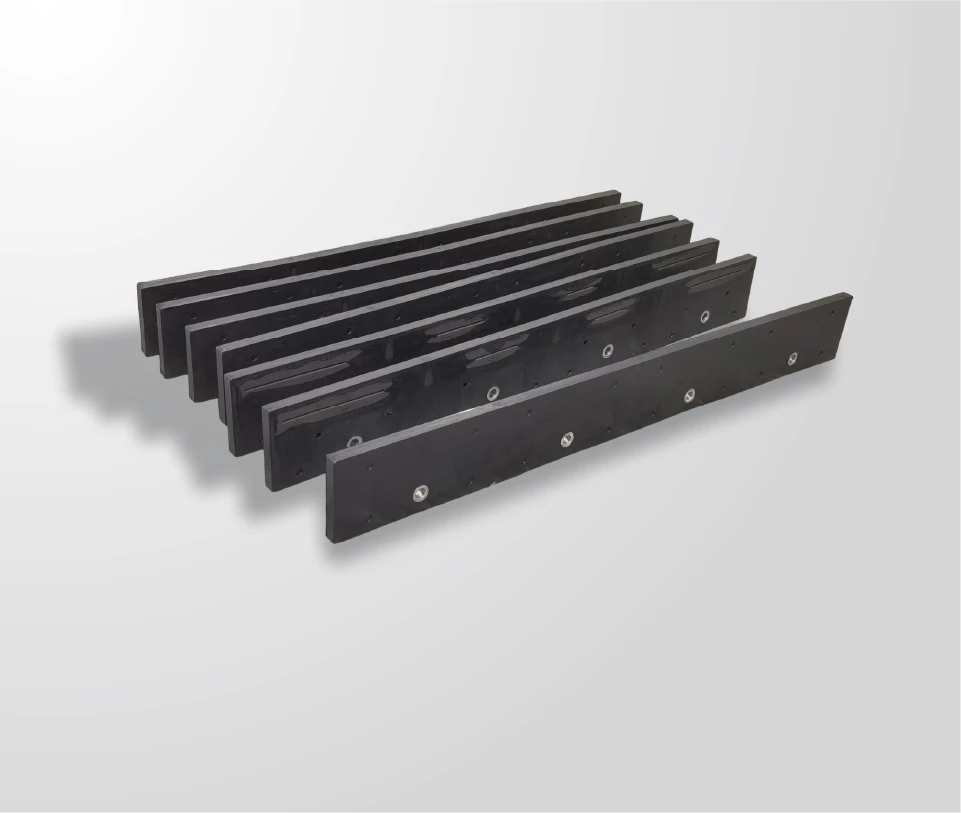
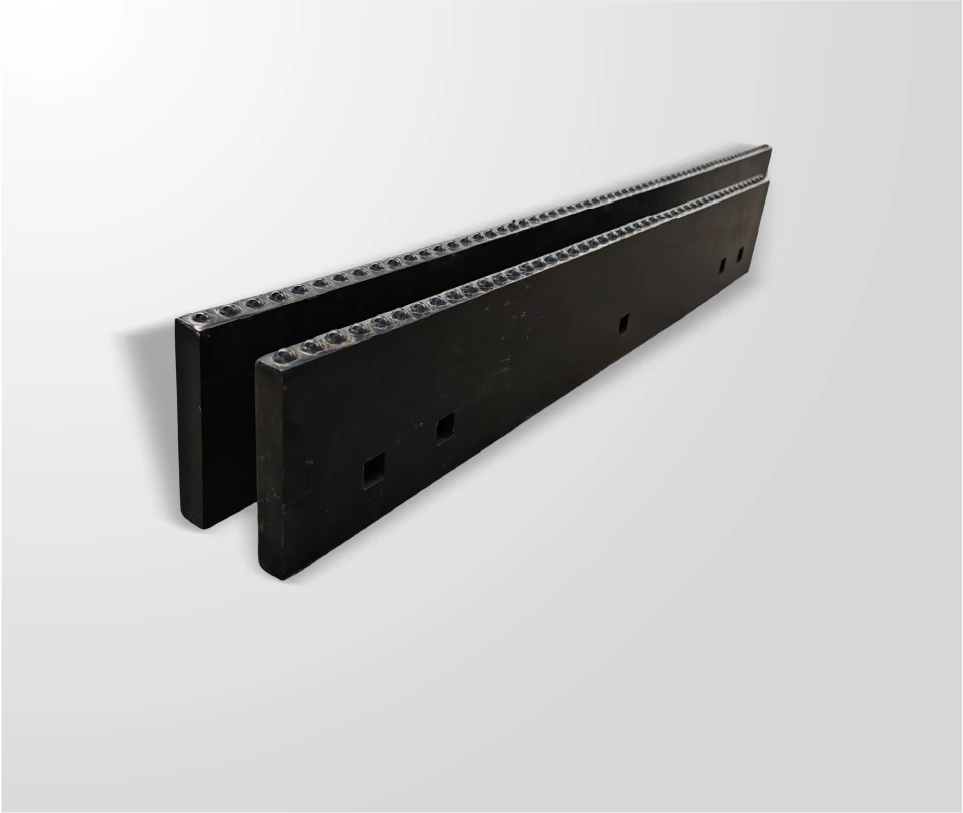
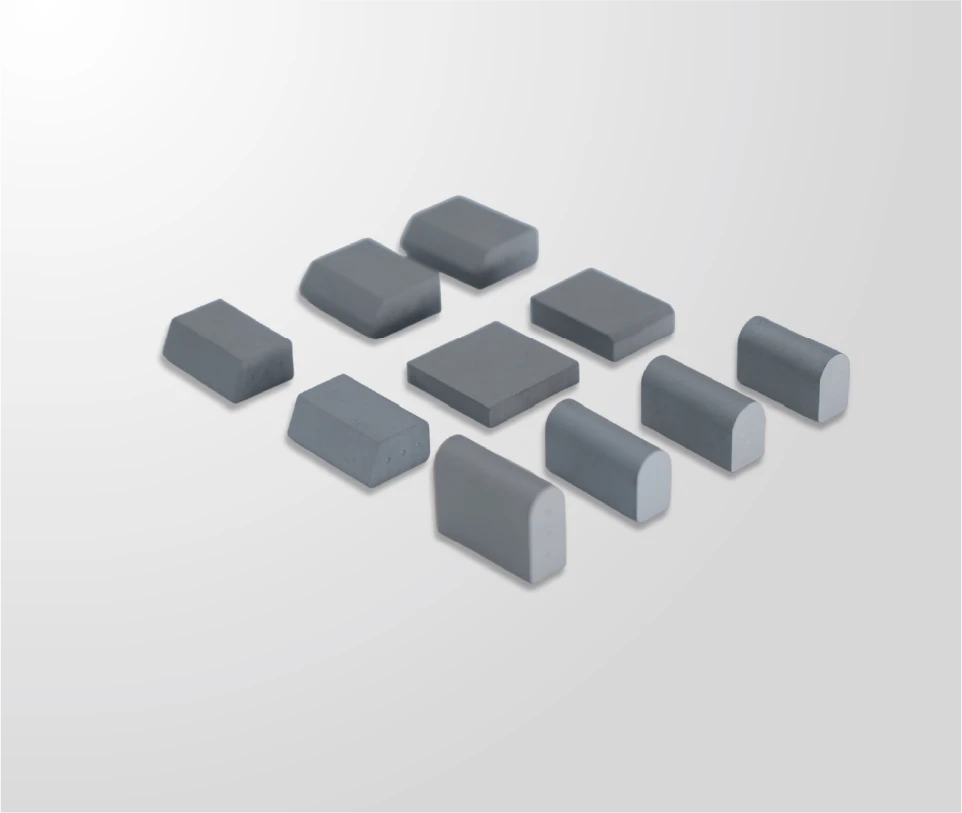
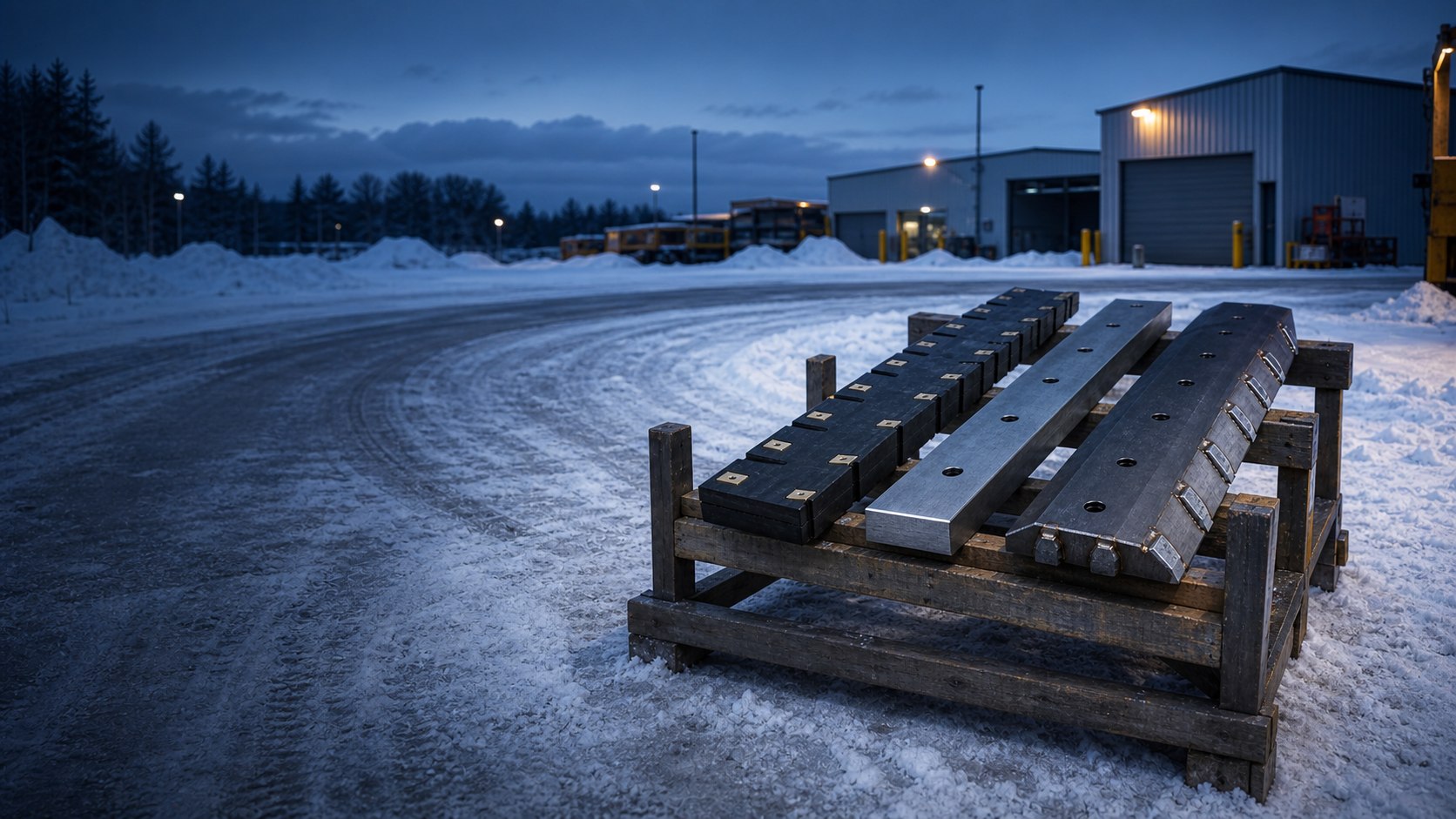
Dozer edges come in three practical families, and the choice trades unit cost against wear life and impact. A plain carbon or hot-rolled section is the least expensive and adequate on light, non-abrasive work. A through-hardened and tempered section is the working standard for general earthmoving, keeping its profile far longer under the same load. A carbide-tipped edge, with tungsten carbide inserts seated in machined pockets along a steel body, is specified where abrasion is heavy enough that edge changes interrupt production.
Hardness on its own is a poor selection criterion, because a harder edge that cracks under impact costs more than a softer edge that wears. The material and test standards used to quote hardness and toughness are published by ASTM, and a quotation should name the method behind the figure rather than present it alone. On carbide-tipped edges the same logic applies at a finer scale: the insert grade is chosen for a hardness and toughness balance, and the body that carries the inserts has to be thick enough to keep them seated.
Section thickness is the third variable, and often the one that decides whether an edge survives. Heavier machines transfer more load into the edge and end bits, and a section too light for the class bends between the holes before it wears out. Where a fleet runs several classes, a heavier section on the largest machines and a lighter one on small dozers is usually cheaper than standardising on one thickness.
Fitment, End Bits and Corner Guards
Fitment is the part of the purchase that cannot be corrected after delivery, and on a dozer it involves more than the cutting edge. Machine and attachment interface conventions are published through SAE, and distributors work to the same conventions through bodies such as the AED, which is why a properly recorded pattern transfers between suppliers.
Four elements go into a fitment record:
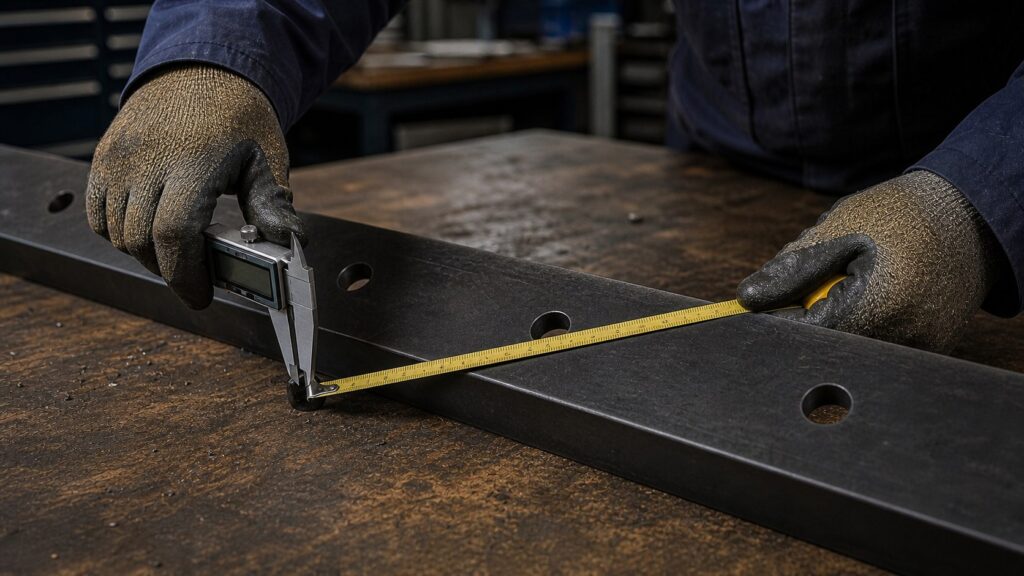
- The edge pattern. Hole diameter, count, centre-to-centre spacing including end distances, and the edge-to-hole distance.
- The countersink and fastener. The countersink angle has to match the plow bolt so the head sits flush and stays out of the wear path.
- End bits. Left and right end bits, which take the corner load and protect the moldboard ends; they are specified with the edge, not after it.
- Corner guards. Where the form loads the front corner, the guard is the part that prevents the structure being worn instead of the edge.
Where a drawing is not available, the machine can be measured or a worn edge sent as a reference. SENTHAI validates bolt patterns against the drawing or a physical sample before production, and holds machined insert pockets to a dimensional tolerance of plus or minus 0.02 mm, since that tolerance is what allows fitting without hand work. End bits and corner guards belong on the same drawing, because a correct edge with the wrong end protection still leaves the structure exposed.
Operational Trade-Offs Beyond Wear
Wear life is the headline number and rarely the whole decision. The same edge behaves differently behind different blade forms, and some of the costs that follow are not in the parts catalogue at all.
Production comes first. A sharp, well-matched edge cuts in fewer passes, reducing fuel burn and machine hours per cubic metre, while a blade form used outside its purpose costs production regardless of how good the edge is. Reversibility is second: an edge that can be rotated or turned end to end before replacement returns more hours per unit, depending on the pattern and whether the holes are symmetric.
Operator exposure belongs in the same discussion, because earthmoving generates dust and noise that are recognised occupational hazards, with guidance published by NIOSH. A change-out done in the field in poor conditions is a different risk from one done in a workshop, so an edge that requires fewer changes reduces handling exposure as well as cost.
Cost Per Hour by Blade Form
Cost per hour of dozing is the metric that makes edge selection comparable across blade forms, because it captures what unit price hides: the change-out labour, the fasteners, and the production lost while the machine is stopped.
| Factor | Straight and semi-U | Universal | Angle |
|---|---|---|---|
| Edges consumed per hour | Moderate; rises with abrasive ground | Higher load shortens life on hard material | Corner-driven, so edge life is set by one end |
| Change-out frequency | Predictable across the edge | Predictable but often heavier parts | Often driven by the corner rather than the full edge |
| Extra parts per change | End bits on heavier machines | End bits and corner protection | End bit and guard are part of the normal cycle |
| Downtime exposure | Moderate | Moderate to high | High if the corner is allowed to run out |
The arithmetic is short: edges consumed per hour, multiplied by delivered price plus change-out cost, plus the production lost during those periods. Change-out cost is not constant, because a shop-based fleet with a spare edge on the shelf carries far less per change than a contractor calling out a fitter to a remote site.
The record is what makes this manageable. Logging blade form, material worked, hours and volume between changes lets a fleet compare a through-hardened edge with a carbide-tipped edge on its own numbers. In practice that comparison settles the specification argument faster than any supplier claim, because the difference usually appears within a single season.
Choosing by Machine and Material
The selection rule that survives contact with a real fleet is short: match the edge to the blade form the machine carries, then to the ground it works in, then to the value of an hour of downtime. Blade form fixes the wear map, and the material fixes how quickly that map is consumed.
- Fine grading, spreading and trimming: a straight blade with a through-hardened edge, replaced on measurement.
- General earthmoving with mixed material: semi-U blade with a through-hardened section, and end bits specified with every edge order.
- Bulk pushing of loose or blasted material: universal blade, heavy section, with protection at the ends.
- Ditching, shoulders and roadside maintenance: angle blade, with the front corner protected and the end bit treated as a consumable.
- Abrasive gravel or crushed rock: move to a carbide-tipped edge where edge changes, not wear, are the constraint.
- Quarry and aggregate duty: heavier section and a grade chosen for toughness as well as hardness, since the material this industry handles, documented by bodies such as the National Stone, Sand & Gravel Association, is unforgiving of a brittle edge.
Before any order, confirm the pattern by drawing or measurement rather than by machine model year, and confirm whether the end bits and guards are being ordered at the same time. Those two checks prevent most of the avoidable cost in dozer edge procurement.
Dozer edge selection follows the blade form and the wear map it creates. Straight and semi-U blades wear predictably and suit a through-hardened section for most work; universal blades transfer more load and need a heavier section; angle blades concentrate wear at the front corner, so end bits and guards are part of the edge cycle rather than an accessory. Material and section then decide the family, fitment decides whether the edge can be used at all, and cost per hour of dozing is the only comparison that reflects the change-out labour and the production lost.
Send SENTHAI the machine list, blade forms and the materials each dozer works in, with the edge pattern or a worn sample for reference, and the technical team will review section, grade, end bits and guards for each group.
Related reading: the hub article on wear parts beyond plows covers how dozer edges, end bits and guards fit together.
Frequently Asked Questions
What is the difference between a straight and a semi-U dozer blade?
A straight blade has a flat or lightly curved moldboard and is used for fine grading, spreading and trimming, so its edge is loaded fairly evenly. A semi-U blade adds a fuller curved moldboard with wings that roll material toward the centre, which makes it the general-purpose choice for earthmoving. The difference shows up in the edge pattern and in where the edge wears: centre and wing junctions for the semi-U, even wear for the straight blade.
How do I choose between a through-hardened and a carbide-tipped dozer edge?
Choose on abrasion and on what an hour of downtime costs. A through-hardened and tempered steel edge is the working standard for general earthmoving and is replaced on measurement. A carbide-tipped edge, with tungsten carbide inserts seated in machined pockets along a steel body, is justified where abrasive material makes edge changes the constraint on production rather than part cost. On impact-heavy ground, grade selection for toughness matters as much as hardness.
Do dozer end bits and corner guards have to be ordered with the cutting edge?
They should be specified together even when they are ordered separately. End bits carry the corner load and protect the moldboard ends, and corner guards stop the front corner of a blade being worn into structure where the form loads that corner hardest. Because all three parts share the same pattern and the same wear cycle, a correct cutting edge with the wrong end protection still leaves the blade structure exposed.
Can one cutting edge pattern fit several dozer models?
Sometimes, but it cannot be assumed. Machine classes differ in blade width, hole spacing and the distance from the hole line to the cutting edge, and interface conventions that suppliers and buyers both work to are published through standardisation bodies rather than agreed informally. The reliable route is to record the pattern from the machine or a worn edge and have it validated against the drawing or sample before an order is placed.
How are dozer cutting edges priced and what are the delivery terms?
Edges are quoted against a specification rather than from a price list: blade form, section, grade or insert specification, pattern, end bits and quantity all affect the quotation. Minimum order quantity, lead time, packing, delivery and warranty terms are not published as universal figures, and the terms that apply to a specific requirement are stated in the written quotation or order documents.
{
“@context”: “https://schema.org”,
“@type”: “FAQPage”,
“mainEntity”: [
{
“@type”: “Question”,
“name”: “What is the difference between a straight and a semi-U dozer blade?”,
“acceptedAnswer”: {
“@type”: “Answer”,
“text”: “A straight blade has a flat or lightly curved moldboard and is used for fine grading, spreading and trimming, so its edge is loaded fairly evenly. A semi-U blade adds a fuller curved moldboard with wings that roll material toward the centre, which makes it the general-purpose choice for earthmoving. The difference shows up in the edge pattern and in where the edge wears: centre and wing junctions for the semi-U, even wear for the straight blade.”
}
},
{
“@type”: “Question”,
“name”: “How do I choose between a through-hardened and a carbide-tipped dozer edge?”,
“acceptedAnswer”: {
“@type”: “Answer”,
“text”: “Choose on abrasion and on what an hour of downtime costs. A through-hardened and tempered steel edge is the working standard for general earthmoving and is replaced on measurement. A carbide-tipped edge, with tungsten carbide inserts seated in machined pockets along a steel body, is justified where abrasive material makes edge changes the constraint on production rather than part cost. On impact-heavy ground, grade selection for toughness matters as much as hardness.”
}
},
{
“@type”: “Question”,
“name”: “Do dozer end bits and corner guards have to be ordered with the cutting edge?”,
“acceptedAnswer”: {
“@type”: “Answer”,
“text”: “They should be specified together even when they are ordered separately. End bits carry the corner load and protect the moldboard ends, and corner guards stop the front corner of a blade being worn into structure where the form loads that corner hardest. Because all three parts share the same pattern and the same wear cycle, a correct cutting edge with the wrong end protection still leaves the blade structure exposed.”
}
},
{
“@type”: “Question”,
“name”: “Can one cutting edge pattern fit several dozer models?”,
“acceptedAnswer”: {
“@type”: “Answer”,
“text”: “Sometimes, but it cannot be assumed. Machine classes differ in blade width, hole spacing and the distance from the hole line to the cutting edge, and interface conventions that suppliers and buyers both work to are published through standardisation bodies rather than agreed informally. The reliable route is to record the pattern from the machine or a worn edge and have it validated against the drawing or sample before an order is placed.”
}
},
{
“@type”: “Question”,
“name”: “How are dozer cutting edges priced and what are the delivery terms?”,
“acceptedAnswer”: {
“@type”: “Answer”,
“text”: “Edges are quoted against a specification rather than from a price list: blade form, section, grade or insert specification, pattern, end bits and quantity all affect the quotation. Minimum order quantity, lead time, packing, delivery and warranty terms are not published as universal figures, and the terms that apply to a specific requirement are stated in the written quotation or order documents.”
}
}
]
}
Related articles
 Aftermarket Versus OEM Cutting Edges: Fitment and DocumentationScraper, dozer and earthmoving cutting edges
 End Bits and Corner Guards: Protecting the Blade StructureScraper, dozer and earthmoving cutting edges
 Matching Cutting Edges to Material Type and Machine WeightScraper, dozer and earthmoving cutting edges
 Carbide Versus Through-Hardened Edges: Choosing by Abrasion LevelScraper, dozer and earthmoving cutting edges