




How does ASTM B406 TRS testing prove the real toughness of heavy plow carbide inserts?
In carbide manufacturing, ASTM B406 transverse rupture strength (TRS) is the most practical way to quantify how a tungsten carbide insert resists bending and sudden fracture under real plow loads. When factories control carbide…
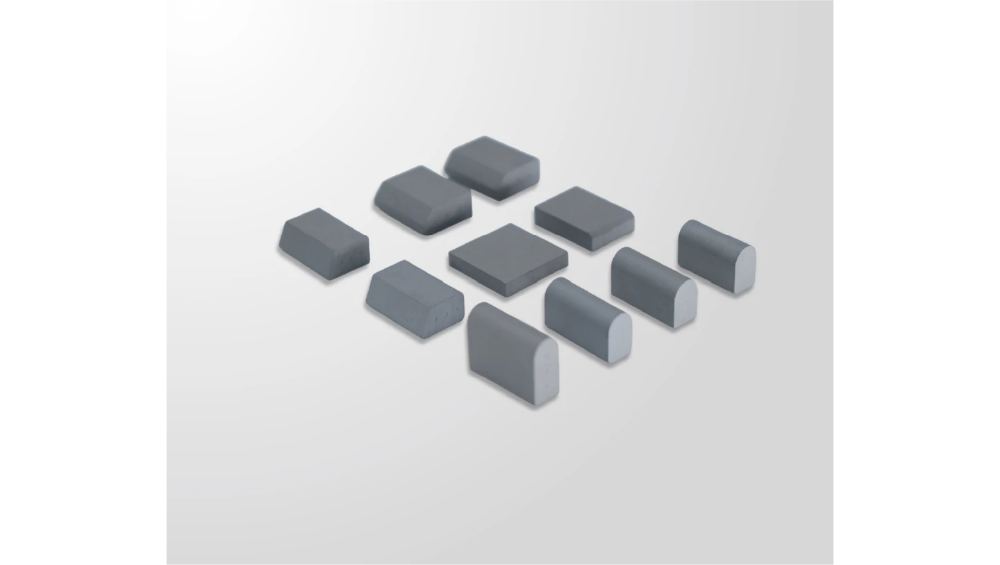
In carbide manufacturing, ASTM B406 transverse rupture strength (TRS) is the most practical way to quantify how a tungsten carbide insert resists bending and sudden fracture under real plow loads. When factories control carbide grade, pressing density, sintering curve, and brazing, TRS values above 2,000 N/mm² translate into fewer broken inserts, longer blade life, and more consistent performance for OEM snow plow and road maintenance tools.
Carbide Insert Failure Analysis and Root Causes
What is transverse rupture strength in tungsten carbide heavy plow inserts?
Transverse rupture strength is the maximum bending stress a tungsten carbide insert can withstand in a three‑point bend before it snaps. In a plow blade factory, we treat TRS as a production health indicator: low values usually point to porosity, binder segregation, or wrong sintering profile. For heavy plow inserts, stable TRS is more critical than chasing record‑high numbers on a single lab coupon.
From years of shop-floor runs, we see TRS shift when powder lots change or when pressing pressure drifts by more than 3–5%. A sudden 10% drop in TRS almost always correlates with higher in-field breakage within one winter season. SENTHAI keeps internal TRS thresholds for each grade and locks production once any batch falls outside that band.
How is ASTM B406 three‑point bend testing performed on carbide inserts?
ASTM B406 uses a small rectangular bar of cemented carbide supported on two rollers with a load applied at the center until fracture. Although the standard specifies specimen size, span, and roller geometry, the real precision comes from fixture alignment and repeatable crosshead speed. In our factory, we reject any test if we detect torsional marks or off‑center fracture on the bar.
In daily QA, we pre‑grind test bars from the same pressed and sintered block as the actual inserts. The three-point bending fixture is mounted on a calibrated universal testing machine, crosshead speed is fixed, and load data is captured digitally at high sampling rate. That way, TRS integrates directly into our batch release system, not just into a lab report.
Why is TRS more meaningful than hardness alone for heavy plow wear parts?
Hardness tells you how well carbide resists indentation and abrasive wear, while TRS shows how long it survives bending shocks from snow plows hitting manholes, curb lines, or frozen ruts. On the factory side, we routinely see grades with 92 HRA but mediocre TRS fail quicker in aggressive municipal routes than slightly softer grades with 15–20% higher TRS.
When customers push for “harder” inserts, we always show wear‑vs‑breakage statistics from old contracts. On some routes, increasing hardness by one HRA point but losing 10% TRS leads to more shattered blades and higher downtime. SENTHAI balances hardness and TRS grade‑by‑grade, instead of optimizing only one number for marketing brochures.
Typical hardness–TRS trade‑offs for plow carbide grades
These ranges are typical factory windows rather than absolute limits.
Which production factors in a carbide factory most strongly influence TRS values?
The biggest levers for TRS are powder quality, pressing density, and sintering cycle. In our own lines, three things move TRS more than anything else: oxygen content in powder lots, compacting pressure profile, and carbon balance in the sintering furnace. Even a 0.02% shift in carbon can push a grade toward eta‑phase and cut TRS noticeably.
For B2B buyers, this matters because two suppliers can declare the same nominal grade but deliver very different TRS stability. SENTHAI maintains traceable powder batches, monitors green density on every press run, and adjusts sintering ramps based on furnace load. That is the kind of discipline that makes TRS values repeatable across thousands of heavy plow inserts, not just a handful of lab samples.
How can manufacturers, wholesalers, and OEM buyers use TRS data in carbide insert procurement?
TRS data lets you move from “looks good on paper” to quantifiable risk in field use. As a manufacturer, we encourage OEM buyers and large wholesalers to specify a minimum TRS window, not just a single nominal value. This avoids suppliers cherry‑picking test coupons while delivering production lots that barely meet the advertised number.
For long‑term contracts, we often agree on three TRS levels: design baseline, minimum acceptable batch average, and customer‑alert threshold. When our internal TRS trend drifts close to that alert line, we inform the OEM before any field complaint appears. Over multiple winters, this kind of cooperation with SENTHAI has cut unexpected breakage incidents for several major fleets.
Practical TRS specification example for heavy plow inserts
This type of spec gives both factory and OEM a clear decision framework.
What are typical failure modes in heavy plow carbide inserts revealed by TRS and fracture surface analysis?
The most common TRS‑related failures are brittle snapping at the brazed joint, subsurface cracking from residual stresses, and edge chipping propagated from pre‑existing grinding defects. On broken inserts we collect, mirror‑smooth fracture planes usually point to internal flaws, while tortuous surfaces with multiple crack origins suggest service‑induced damage.
Inside the factory, we correlate fracture patterns with TRS numbers. Low‑TRS batches often show large pores or local binder lakes on fracture faces when inspected under magnification. Batches with normal TRS but high field failures usually reveal improper brazing or mis‑matched steel blade stiffness, not an inherent carbide issue. This level of analysis helps SENTHAI improve both inserts and assembly recommendations.
How does the three‑point bend test machine generate N/mm² TRS data step by step?
In a three‑point bend test, the machine records the breaking load in newtons and uses the span and specimen dimensions to calculate stress. The TRS formula converts that load into N/mm² by combining the bending moment and section modulus. On our shop floor, this conversion is built into the test software so operators only see final TRS values, not raw load numbers.
At SENTHAI, a typical test might show a fracture load around 2.5–3.0 kN for heavily reinforced grades. With a 25.4 mm span and the specified bar dimensions, the machine outputs TRS around the mid‑2,000 N/mm² level. We then store that value against the batch number and keep long‑term statistics to watch for drift before it affects any customer deliveries.
Why is SENTHAI TRS testing especially relevant for snow plow blades, JOMA style blades, and road maintenance inserts?
Snow plow and JOMA style blades experience cyclic bending every time the truck hits uneven road surfaces or packed ice. In such applications, TRS controls whether carbide inserts survive the shock or crack prematurely. SENTHAI designs grades and brazing patterns specifically to keep the effective TRS high at the brazed region, not just in isolated lab coupons.
For road maintenance wear parts, repeated impact with gravel and potholes adds micro‑cracks that grow over time. With over 21 years of carbide wear part production, SENTHAI has tuned grades where TRS stays robust even after thousands of load cycles. We adjust grain size, binder level, and insert geometry so the field TRS behavior matches the lab test, which is rarely the case with generic mass‑market carbides.
Could TRS be used as a predictive tool to reduce in‑field failures and lifetime cost for OEM plow systems?
TRS, combined with real route loading data, can be used to model failure probability before a blade ever sees snow. In practice, OEMs share truck speed ranges, typical obstacles, and expected service hours, and we match grades whose TRS statistics suit that risk profile. Batches with tighter TRS distributions generally deliver lower lifetime cost even if unit price is slightly higher.
In several fleet projects, we used TRS and fracture data to redesign insert geometry and mounting positions. That cut unexpected failure rates by over 30% across two winter seasons with only minor grade changes. For serious OEM buyers, working with SENTHAI on TRS‑based design rather than off‑the‑shelf grades is one of the fastest ways to reduce warranty claims and downtime.
SENTHAI Expert Views
In our production runs for JOMA style blades and custom OEM plow inserts, we stopped chasing record TRS numbers and focused on TRS stability. A batch that averages 2,250 N/mm² with tight distribution is more valuable than one spectacular 2,400 N/mm² result hiding several weak pieces. This philosophy, combined with controlled pressing and sintering, is why SENTHAI inserts stay intact when trucks hit real‑world obstacles, not just lab fixtures.
Are there practical guidelines for manufacturers, wholesalers, and factories when comparing TRS claims from different carbide suppliers?
Yes. First, ask whether TRS values come from ASTM B406 or another method, and whether specimens were cut from actual production parts. Second, compare batch‑average values and scatter, not only the headline maximum. Finally, verify that TRS is monitored at least per furnace load, not merely per month or per quarter.
In our experience, suppliers who only show one number are usually sampling selectively. SENTHAI shares TRS ranges and test frequency so OEM buyers and wholesalers can audit quality over time. For factories assembling blades, we recommend keeping broken inserts and sharing fracture photos with the carbide supplier. It quickly exposes whether the real issue was carbide grade, brazing, or steel support design.
Why do some high‑TRS carbide inserts still fail prematurely in service?
High TRS in the lab does not guarantee success if brazing induces residual tensile stresses, if steel backing plates are too flexible, or if inserts are over‑hanging unsupported regions. We frequently receive failed parts where the carbide grade is sound, but assembly or blade design created stress concentrations that overwhelmed even strong inserts.
From SENTHAI’s perspective, the best results happen when blade designers share CAD models and service expectations early. We can then adjust insert dimensions, chamfers, and brazing clearances to reduce peak bending stresses. In several OEM projects, minor design tweaks eliminated failures without changing the underlying TRS grade at all.
FAQs
What TRS level is recommended for heavy snow plow carbide inserts?
For most municipal and highway plow routes, a batch‑average TRS between 2,200 and 2,400 N/mm² offers a good balance of impact toughness and wear life. Grades outside this window need route‑specific validation.
Does higher hardness always mean better performance in carbide plow inserts?
No. Extremely hard grades can chip or break under impact even if wear is low. For plow inserts, pairing adequate hardness with robust TRS yields more reliable field performance than maximizing hardness alone.
Can TRS testing be skipped if a supplier has long experience?
It should not be skipped. Even experienced factories can see shifts from new powder batches or furnace maintenance. Routine TRS testing per batch is the only way to catch these changes before they affect customers.
Are OEM‑specific TRS grades worth the extra cost?
For fleets with demanding routes or high downtime costs, OEM‑tailored TRS grades often pay back quickly. They reduce unexpected failures, lower blade replacement frequency, and improve overall route reliability.
Who should interpret TRS results for an OEM buyer?
Ideally, a collaboration between the carbide manufacturer’s technical team and the OEM’s engineering or maintenance group. Together they can connect TRS numbers to real route conditions and design decisions.
Related articles
 Best Snow Plow Blade Family for Your Fleet: Top 5 ScenariosKnowledge
 Top 10 Snow Plow Blade Types for Winter Fleets (Ranked by Duty Fit)Knowledge
 Top 5 Best Carbide Blade Configurations for Highway PlowingKnowledge
 Best Snow Plow Blade Materials Ranked: Steel vs Carbide vs Cladding vs Rubber-CarbideKnowledge