
OEM Wear Parts Manufacturing: What the Technical Package Must Contain
An OEM wear part that has to be re-quoted because the technical package was incomplete costs weeks, and the cost lands at the worst point in a build schedule. The usual reason a first…

An OEM wear part that has to be re-quoted because the technical package was incomplete costs weeks, and the cost lands at the worst point in a build schedule. The usual reason a first article fails is not the machine, the grade or the price: it is a package that leaves the interface, a tolerance or the acceptance criteria to be inferred. Reading a package the way an oem wear parts manufacturer has to read it is the quickest way to remove that risk before the enquiry is issued.
Two kinds of buyer send packages. The first has a released drawing set and a change process. The second has a sample, a machine and a promise to send files later. Both can be supplied, but only one can be quoted against a fixed scope, and the difference appears in the price and the delivery date rather than in the drawing itself.
What the Buyer Actually Controls
The buyer controls the package, not the process.
The buyer fixes geometry, tolerances, acceptance criteria and commercial terms. The supplier owns grade selection, the press and sinter route and joining quality.
That division is what keeps an OEM programme stable. The buyer defines the interface, because the buyer owns the machine or the assembly the part goes into. The supplier defines how the part is made, because that is where the process knowledge sits. When either side crosses the line, the result is usually a part that meets every requirement written down and still cannot be used.
The tolerance scheme is the first thing the buyer owns. A drawing that dimensions from a chain of features gives the supplier no clear reference and no basis for a rejection decision; one that dimensions from datums does. Machine and attachment interface conventions are published through the SAE standards programme, and referencing them is quicker than describing the same fitment in prose.
Acceptance criteria and volume profile are the other two buyer-side items. Naming what will be measured before the first shipment avoids a conversation about interpretation later, and a realistic annual volume with a rhythm stated on paper is worth more than a headline quantity that never materialises.
What a Workable Technical Package Includes
Geometry, material, interface, acceptance and volumes.
A workable pack carries geometry in 2D or 3D, the material or performance requirement, interface data, acceptance criteria, marking and packing instructions, volumes and a revision number.
Geometry comes first, and it should be a released drawing with a revision number rather than a marked-up photocopy. Where the part has free-form or profiled features, a 3D model shortens the path from enquiry to first article considerably, and a measured physical sample is an acceptable substitute only when it is measured and documented rather than sent loose.
Material can be specified two ways: as a grade with a stated hardness band and grain size, or as a performance requirement the supplier has to meet. Grades in cemented carbide are defined by the carbide grain and the metallic binder, and the binder metal supply and use are documented by the Cobalt Institute. Whichever route is chosen, the requirement has to be verifiable, because an unverifiable grade clause cannot be enforced.
| Package item | What it must state | What its absence causes |
|---|---|---|
| Released drawing with revision | Geometry, tolerances, datums | Quotation against a guess and a rejected first article |
| 3D model or measured sample | Profiled or free-form geometry | Insert pocket and profile mismatch |
| Material or performance requirement | Hardness band, grain size or a target to demonstrate | Substitutions that cannot be challenged |
| Interface data | Bolt pattern, hole diameter, countersink angle | A part that does not mount |
| Acceptance criteria | What is measured, how, and at what frequency | Disputes at goods-in |
| Marking, packing and volumes | Identification, handling, quantities and rhythm | Mix-ups in stores and price quoted on the wrong basis |
Hardness and test methods referenced in that pack should be quoted from published standards rather than from a supplier datasheet alone; the material and test standards issued through ASTM are the usual reference for that clause.
Documentation to Demand Before Award
Documentation is the part of an OEM package that is easiest to defer and most expensive to do without. Federal procurement practice has long treated documentation and supplier records as part of the deliverable rather than a courtesy, which is the same posture worth taking with a commercial supplier, and the GSA publishes the acquisition guidance behind that approach.
Before award, four records are worth naming. A grade sheet with hardness and grain size makes the material clause enforceable. A process description from powder preparation through pressing, sintering and any brazing or welding step shows the route is defined rather than improvised. A dimensional or first article inspection report gives the buyer measured values instead of an assurance. A lot number with a traceability record is the item that makes a later claim investigable.
After award, keep the file alive. The approved first article, the released drawing revision and the inspection records for each batch should sit together, because that set is what answers a fitment question in the second year of a programme without a re-measurement exercise.
Pricing Structure and What Drives It
OEM part pricing is a structure, and the useful negotiation is about which lines in it the buyer can influence. Tooling recovered across an order, the grade specified and the tolerances called out move the price more than any single material decision, which means the specification itself is the main cost lever.
| Cost line | What moves it | Buyer’s lever |
|---|---|---|
| Tooling and fixtures | New forms, pocket forms and brazing fixtures | Share one profile across part numbers |
| Grade and powder preparation | Grain size, binder content, wet grinding effort | Specify the grade the duty needs |
| Machining | Feature count and tolerance callouts | Call out only tolerances that affect fitment |
| Joining and finishing | Brazing, welding and annealing steps | Batch size and repeat rhythm |
| Inspection and documentation | Sampling plan and reporting depth | Agree the plan before award |
One structural point is worth insisting on: tooling and part price quoted separately. A combined figure cannot be compared with a competing offer, and it hides where the money actually goes. Unit structure, quantities and any tooling arrangement are stated in the written quotation or order documents, and those documents are the place to check the model against the annual volume.
Lead Time, MOQ and Continuity
Lead time on an OEM programme is a chain rather than a number: drawing release and review, tooling or fixture preparation where the geometry is new, first article production and approval, then the production run. Each stage has a different owner, and the stage that actually consumes time in most programmes is first article approval, because it waits on a decision as well as on a machine.
MOQ follows the setup. A new form, a pocket form or a brazing fixture is paid for once, so a small first order spreads that cost over few parts while a repeat order against a frozen specification is materially cheaper per part. Blanket orders and scheduled call-offs are the usual way to keep a repeat part economical without holding stock on either side.
Delivery terms belong in the same conversation. The Incoterms rules published by the International Chamber of Commerce define where risk and cost transfer, and a programme that spans several plants usually needs that point named per destination rather than assumed from a previous order. Applicable quantities, delivery windows and scheduling terms are stated in the written quotation or order documents.
Quality Gates and Acceptance Testing
Acceptance testing on an OEM part is only meaningful when it attaches to defined gates. A supplier with its own process chain controls three: powder preparation, the press and sinter stage, and the joining and finishing stage after which the part is dimensionally final. The powder metallurgy route itself is documented by the industry bodies behind the process, including the Metal Powder Industries Federation.
Wet grinding powder preparation sets the grain structure that later governs hardness and toughness, and pressing on robotic presses up to 500 tons sets the green density that vacuum and low-pressure sintering consolidates. Variation at either point shows up after sintering as porosity or dimensional drift, which is why these gates are recorded rather than watched.

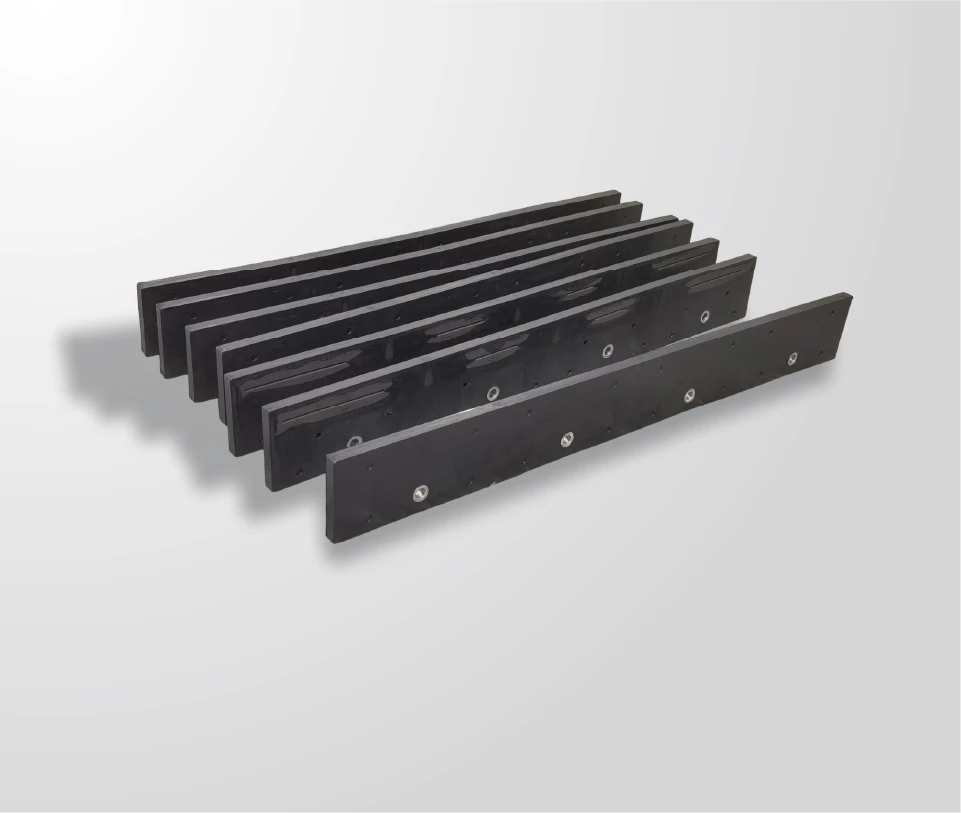
Machining is the gate that decides fitment. SENTHAI holds machine insert pockets to a tolerance of ±0.02 mm and validates AASHTO and DIN bolt patterns against the customer drawing or a physical sample. Lot-level traceability means every batch is inspected and the records archived, and a programme developed for a specific machine family, such as a custom rubber-flex blade system, will already have a documented first article routine to build on.
Change Control and Revision Handling
Change control is what separates a supply programme from a series of orders. Once a part is in production, every change needs a revision number, a reason and an effectivity point, whether by date, by order or by serial range. Without that discipline, two batches of the same part number can be built to two different drawings and nothing in the paperwork will show it.
The practical rule is that the supplier builds only to the released revision. Changes that affect fitment, material or an acceptance criterion should trigger a new first article, because those are the three things a dimensional report is checking. Cosmetic changes, a marking adjustment or a packing change, normally do not.
Handle obsolescence at the same time. When a part number is superseded, the old tooling, the remaining stock and the service spares picture all need a decision, and the cleanest decision is taken before the last order rather than after it. A short written change procedure agreed at award makes all of this routine instead of adversarial.
An OEM programme is decided by the package, not by the press. The buyer owns the drawing revision, the tolerance scheme, the acceptance criteria and the volume profile; the supplier owns grade selection, the process route and joining quality. Documentation requested before award — grade sheet, process description, first article report and lot traceability — is what makes the first article repeatable on the tenth run. Change control is what keeps it repeatable after the first revision, and the commercial structure belongs in the written quotation rather than in an assumption about volume.
Send SENTHAI the released drawing or sample, the grade or performance requirement and the annual volume profile, and the technical team will review the package, flag what is missing and quote against a fixed scope.
Frequently Asked Questions
Who manufactures OEM parts?
An OEM wear parts manufacturer builds to the buyer’s own drawing and specification, whether or not the part carries the buyer’s brand. SENTHAI is a US-invested manufacturer producing in Rayong, Thailand, with an in-house chain from wet grinding powder preparation through robotic pressing, vacuum and low-pressure sintering, induction brazing and finishing, using non-China tungsten raw materials. The commercial model is quotation-based: terms are stated in the written quotation or order documents.
What is the difference between OE and OEM wear parts?
In the ground-engaging tool market the practical difference is the specification the part is built to, not the badge on the box. A part made to the machine maker’s released drawing is an original-equipment part; a part made to the same drawing by a second manufacturer is an OEM part with equivalent fitment. What a buyer can check in both cases is the drawing revision, the grade documentation and the fitment validation record.
What should be in an OEM wear parts technical package?
Geometry as a released drawing with a revision number, a 3D model where the part has profiled features, the material or performance requirement including a hardness band, the interface data such as bolt pattern, hole diameter and countersink angle, the acceptance criteria, marking and packing instructions, and the annual volume profile with its rhythm. Anything left out of the package is eventually decided by assumption.
What MOQ and lead time apply to OEM wear parts?
Both follow the amount of setup an order has to carry and the state of the drawing. Repeat orders against a frozen specification are cheaper and faster than a new part number that needs tooling and a first article. Lead time is the chain of drawing review, tooling where needed, first article approval and production. Quantities and delivery windows are stated in the written quotation or order documents.
{
“@context”: “https://schema.org”,
“@type”: “FAQPage”,
“mainEntity”: [
{
“@type”: “Question”,
“name”: “Who manufactures OEM parts?”,
“acceptedAnswer”: {
“@type”: “Answer”,
“text”: “An OEM wear parts manufacturer builds to the buyer’s own drawing and specification, whether or not the part carries the buyer’s brand. SENTHAI is a US-invested manufacturer producing in Rayong, Thailand, with an in-house chain from wet grinding powder preparation through robotic pressing, vacuum and low-pressure sintering, induction brazing and finishing, using non-China tungsten raw materials. The commercial model is quotation-based: terms are stated in the written quotation or order documents.”
}
},
{
“@type”: “Question”,
“name”: “What is the difference between OE and OEM wear parts?”,
“acceptedAnswer”: {
“@type”: “Answer”,
“text”: “In the ground-engaging tool market the practical difference is the specification the part is built to, not the badge on the box. A part made to the machine maker’s released drawing is an original-equipment part; a part made to the same drawing by a second manufacturer is an OEM part with equivalent fitment. What a buyer can check in both cases is the drawing revision, the grade documentation and the fitment validation record.”
}
},
{
“@type”: “Question”,
“name”: “What should be in an OEM wear parts technical package?”,
“acceptedAnswer”: {
“@type”: “Answer”,
“text”: “Geometry as a released drawing with a revision number, a 3D model where the part has profiled features, the material or performance requirement including a hardness band, the interface data such as bolt pattern, hole diameter and countersink angle, the acceptance criteria, marking and packing instructions, and the annual volume profile with its rhythm. Anything left out of the package is eventually decided by assumption.”
}
},
{
“@type”: “Question”,
“name”: “What MOQ and lead time apply to OEM wear parts?”,
“acceptedAnswer”: {
“@type”: “Answer”,
“text”: “Both follow the amount of setup an order has to carry and the state of the drawing. Repeat orders against a frozen specification are cheaper and faster than a new part number that needs tooling and a first article. Lead time is the chain of drawing review, tooling where needed, first article approval and production. Quantities and delivery windows are stated in the written quotation or order documents.”
}
}
]
}

