




Carbide Plow Inserts for Long-Life Snow Plow Blades and Road Maintenance
Carbide plow inserts have become the backbone of modern snow removal and road maintenance, delivering far longer life and more consistent scraping performance than traditional steel edges. For municipal fleets, state DOTs, private contractors,…

Carbide plow inserts have become the backbone of modern snow removal and road maintenance, delivering far longer life and more consistent scraping performance than traditional steel edges. For municipal fleets, state DOTs, private contractors, and airport operators, choosing the right carbide inserts for snow plow blades directly impacts safety, uptime, and total seasonal cost.
(Last modified date: August 31, 2026)
Key Takeaways
- Carbide plow inserts are high-hardness wear segments, typically tungsten carbide with a metallic binder, brazed or mechanically fixed into a steel cutting edge.
- Carbide edges last 3–20× longer than steel; high-hardness carbide (90+ HRA) delivers 500–1,000+ hours versus ~60 hours for steel.
- Common profiles include 3/4 × 5, 3/4 × 6, 7/8 × 5, and 7/8 × 6 inches for most underbody and wing plows.
- Carbide inserts create a scraper effect that breaks ice bonds mechanically, cutting salt use 30–50%; see how to select the right inserts for road conditions.
What Are Carbide Plow Inserts and How They Work
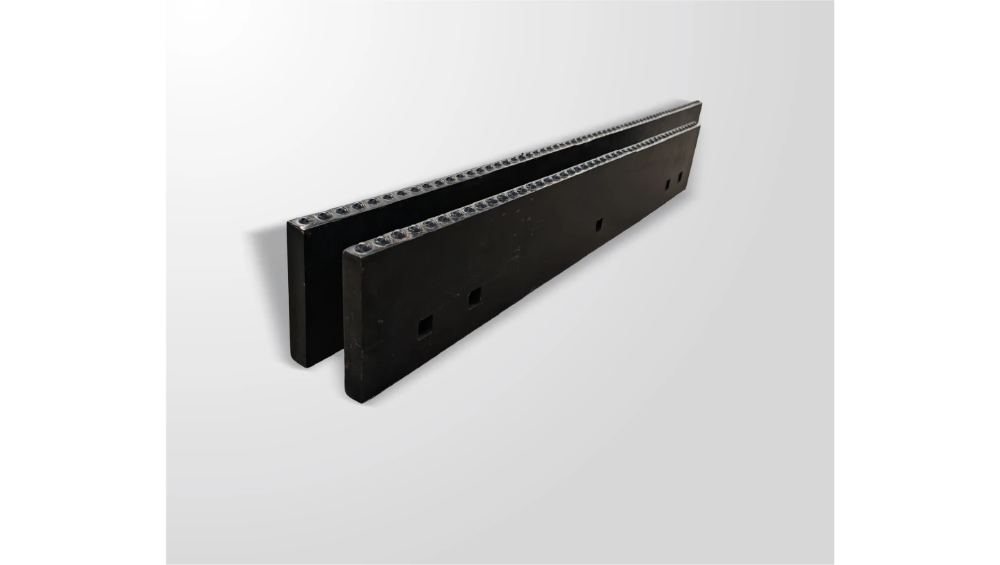
Carbide plow inserts are small, high-hardness wear segments, typically made from tungsten carbide and a metallic binder, brazed or mechanically fixed into a steel snow plow cutting edge. The steel section provides structural support and impact resistance, while the carbide insert delivers exceptional wear resistance at the road-contact surface. Inserts are often set into a milled slot, flush with or slightly proud of the steel edge, so the carbide takes most of the abrasion from snow, ice, salt, sand, and aggregate. They are used in sectional edges, trip-edge systems, underbody scrapers, and wing plows, available in square, trapezoidal, or rounded geometries with different grades, grain sizes, and binder ratios.
Benefits of Carbide Plow Inserts
- Wear-life improvements of 7–20× versus through-hardened steel depending on conditions and configuration.
- Fewer blade change-outs per season and reduced emergency downtime during storms.
- Mechanical ice-bond breaking that cuts salt use 30–50% and achieves bare pavement in one pass.
- More predictable budgeting for wear parts.
See also carbide inserts beyond plows and wear-resistant carbide blades.
Common Types and Configurations
JOMA-style blades with rubber-encased carbide segments, I.C.E. (isolated carbide edge) systems, and sectional plow edges are gaining adoption among DOTs and large fleets, combining carbide inserts with flexible or shock-absorbing backing to reduce vibration, noise, and infrastructure damage. See also the JOMA carbide system guide.
Installation and Maintenance
Braze inserts into blade carriers using automated welding for 100,000+ psi bond strength, then bolt to the plow frame — ensuring zero pop-outs under high-speed impacts. Maintenance focuses on inspecting insert retention, cleaning salt buildup, and replacing worn inserts before the steel carrier is exposed. See also the ISO carbide manufacturer guide and why SENTHAI carbide resists fractures.
Frequently Asked Questions
What are carbide plow inserts?
Durable tungsten carbide slugs brazed into snow plow blades, providing extreme wear resistance against ice, sand, and grit for long-life blades.
Why choose carbide inserts for road maintenance?
They last 3–20× longer than steel, reducing replacements and downtime while maintaining sharp edges on abrasive surfaces.
How do carbide inserts extend snow plow blade life?
High-hardness tungsten carbide (90+ HRA) resists abrasion and impact, delivering 500–1,000+ hours of service versus ~60 hours for steel.
What sizes fit standard snow plows?
Common profiles include 3/4 × 5, 3/4 × 6, 7/8 × 5, and 7/8 × 6 inches, compatible with most underbody and wing plows for easy retrofitting.
Are carbide inserts better than steel for ice?
Yes — they create a scraper effect that breaks ice bonds mechanically, cutting salt use by 30–50% and achieving bare pavement in one pass.
How do I install carbide plow inserts?
Braze inserts into blade carriers using automated welding for 100,000+ psi bond strength, then bolt to the plow frame for zero pop-outs under high-speed impacts.
What makes SENTHAI carbide inserts reliable?
Fine-grain carbide with ISO 9001/14001 certification, full in-house sintering and vulcanization in Thailand for superior bonding.
Where can I buy carbide inserts for road maintenance?
Source from specialized manufacturers like SENTHAI for OEM-grade inserts tailored to highways, gravel roads, and airports, with fast delivery from Thailand. See also impact-resistant insert blades for OEMs and carbide insert grading blades.
Related Articles
- How to Select the Right Carbide Inserts
- Carbide Inserts Beyond Plows
- JOMA Carbide System Guide
- ISO Carbide Manufacturer Guide
- Impact-Resistant Insert Blades for OEMs
Official Resources
References
Related articles
 Carbide Corrosion Resistance: Complete Guide to Materials, Grades, and Real-World Performance2026
 Snow Plow Carbide Blades: Durability, Performance, and Market Evolution2026
 Sustainable Road Carbide Solutions For Greener, Longer-Lasting Highways2026Superior Carbide Bonding for Snow Plow Blades and Roadwear Parts2026