




Motor Grader Cutting Edge Selection: Carbon, Heat-Treated and Carbide Compared
An edge that has to be changed twice in one season is rarely a blade problem. It is usually a selection problem: a motor grader cutting edge bought on unit price rather than on…

An edge that has to be changed twice in one season is rarely a blade problem. It is usually a selection problem: a motor grader cutting edge bought on unit price rather than on abrasive load, machine class and the cost of the machine standing still. Three families cover almost every decision a fleet, contractor or distributor has to make — carbon steel, heat-treated steel and carbide-tipped — and the specification points below are the ones that decide which of them belongs on a given moldboard.
What Each Edge Type Is Built For
Carbon cuts cost, heat-treated cuts hours, carbide cuts stops.
Carbon steel covers light grading and short seasons; heat-treated steel carries most municipal and contractor programmes; carbide-tipped edges are justified where abrasive material or high annual hours make downtime the dominant cost.
A carbon steel edge is a plain rolled section, supplied in the softer end of the structural steel range. Most public agencies buy against a standard specification rather than a brand, and the AASHTO publications and the material standards issued by ASTM are the documents those specifications are usually written around. It is inexpensive, easy to cut and drill on site, and forgiving of a rough operator. It is also the fastest-wearing option on crushed aggregate, and its edge dulls into a rounded profile that starts riding on top of compacted material instead of cutting it.
A heat-treated edge is the same section through-hardened and tempered to a controlled hardness band. It keeps a cutting profile longer, resists bending at the ends of the blade, and remains the default for county and state grading programmes that measure edge life in hours rather than weeks.
A carbide-tipped edge takes a third route: tungsten carbide inserts are brazed into pockets machined along a steel body, so the wear surface is a cemented carbide rather than steel. That is a different purchase decision, because the edge is now a specialist manufactured item with a documented grade, a braze joint and a fitment tolerance, not a cut length of plate. It is the same engineering logic that sits behind a carbide-edged blade selection process for winter equipment.
Hardness, Thickness and Wear Rate in Practice
Three numbers travel together in a grader edge specification: section thickness, hardness, and the shape of the cutting profile. Thickness sets how much material there is to wear away and how much load the edge can take before it bends; hardness sets how fast that material disappears on abrasive surfaces; the profile sets whether the edge keeps cutting as it wears or starts to polish the surface.
Hardness itself should be verifiable: the test methods used to quote it are published by ASTM, and wear-steel producers such as SSAB publish abrasion data for their grades rather than a single headline number. Treat published hardness as a band, not a promise. Quoted hardness describes the steel as supplied, and the working hardness at the cutting edge after a season of gravel is lower at the tip and unchanged at the bolt line, which is exactly why an edge loses its cutting profile before it wears out.
| Point | Carbon steel | Heat-treated steel | Carbide-tipped |
|---|---|---|---|
| Hardness as supplied | Lowest of the three | Controlled band, higher than carbon | Carbide inserts far harder than any steel edge |
| Section thickness | Common in light sections | Available in heavier sections for road work | Heavier body with machined insert pockets |
| Wear mechanism | Even metal loss, profile rounds off early | Slower metal loss, holds profile longer | Carbide resists abrasion; the braze joint and body become the limiting features |
| Failure mode seen first | Rounded edge, lost cutting action | Edge wear, then bending at the end bits | Insert loss or pocket wear if the braze or fitment is poor |
| Reconditioning | Field cutting and drilling | Limited — heat treatment governs | Not a field operation; replace inserts or the edge |
How Surface and Material Change the Answer
Abrasion, not distance, decides edge life.
Crushed granite and river gravel wear an edge several times faster than limestone or sand, so the same edge can last a season on one road and weeks on another.
Two variables dominate. The first is the aggregate: angular, silica-bearing material cuts steel the way a grinding wheel does, while softer limestone and rounded sand mostly displace. The second is the condition of the surface being graded. Loose gravel that the moldboard is shaping passes across the edge; compacted, frozen or ice-bonded material has to be cut, and that requires down-pressure and a sharper profile.
An edge specification should therefore be written against a road description rather than a machine list. A programme with a high proportion of crushed surfacing punishes a carbon edge within weeks, while the same edge is adequate on soft shoulders and shallow passes. Fleets that record where an edge failed, and on which road type, build a better selection rule than any specification sheet provides.
Bolt Patterns and Fitment Across Machine Classes
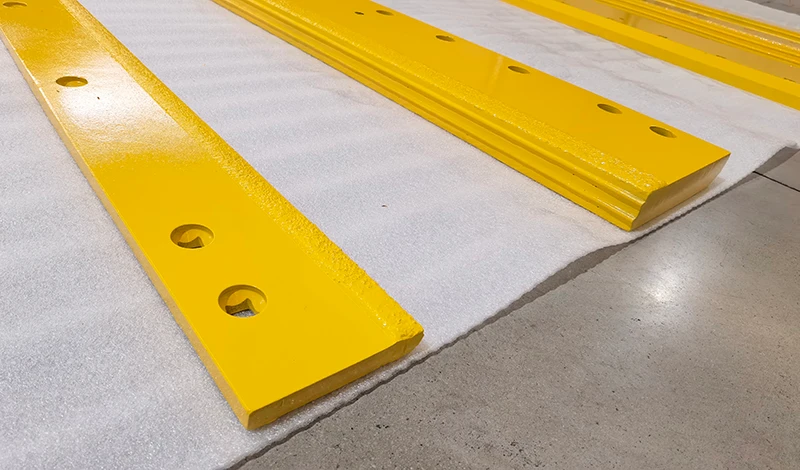
Fitment is where an otherwise correct edge becomes a rejected delivery. Machine and attachment interfaces are covered by SAE standards, and AEM publishes the industry conventions that suppliers and buyers both work to. Grader cutting edges are bought against a moldboard, a bolt pattern and a machine class, and a millimetre of drift at the bolt line or a mis-set countersink will leave the edge sitting proud of the moldboard, cracking at the holes or refusing to seat flat.
Four fitment points decide whether an edge can be used:
- Bolt pattern and spacing. Hole diameter, spacing along the edge and the distance from the hole centre to the cutting edge are all part of the pattern. A pattern that is close is not a pattern that fits.
- Fastener type. Plow bolts are the norm on ground-engaging tools because the head sits flush and resists wear; hex-head bolts are used where the application allows them. The countersink angle has to match the fastener or the head stands proud and wears through.
- Section shape. Flat, curved and beveled sections are not interchangeable across moldboards. Curved edges follow the moldboard arc; a flat edge on a curved moldboard leaves a gap that fills with fines.
- Machine class and length. Graders in different weight classes take different blade lengths and thicknesses, and heavier machines transfer more load into the edge and the end bits.
Where a fleet is standardising across a mixed fleet, the practical route is to specify the edge by drawing and by measured pattern rather than by an equipment brand and model year. A carbide supplier that machines its own insert pockets works to dimensional tolerances measured in hundredths of a millimetre for this reason: the tolerance is what allows an edge to be ordered against a drawing and used across a machine class without hand-fitting.
Operational Trade-Offs Beyond Wear
Wear rate is the headline number and rarely the whole decision. NIOSH documents the respirable crystalline silica exposure that grading crews face on unpaved roads, which is one reason FHWA guidance treats surface condition as a safety matter as well as a service one. An edge that lasts longer but scars the surface or cannot be rotated to a second position can cost more than it saves.
Hardened and carbide edges hold a keener profile, which improves cutting on hard-packed material and reduces the number of passes needed to bring a road back to grade. The same profile can be less forgiving on a sensitive surface: on asphalt shoulders or chip-sealed roads, a sharp edge is more likely to shave material and leave a visible line, and some programmes deliberately run a slightly worn edge or a flexible edge for that reason.
Operator practice interacts with selection. Angle of attack, down-pressure and travel speed change the load the edge sees far more than a step change in hardness does, and a fleet that fits a premium edge without adjusting technique will see part of the benefit disappear. Rotation policy matters too: edges that can be reversed or moved end-to-end before replacement typically return more hours per unit than the choice of material alone.
Cost Per Lane Mile by Edge Type
Unit price is the least useful number in edge procurement because it excludes the two costs that dominate: the labour or contractor cost of the change-out, and the lost service hours while the machine is parked. Cost per lane mile is the metric that makes the comparison honest, and it can be built from four inputs a fleet already has.
The model is edges consumed per lane mile multiplied by unit cost plus change-out cost. Change-out cost is where the families separate. A carbon edge may cost the least per unit and be replaced three or four times in the same interval that a harder edge covers in one, so the labour, the fastener replacement and the machine downtime are paid three or four times as well.
| Cost driver | Carbon steel | Heat-treated steel | Carbide-tipped |
|---|---|---|---|
| Unit price | Lowest | Mid | Highest |
| Edges per lane mile | Highest count | Fewer than carbon | Fewest on abrasive material |
| Labour per change | Paid most often | Moderate | Paid least often |
| Effect on passes required | More passes as profile dulls | Stable over most of its life | Stable until the inserts are consumed |
| Effect of a poor choice | Low — cheap to change | Low to moderate | High — a wrong pattern or grade is an expensive mistake |
Two cautions belong with the arithmetic. Change-out cost is not a constant: a fleet that changes edges in its own shop has a much lower marginal cost than a contractor paying road-call rates. And a quoted multiple of service life only holds under the conditions it was measured in, so ask for the conditions rather than the multiplier. Programme-level practice is documented through the Transportation Research Board and the AASHTO publications programme.
Choosing by Road Type and Machine Class
The selection rule that survives contact with a real programme is short. Match the edge to the material being cut and the cost of stopping the machine, then confirm fitment by drawing.
- Light grading, soft shoulders, occasional use: carbon steel, replaced on condition.
- Gravel and crushed surfacing programmes, high annual hours: heat-treated steel as the baseline, with carbide only where abrasion and downtime justify it.
- Hard-packed, frozen or ice-bonded surfaces: carbide-tipped edges with a grade selected for toughness as well as hardness.
- Mixed fleets and distributor stock: standardise on patterns that fit the largest share of the fleet, and keep one abrasive-duty option for the roads that destroy the standard edge.
- Before any order: confirm pattern, section shape and thickness against the moldboard by measurement or drawing, not by model year.
The decision comes down to three questions the article has answered. How abrasive is the material the edge will work in? What does an hour of that machine standing still cost? Can the pattern be confirmed by drawing rather than assumption? Where abrasion and downtime are both high, a carbide-tipped edge is the cheaper edge even though it is not the cheaper part, and where the programme is soft-surfaced and seasonal, a heat-treated edge is the disciplined choice. In every case the fitment data decides whether the edge can be used at all, so it belongs in the same document as the grade.
Send SENTHAI the moldboard drawings, bolt patterns and the road types your machines work in, and the technical team will review the edge specification, hardness and toughness balance and fitment tolerances for each machine group.
Related reading: wear parts beyond plows and quality control and batch traceability.
Frequently Asked Questions
How thick should a motor grader cutting edge be for road work?
Thickness is set by machine class and the load the edge has to carry, not by a single road-work figure. Heavier machines and abrasive programmes need a heavier section, and the pattern and countersink must match it. The practical approach is to specify the section from the moldboard and machine weight, then confirm by drawing before ordering, rather than assuming a thickness transfers from another machine.
Can a carbide grader edge go on the same moldboard as a steel edge?
Yes, provided the pattern, section shape and thickness are specified to the same moldboard. A carbide-tipped edge is a steel body with machined insert pockets, so it mounts with the same fasteners and pattern as a steel edge of the same profile. The difference is that fitment tolerance matters more, because the edge is carrying a harder working surface.
How often should grader cutting edges be replaced?
Replace on measurement, not on a fixed calendar. Track the distance from the cutting edge to the bolt line and the profile of the tip: once the edge rounds off and stops cutting, or the remaining section at the hole line approaches the point where the end bits bend, it is due. Recording where and on which road type each edge failed gives the next specification a real basis.
Do serrated grader edges use a different bolt pattern?
Not necessarily. Serration changes the working profile of the edge, not the mounting interface, so a serrated edge can share the pattern of a straight edge for the same moldboard. What changes is the application: serrated profiles are used where material benefit from a broken cutting line, and they need the same fitment confirmation as any other pattern.
Related articles
 Asphalt Milling Teeth: Grade, Holder and Cost Per TonneGrader blades and road grading cutting edges
 Grader Blade Thickness, Hole Pattern and Bolt GradesGrader blades and road grading cutting edges
 Carbide Grader Blades for High-Abrasion Road SurfacesGrader blades and road grading cutting edgesGrader Blade Versus Cutting Edge: What Your Machine Actually NeedsGrader blades and road grading cutting edges