




Carbide Insert Retention in Snow Plow Blades: Why JOMA Style Inserts Stay Put
When a carbide insert pops out of a snow plow blade, it is almost never because the carbide failed — it is because the bond failed. Insert retention comes down to three engineered layers:…
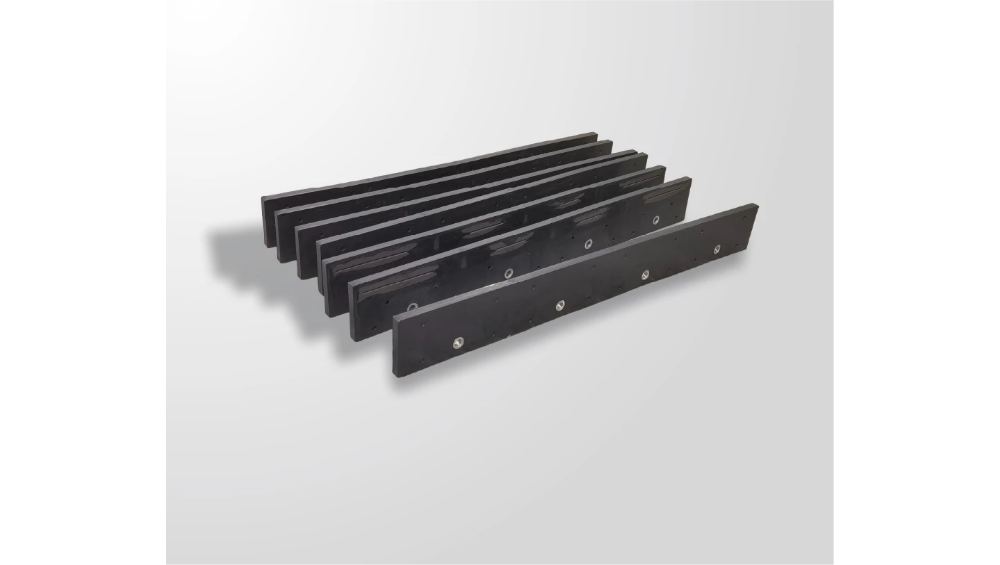
When a carbide insert pops out of a snow plow blade, it is almost never because the carbide failed — it is because the bond failed. Insert retention comes down to three engineered layers: brazing that locks the carbide into a steel holder, a bonding agent that joins the holder to the rubber, and vulcanization that locks the whole assembly together. SENTHAI builds all three layers specifically for high-speed impacts against manholes and road obstructions. The SENTHAI rubber-carbide JOMA blade line documents the design and specifications behind this retention system.
The Failure Mode: Insert Pop-Out at High-Speed Impact
Plows hit manhole covers, curb transitions, expansion joints, and buried obstacles at plowing speed. The impact energy has to go somewhere. In a weakly bonded blade, that energy breaks the insert loose or fractures the pocket around it, and the plow is down until the section is replaced. Pop-out is not random bad luck — it is the predictable result of a bond that was never engineered for impact loading.
Transportation research has reached the same conclusion. NCHRP Project 06-19, the Transportation Research Board study on snowplow cutting edge improvements, identified the material and bonding of carbide inserts as a critical quality factor in blade performance, and recommended that agencies specify measurable quality controls — including insert hardness and bond integrity — when purchasing carbide insert edges. If a supplier cannot describe how inserts are bonded, that is a red flag, not a detail.
Brazing: The First Defense
Each tungsten carbide insert is secured into a reinforced steel holder using brazing — a metal-joining process that creates a metallurgical bond between the carbide and the steel. SENTHAI’s proprietary high-temperature brazing process is designed so the bond absorbs high-velocity impacts rather than transmitting the shock directly into the insert. Brazing quality is the single biggest difference between blades that lose inserts and blades that do not.
Brazing matters because it spreads load across the full joint area. A small, weak joint concentrates every impact into a tiny zone; a properly brazed insert has a large, consistent bond face that distributes shock. That is why SENTHAI’s brazing is automated and documented — consistency from insert to insert is what makes a blade predictable over a full season.
Steel Holders and Vulcanized Rubber: The Second Layer
The brazed insert-and-holder assembly is then integrated into the rubber matrix. Before rubber injection, a high-performance thermoset bonding agent is applied to the treated steel skeleton, creating a molecular-level bond. The assembly is then encapsulated under high pressure during vulcanization, which chemically and mechanically locks the holders into the rubber. The rubber absorbs and spreads impact shock, so the carbide inserts are protected from the full force of the blow.
This second layer is what separates a rubber-carbide blade from a carbide blade with rubber glued around it. Without vulcanization and a bonding agent, the rubber can separate from the steel over time — and once moisture and road chemicals get between the layers, the blade starts failing from the inside.
Manholes and Road Obstructions: The Real Test
Retention engineering only matters at the moment of impact. A blade that holds its inserts through repeated manhole strikes, curb hits, and buried utility covers is a blade a fleet can trust for a full season. That is the operating scenario SENTHAI designs for — and it is why the JOMA style blade ordering page focuses on the brazing process and vulcanization as much as on carbide grade.
How to Verify Retention Quality
- Ask how inserts are bonded. The answer should include brazing into a steel holder, not just epoxy or mechanical clamping.
- Ask how the rubber is applied. High-pressure vulcanization with a bonding agent beats simple molding or gluing.
- Ask for evidence. Brazing process documentation, QC records, and field trial results are the proof that matters. Agency evaluation programs such as Clear Roads exist because field performance, not marketing, decides which blades last.
- Run a trial. Put the blade on your worst route — manholes, curbs, and obstacles — for one season before scaling.
How to Inspect a Section for Bond Defects
Before installation, check three things on every section. First, press each insert: there should be no movement or “click” in its holder. Second, examine the rubber-to-steel interface: no gaps, bubbles, or separation at the bond line. Third, look at the insert seating: joints should be consistent, with no cracked or tilted inserts. Any defect is a bond failure waiting for an impact to trigger it.
After installation, inspect the section after the first storm and then monthly. Compare sections across the plow — uneven insert wear or loss on one side usually points to a fitment or pressure problem, not a material problem. Documented inspections give you the evidence to hold a supplier accountable, which is exactly the quality-control discipline NCHRP recommends buyers apply.
Frequently Asked Questions
Why do carbide inserts pop out of some JOMA blades?
Weak brazing, a missing steel holder, or rubber that is not vulcanized around the holder. All three are bonding failures, not carbide failures.
Is brazing better than welding or glue for inserts?
Brazing into a reinforced steel holder is the standard for impact-loaded carbide because it creates a bond that absorbs shock without cracking the insert. The rubber shell then protects that bond from direct impacts.
Can I inspect retention quality before buying?
Yes — ask for brazing process details and QC documentation, and run a trial on your hardest route. Both cost far less than a mid-season pop-out.
Does the rubber affect the insert’s cutting performance?
No. The carbide inserts do the cutting and maintain consistent downward pressure through the steel structure; the rubber handles flex and impact absorption around them.
Stop losing inserts mid-season. Review the retention design on the SENTHAI JOMA style cutting edge systems and ask SENTHAI’s engineering team about the brazing process and a field trial on your routes.
Related articles
 Choosing Between JOMA, Carbide, and Packed Ice Kits for Ice RoutesJOMA Style BladeJOMA Style Blade Manufacturer for OEM and Distributor ProgramsJOMA Style Blade
 Black Ice Snow Plow Blades: How JOMA Style Edges Cut Packed Snow and IceJOMA Style BladeJOMA Style Blade Fitment: Bolt Patterns, Sizes, and Mounting HardwareJOMA Style Blade