




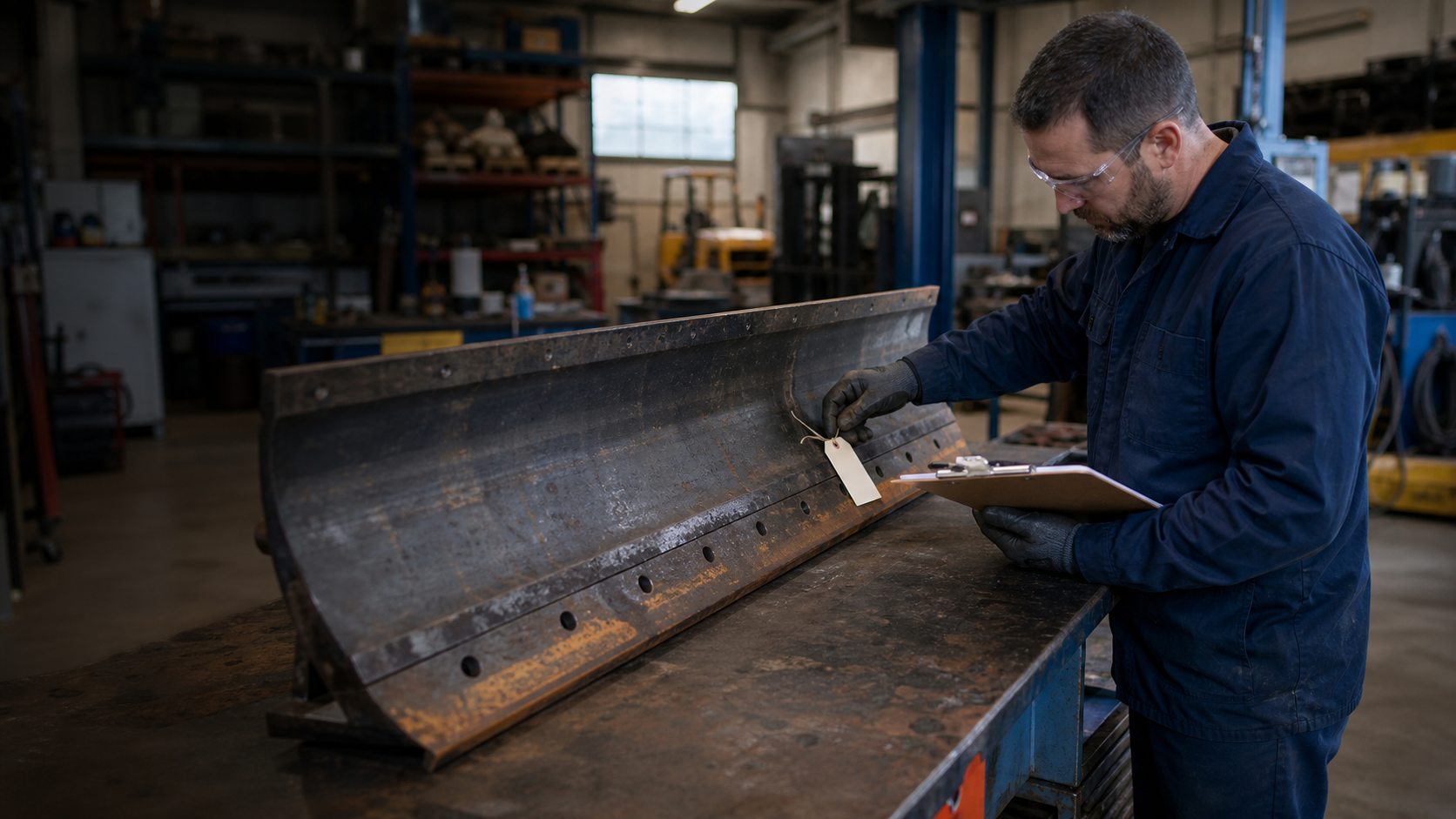
Straightness, hole condition, pocket wear and corrosion decide whether re-tipping is viable. Any one of them failing usually means a new blade is cheaper.
Check straightness along the mounting face, elongation at the bolt holes, wear in the insert pockets and corrosion at the exposed steel. A carrier that passes all four is a genuine candidate for re-tipping.
Re-tipping has to reproduce the original braze specification, including the grade, the filler and the cooling cycle. Where that specification is unknown, the rebuilt edge becomes an experiment run on a live route.
Re-tipping typically costs less than half a new blade and returns most of its life — but only when the carrier passes and the logistics work.
It does not correct a distorted carrier, restore worn pockets or repair corrosion. Those are the failure modes that make a rebuilt edge disappoint, and they have nothing to do with the inserts.
Re-tipping usually means shipping the carrier to the factory and waiting. That round trip has to fit inside your spares level, or the saving turns into a shortage in the middle of a storm.
Typically a significant fraction of the price of a new blade, and the exact figure depends on the carrier condition and the insert specification. Assess the carrier before you rely on the saving.
Usually once or twice, depending on the steel condition, the pocket wear and how much material each rebuild removes. After that, straightness and hole condition decide against it.
It can be, when the carrier passes inspection and the original bond specification is reproduced. Where it cannot be, the difference will show up as early failures.
Enough to cover shipping both ways plus the rebuild, and it has to fit inside your spare blade level. Plan it in the off-season rather than during a storm cycle.
No. Mechanically retained inserts may be field-serviceable, while damaged or heavily corroded brazed carriers are not economic to rebuild.
Which designs can be serviced in the field.
Reproducing the original bond correctly.
Planning refurbishment into the season.
Comparing rebuilt and new on running cost.
Send photographs of the carrier and pockets and we will tell you whether a rebuild is economic or a waste.
✓ Photographs of carrier and pockets
✓ Blade specification and age
✓ Number of blades involved
✓ Delivery country and timing
Email: [email protected]