




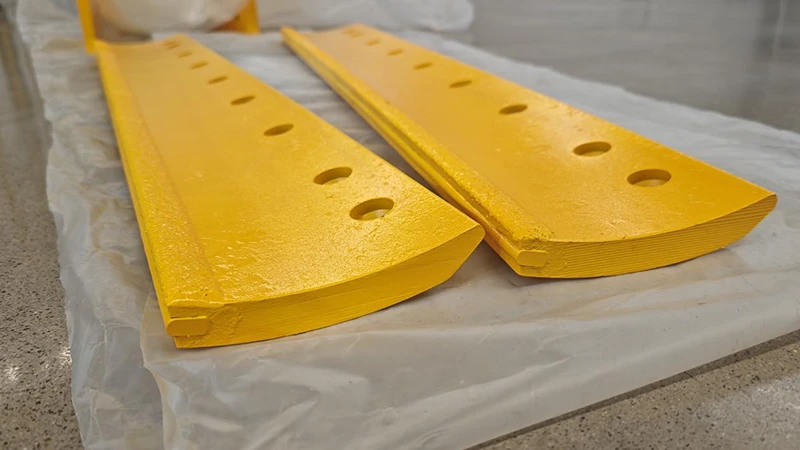
An isolated edge lets each carbide element move independently, so a strike on one section does not propagate a crack through the rest of the blade.
Sectioning an edge changes where stress concentrates. Instead of one long brittle body carrying every impact, each segment carries its own and passes the remainder into the carrier. The result is a blade that survives roads a solid carbide edge cannot.
Ice does not yield to down-pressure the way snow does. Ice-specific geometry concentrates force into a narrow contact area, fracturing the surface instead of riding over it. That is a shape decision more than a material one.
Quieter operation, less down-pressure needed to cut, and fewer cracked blades — but a higher unit cost and a stricter fitment requirement.
On municipal and highway routes with repeated freeze-thaw and glazed surfaces, isolated edges cut more ice per pass, which reduces de-icer use and repeat passes. Those savings are usually larger than the wear saving.
Isolated edges want a correctly set mounting height and adequate down-pressure. Fitted to a machine that cannot hold them flat, they behave like any other edge — and the extra cost buys nothing.
It is SENTHAI’s designation for its ice-cutting edge family, built around isolated or segmented carbide elements intended to cut bonded ice while limiting crack propagation.
Probably not. Occasional ice is usually handled by the standard carbide edge plus correct down-pressure. The isolated designs earn their cost where packed or bonded ice is the routine condition.
It cuts rather than scrapes, so on sound pavement it is usually gentler than a heavily loaded flat edge. On decorative or soft surfaces the constraint is still the surface, not the blade.
Usually yes, if the mounting pattern and carrier can take the section lengths. Fitment follows the same rules as any other edge: dimensions, hole pattern and mounting position.
By removing more ice mechanically in fewer passes. Where the de-icer is applied to compensate for an edge that is polishing the surface, a cutting edge removes the reason for the second application.
Where the I.C.E. family sits in the wider comparison.
The kit-level version of the same idea.
Rubber, ceramic, cladding and hybrid options.
Tell us how often you get packed or bonded ice and what the current edge leaves behind. We will say whether the isolated designs are worth it.
✓ How often packed or bonded ice occurs
✓ Current edge and what it leaves behind
✓ Machine, down-pressure and route speed
✓ Quantity and delivery destination
Email: [email protected]