




What Is the I.C.E. Blade with Isolated Edge Technology?
The I.C.E. Blade with Isolated Edge Technology is a next‑generation carbide‑edged snow plow blade that uses individually mounted tungsten carbide inserts to prevent lateral cracking and deliver skate‑like precision when clearing packed ice and…
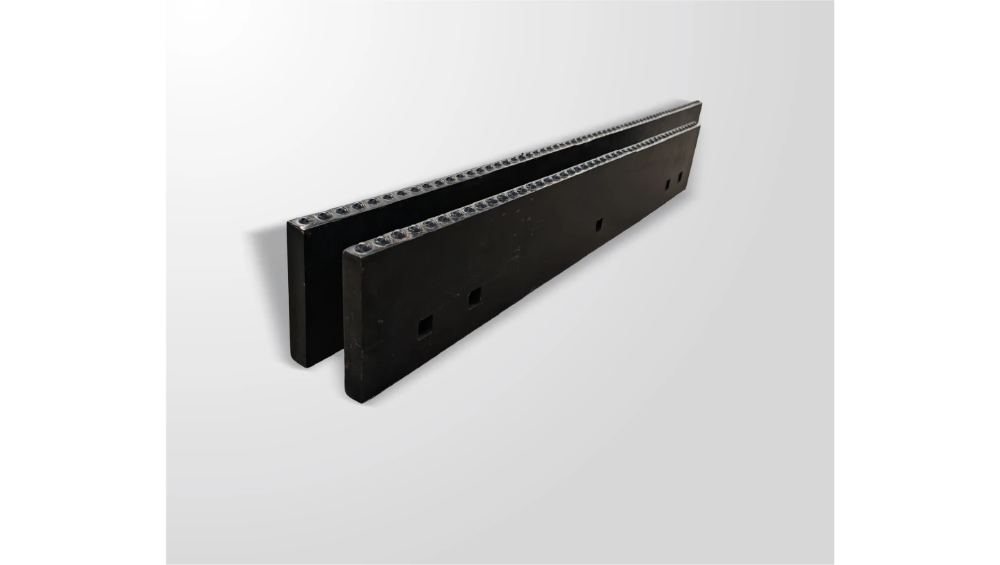
The I.C.E. Blade with Isolated Edge Technology is a next‑generation carbide‑edged snow plow blade that uses individually mounted tungsten carbide inserts to prevent lateral cracking and deliver skate‑like precision when clearing packed ice and frozen pavement. By isolating each carbide tip and adding impact‑absorbing buffers, the I.C.E. Blade can last up to three times longer than standard carbide edges in high‑impact conditions, while improving ice penetration and blade longevity for municipal and commercial fleets.
As a manufacturer, wholesale supplier, and OEM partner, SENTHAI produces and sources these I.C.E. Blades and related packed‑ice carbide kits for global road‑maintenance customers, ensuring cost‑effective, high‑wear resistance performance on uneven and jointed surfaces.
Packed Ice Carbide Kit – SENTHAI
What Is the I.C.E. Blade and How Does It Work?
The I.C.E. Blade is a high‑speed snow plow edge system that uses isolated tungsten carbide inserts mounted in a composite or rubber‑alloy buffer layer. Each insert is positioned independently so that impact energy from road joints, potholes, or cracks is confined to a single carbide pocket instead of propagating along the entire blade.
This “isolated edge” configuration mimics the behavior of an ice‑hockey skate blade, maintaining a sharp cutting profile under stress while preventing lateral cracking and large‑scale blade breakage. The design also enhances bonding strength between carbide and base steel, improving overall durability in extreme winter conditions.
How Does Isolated Edge Technology Improve Blade Longevity?
Isolated Edge Technology increases blade longevity by decoupling each tungsten carbide tip from its neighbors and embedding it in a shock‑absorbing layer. When the blade hits a joint or uneven surface, the force is localized to the impacted insert instead of traveling through a continuous carbide strip, which reduces micro‑cracking and spalling.
Because damage does not spread easily, the working edge remains intact longer, even under repeated high‑speed passes. SENTHAI’s I.C.E. Blade and Packed Ice Carbide Kit leverage this logic to achieve up to three times the service life of conventional carbide edges in aggressive, high‑impact plowing scenarios.
Why Is Impact Protection Critical in High‑Speed Plowing?
Impact protection matters in high‑speed plowing because fast‑moving blades transmit much larger shock loads into the carbide edge when they strike road joints, cracks, or uneven pavement. Without protection, rigid carbide strips can chip, crack, or delaminate, leading to sudden blade failure and costly downtime.
I.C.E. Blades address this by combining isolated inserts with rubber‑alloy or composite buffers that absorb and dissipate impact energy. This impact protection not only reduces blade breakage but also stabilizes the cutting edge, allowing fleets to maintain higher travel speeds over rough surfaces without sacrificing safety or reliability.
How Does the I.C.E. Blade Prevent Lateral Cracking?
Lateral cracking occurs when a single impact causes a fracture to propagate along the full length of a continuous carbide strip. The I.C.E. Blade stops this by cutting the carbide edge into discrete inserts separated by steel or buffer material.
Each insert sits in its own pocket, so cracks that start in one tip cannot easily travel to the next. This segmented, isolated‑edge design turns one long weak line into many short, protected segments, dramatically improving structural integrity and reducing the risk of catastrophic edge failure during high‑speed or joint‑heavy plowing.
What Are the Key Benefits of Isolated Carbide‑Edged Blades?
Isolated carbide‑edged blades deliver several core benefits: reduced lateral cracking, improved impact resistance, longer service life, and sharper ice penetration. Because each insert can be sharpened or replaced individually, maintenance becomes modular and targeted instead of requiring full‑edge replacement.
For municipal, airport, and highway operators, these advantages translate into lower total ownership costs, fewer unplanned downtimes during storms, and more consistent performance on snow‑packed and ice‑covered roads. SENTHAI’s I.C.E. Blade and Packed Ice Carbide Kit are engineered to maximize these benefits while remaining cost‑efficient for high‑volume buyers.
How Does the I.C.E. Blade Compare to Standard Carbide Edges?
Compared to standard carbide edges, the I.C.E. Blade offers superior performance in high‑impact, high‑speed environments. Traditional carbide‑edged blades typically use a continuous strip of carbide welded or bonded along the lower edge, which is prone to cracking and chipping when hitting joints or uneven surfaces.
The I.C.E. Blade’s isolated inserts and buffer layer absorb shock locally, limit crack propagation, and maintain a sharper cutting profile over time. Reports indicate an I.C.E. Blade can last up to three times longer than comparable conventional carbide edges under similar plowing conditions, making it especially attractive for fleets that prioritize uptime and long‑term value.
Comparison: I.C.E. Blade vs Standard Carbide Edge
Why Is the I.C.E. Blade Ideal for High‑Speed Plowing?
The I.C.E. Blade is ideal for high‑speed plowing because it maintains a stable, sharp cutting edge even when the plow encounters repeated impacts from road joints, bridge seams, and potholes. The isolated inserts and underlying buffer material help dampen vibrations and localize shock, reducing the risk of blade chatter and sudden fracture.
This stability allows operators to keep plowing speeds higher without dramatically increasing blade replacement frequency. For highway, airport, and suburban‑road contractors, the combination of speed, durability, and precision makes the I.C.E. Blade a strong match for 24/7 winter‑maintenance operations.
How Does the I.C.E. Blade Support Packed Ice Clearance?
The I.C.E. Blade excels with packed ice because its tungsten carbide inserts are engineered for high hardness and aggressive ice‑shearing geometry. The isolated‑edge configuration ensures that each carbide tip can bite into compacted snow and ice without pulling the entire edge into a brittle fracture.
When paired with SENTHAI’s Packed Ice Carbide Kit, the I.C.E. Blade gains optimized spacing, geometry, and bonding technology tuned specifically for dense, frozen surfaces. This synergy enhances ice penetration, reduces material buildup on the blade, and lowers the need for repeated passes or heavy salt application.
What Role Does SENTHAI Play as a Manufacturer and OEM Partner?
SENTHAI Carbide Tool Co., Ltd. operates as a full‑cycle manufacturer, wholesale supplier, and OEM partner for I.C.E. Blades, packed‑ice carbide kits, and related wear parts. With over 21 years of experience in carbide tool production, SENTHAI manages R&D, material selection, pressing, sintering, welding, and vulcanization in‑house at its Rayong, Thailand facility.
As a factory‑direct supplier, SENTHAI offers bulk pricing, custom‑carbide‑insert options, and OEM‑labeled solutions for OEMs and equipment brands. ISO9001 and ISO14001‑certified processes ensure consistent quality, strong bonding, and reliable performance, making SENTHAI a preferred carbide‑wear‑parts partner for global fleets and distributors.
How Can Distributors and Contractors Source I.C.E. Blades Wholesale?
Distributors and contractors can source I.C.E. Blades wholesale through SENTHAI’s factory‑direct supply channels, which include standard and custom‑specification orders for JOMA‑style blades, carbide blades, and Packed Ice Carbide Kits. SENTHAI offers tiered pricing based on volume, with options for drop‑shipping, private labeling, and blended packages combining blades, inserts, and spare parts.
For larger fleets or regional networks, SENTHAI supports bulk catalogs, technical documentation, and application engineering to help partners select the right I.C.E. Blade configurations for specific road conditions and vehicle types. This wholesale model reduces middle‑tier markups and shortens the supply chain from manufacturer to end user.
SEN THAI Expert Views
“Isolated Edge Technology marks a real shift in how we think about carbide‑edged snow plow blades,” says a SENTHAI technical manager. “Instead of treating the edge as one rigid part, we design it as a series of independent, protected carbide elements. By buffering impact at each insert and preventing lateral cracking, we significantly extend edge life and reduce unplanned repairs for fleets operating at high speed over jointed pavements.”
“From a manufacturing perspective, this approach also lets us offer more flexible OEM and custom‑insert options. Operators who plow the hardest roads—highways, airport runways, and urban networks with many joints—can now get a solution that combines the sharpness of an ice‑hockey‑style edge with the durability of a fully engineered carbide‑wear system.”
How Can Fleet Managers Maximize I.C.E. Blade Performance?
Fleet managers can maximize I.C.E. Blade performance by matching blade geometry and insert spacing to their typical road conditions and operating speeds. Regular inspection for localized wear or damaged inserts, followed by timely sharpening or replacement of individual tips, preserves the segmented advantage of isolated‑edge technology.
Training operators to adjust plow angle, travel speed, and down‑pressure based on surface conditions also helps prevent excessive impact stress. Finally, using SENTHAI’s Packed Ice Carbide Kit and OEM‑recommended service intervals ensures that the I.C.E. Blade maintains ice‑hockey‑like precision and impact protection over its full service life.
FAQs on the I.C.E. Blade with Isolated Edge Technology
1. What is the main advantage of using an I.C.E. Blade over a standard carbide edge?
The main advantage is that isolated tungsten carbide inserts and buffer layers prevent lateral cracking, deliver up to three times longer life in high‑impact conditions, and maintain sharper ice penetration during high‑speed plowing.
2. Can the I.C.E. Blade be used on existing plow systems?
Yes, SENTHAI designs I.C.E. Blades and packed‑ice carbide kits to fit many standard and JOMA‑style plow configurations. Customers can often retrofit existing blades or work with SENTHAI to customize mounting and geometry for specific equipment lines.
3. How does SENTHAI support OEM or private‑label partnerships?
SENTHAI offers OEM and private‑label manufacturing services, including custom carbide‑insert shapes, branding, packaging, and volume‑pricing agreements. As a factory‑direct supplier, SENTHAI handles full production from R&D through to final assembly and quality control.
4. Why is isolated edge technology important for high‑speed plowing?
Isolated edge technology localizes impact energy to each insert, dampens shocks, and prevents cracks from spreading along the edge. This stability allows fleets to plow faster over joints and uneven surfaces without dramatically increasing blade replacement frequency.
5. How often should I.C.E. Blades be inspected or serviced?
For high‑speed, high‑mileage operations, inspect the I.C.E. Blade after every major storm or several hundred plowing hours. Focus on checking for damaged or excessively worn inserts and replace or sharpen tips as needed to maintain the isolated‑edge advantage and overall blade longevity.
Related articles
 Best Snow Plow Blade Family for Your Fleet: Top 5 ScenariosKnowledge
 Top 10 Snow Plow Blade Types for Winter Fleets (Ranked by Duty Fit)Knowledge
 Top 5 Best Carbide Blade Configurations for Highway PlowingKnowledge
 Best Snow Plow Blade Materials Ranked: Steel vs Carbide vs Cladding vs Rubber-CarbideKnowledge